
School Rumble
Tsukamoto Tenma is an ordinary 2nd year high school student who has fallen in love with one of her classmates, Karasuma Ooji. However, currently she is unable to confess her feelings to him. To make things worse, she found out that Karasuma is transferring to another school in a year. On the other hand, Tenma's other classmate, Harima Kenji (who is a delinquent) is also in love with Tenma. Not being able to confess his feelings, Harima gets depressed day by day.
(Source: Anime News Network)
📺Anime Details
📝Editorial Analysis
Tenma’s hand hovers over Karasuma’s notebook—just inches away—her fingers trembling not from fear, but from the sheer weight of proximity: he’s asleep at his desk, sunlight catching the dust motes above his hair, and she’s holding a love letter she’ll never deliver. Not because it’s dangerous or forbidden, but because the moment is too fragile, too ordinary, too full of everything she can’t name—hope, panic, tenderness, the quiet ache of time slipping past like chalk dust off a blackboard.
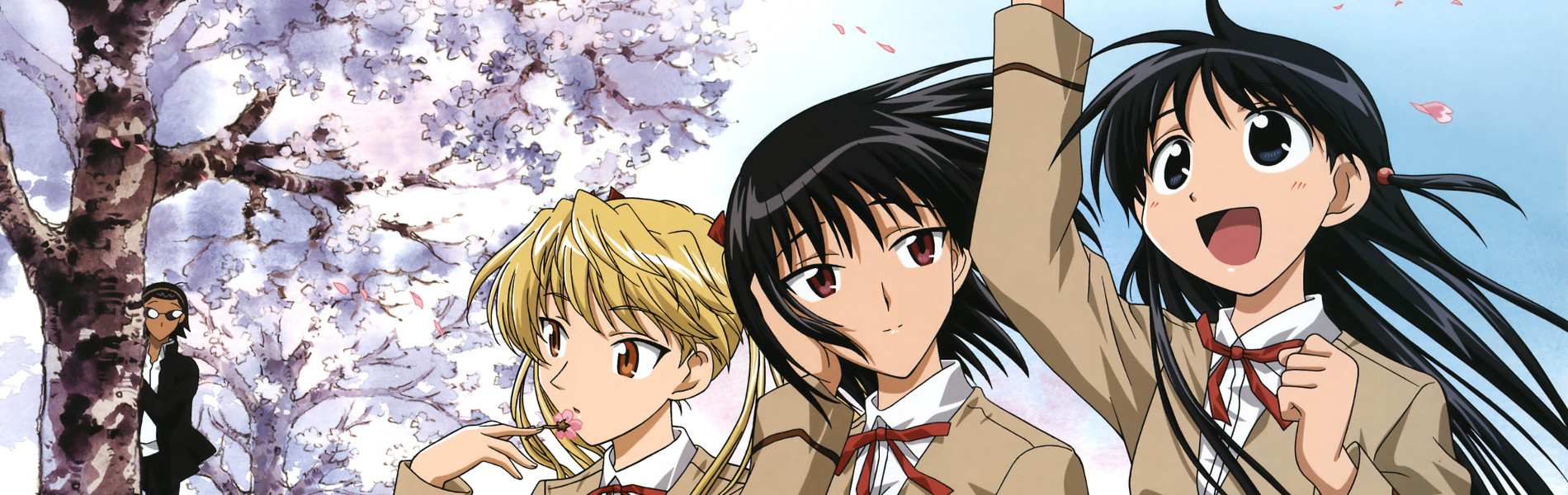
That’s School Rumble: not a story about grand confessions or climactic battles, but about the suspended breath before the bell rings—the way Harima Kenji stares at Tenma from across the hallway, mouth half-open, thoughts collapsing into silence; the way a classroom erupts in chaotic, overlapping noise when someone mishears “I like you” as “I like udon”; the way love isn’t a destination but a series of near-misses, misread glances, and handwritten notes folded into origami cranes that get lost in the wind. Its atmosphere isn’t romantic in the glossy, cinematic sense—it’s melancholic exploration of feeling too much, too quietly, while surrounded by people who are also stumbling, shouting, blushing, or pretending not to care. It makes you feel the soft, persistent pressure of adolescence—not as crisis, but as accumulation: of unspoken words, of routines that somehow hold meaning just because they’re repeated, of affection that leaks out sideways, through parody, through tsundere stammering, through kuudere stillness.
That emotional DNA pulses in Prince of Persia—not the acrobatics or sand magic, but the melancholic exploration baked into its very movement: the Prince walking alone through sun-bleached ruins, his voice layered with wry self-awareness, undercutting grandeur with dry, human-scale humor. The player review calls it “an all-new epic journey,” yet the game’s soul lives in those pauses—leaning against a crumbling archway, watching light shift across stone, remembering a line he shouldn’t have said. Like Tenma tracing Karasuma’s handwriting, the Prince touches walls not to solve puzzles, but to linger. And the shared dimension “Romance & Shoujo” isn’t about courtship—it’s about how intimacy blooms in the margins: a glance held too long, a gesture softened by irony, love as something you practice in private, then fumble publicly.
Then there’s Persona 5 Royal, where the daily life loop—attending class, choosing dialogue options, building bonds during rainy afternoons—mirrors School Rumble’s episodic heartbeat. The player review praises “the seamless transition between daily life and extraordinary stakes,” but what’s extraordinary isn’t the Phantom Thieves’ heists—it’s Ann asking if you’ve eaten lunch, or Ryuji cracking a joke while leaning against lockers, or Futaba quietly sliding you a handmade bento. Like Harima’s silent vigil outside Tenma’s house, these moments gain gravity precisely because they’re small, repeated, and emotionally unguarded. Both works treat school not as backdrop but as emotional ecosystem—where romance isn’t declared, but cultivated through shared silence, borrowed erasers, and the unbearable lightness of almost-touching hands.
And yes—even The Sims™ 4, flawed and monetized as it is, taps the same nerve. That player review complains about DLC costs and bugs, but misses the raw, tender truth buried in the description: “Play with life and discover the possibilities.” Because what is School Rumble if not simulating the absurd, tender physics of teenage connection? Watching a Sim awkwardly attempt to flirt, fail, then try again with slightly better timing—that’s Tenma rehearsing confessions in the mirror. Watching Harima cook ramen for no one, stirring endlessly, steam rising like unvoiced longing—that’s a Sim standing motionless in the kitchen at 3 a.m., mood bar flickering between “Inspired” and “Lonely.” The comedy isn’t in the parody—it’s in the recognition: this is how real hearts stutter.
You’d love this pairing if you’ve ever memorized someone’s schedule just to “accidentally” pass them in the hallway—or if your idea of romance includes sharing earbuds on a train, arguing about manga chapters, or laughing so hard you snort, then immediately pretending you didn’t. If you believe heartbreak can wear a school uniform, and joy can hide inside a badly timed pun. If you don’t want love to be solved—you want it to breathe, messy and alive, in the space between one bell and the next.
🎮43 Games That Match the Vibe


































Match Dimensions Explained
❓Frequently Asked Questions
Why does Prince of Persia keep showing up in 'Games Like School Rumble' lists when it’s an action-adventure game?
Great question—it’s all about the *Romance & Shoujo* and *Comedy & Parody* dimensions it shares with School Rumble. Think of the Prince’s flustered, over-the-top reactions to Farah (like that hallway chase scene where he trips over his own scarf while trying to look cool), or how the game constantly undercuts epic stakes with slapstick—very Harima-energy. It’s not about genre; it’s about tonal DNA: earnest romance tangled up with self-sabotaging humor.
Is there a School Rumble anime or manga adaptation for any of these games?
No—none of these games have official School Rumble adaptations. But Persona 5 Royal *feels* like the spiritual cousin fans wish had one: Ann Takamaki’s shy-to-confident arc mirrors Tenma’s growth, Ryuji’s loud-but-loyal energy channels Harima’s protective chaos, and the Confidant system literally lets you build romantic bonds just like classroom confession scenes. It’s not adapted—but it *breathes* the same air.
How does The Sims 4 compare to Persona 5 Royal for School Rumble-style romantic comedy?
The Sims 4 leans hard into chaotic, player-driven parody—imagine making your Sim trip into Tenma during homeroom, then having them awkwardly share bento boxes while their relationship meter glitches hilariously. Persona 5 Royal delivers tighter, story-driven shoujo beats: think Ann’s confessional rooftop scene or Futaba’s ‘I’m not cute!’ meltdown—structured, character-rooted, and emotionally resonant. Both nail the vibe, but Sims is improv comedy; P5R is scripted rom-com gold.
What’s the best game like School Rumble if I want melancholic exploration mixed with goofy romance?
Disco Elysium — seriously! It’s got the *Melancholic Exploration* + *Romance & Shoujo* + *Comedy & Parody* trifecta. Picture Detective Harry’s internal monologue spiraling from ‘I love this city’ to ‘I forgot my own name’ while flirting badly with Kim Kitsuragi—his flustered, poetic, deeply human stumbles mirror Harima’s journal entries *so* hard. And that rain-soaked, neon-drenched Low City? It’s the emotional equivalent of walking home past the school gate after a failed confession—sad, funny, and weirdly tender.