
Beautiful Bones -Sakurako's Investigation-
Most young women have lots of obsessions, but Sakurako Kujou only has two: work and bones… and since the bones are part of her work, it really comes down to just bones. However, in between collecting de-fleshed animal and human remains for her studies, Sakurako also assists the local police as a forensic consultant, where she's developed a formidable reputation as both a corpse magnet and detective.
Assisting her in these tasks is young Shoutarou Tatewaki, who is no slouch at sleuthing himself, though his primary task is to keep Sakurako focused (and keep her from occasionally "borrowing" a particularly interesting specimen). If there's a bone to pick, a stray skull to be found, or a random skeleton hidden in a closet, you can trust this team to unearth the evidence.
(Source: Sentai Filmworks)
📺Anime Details
📝Editorial Analysis
The rain in Beautiful Bones -Sakurako's Investigation- doesn’t fall—it settles, like dust on a rib cage left too long in the open air. You see it in the quiet pause after Sakurako lifts a human femur from damp earth, her gloved fingers tracing the subtle fracture line while Shoutarou watches, breath held—not in fear, but in the hush that comes before understanding. No music swells. No flashbacks interrupt. Just the low hum of distant traffic, the rustle of plastic evidence bags, and the weight of something irreversibly gone. That silence isn’t empty. It’s charged—with care, with precision, with grief worn so thin it’s almost translucent.
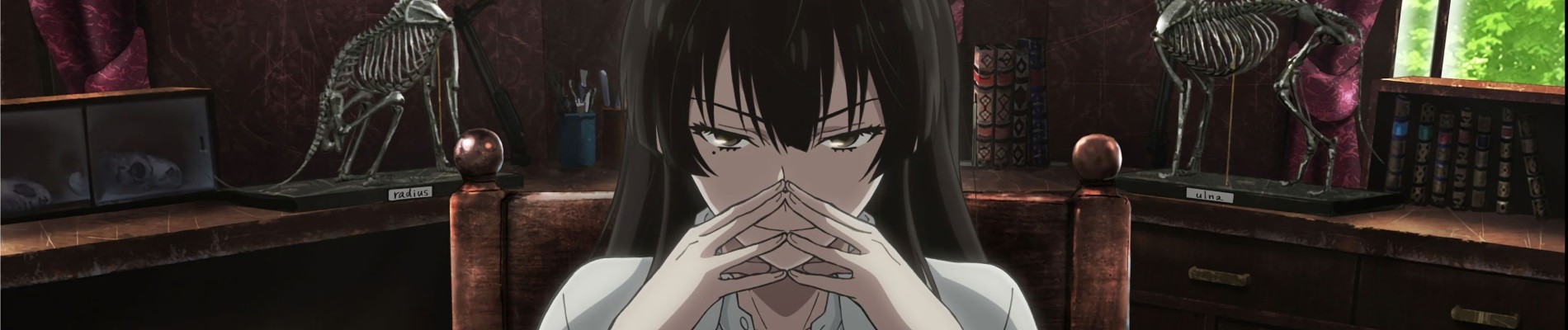
What makes this anime vibrate at such a low, steady frequency isn’t its detective scaffolding or even its forensic accuracy—it’s how deeply it treats absence as a presence. Sakurako doesn’t solve cases to restore order; she reconstructs fragments because not looking feels like complicity. Her obsession with bones isn’t clinical detachment—it’s reverence for what remains when everything else has been stripped away: identity, intention, love, life. And Shoutarou? He doesn’t just assist—he witnesses, his youth a quiet counterpoint to her stillness, his unrequited feelings folding into the same respectful distance he gives every corpse, every suicide note, every police report filed under “no suspects.” There’s no catharsis here, only continuance: the slow, deliberate act of holding space for tragedy without flinching. It leaves you not shaken—but hollowed out, then gently refilled with something like tenderness.
That emotional resonance echoes sharply in Disco Elysium - The Final Cut, where the city of Revachol doesn’t offer answers—it offers layers of decay, ideology, and half-remembered pain. Like Sakurako examining cortical bone, the game forces you to parse meaning from fragments: a torn letter, a cracked tile, a cop’s own fractured psyche. The player review’s line—“Capital has the ability to subsume all critiques into itself”—mirrors Sakurako’s quiet resistance: she doesn’t rail against systems, but works within them, using bone density, trauma patterns, soil pH—cold, measurable truths—to anchor humanity in bureaucracy. Both refuse easy justice. Both treat melancholy not as mood, but as method.
Then there’s Max Payne 2: The Fall of Max Payne, whose description calls it “a violent, film-noir love story. Dark, tragic and intense”—and that’s the key. Not the gunplay, not the bullet-time, but the love story. Like Shoutarou’s silent devotion, Max’s bond with Mona is defined by proximity to loss, by gestures that land just shy of reciprocity, by intimacy forged in shared trauma rather than ease. The player review notes how the sequel “successfully improving on many of the original's key mechanics”—but what it deepens most is the ache of connection that can’t quite bridge the gap between two broken people. Sakurako and Shoutarou don’t kiss. Max and Mona don’t get closure. Both stories understand that some bonds are measured not in touch, but in endurance.
And though Sherlock Holmes versus Jack the Ripper leans into historical horror, its description nails the shared spine: “The famous detective stands…”—not triumphant, but standing, facing something unspeakable with tools that feel terrifyingly insufficient. Sakurako doesn’t chase monsters; she catalogs their aftermath. Holmes confronts a killer who erases women from history—just as Sakurako’s cases often involve marginalized lives reduced to evidence tags. The player review’s frustration with technical flaws (“technically unable to work on my pc”) ironically underscores what both works share: they’re hard to sit with, not because they’re broken, but because they refuse to soften the edges of suffering.
This pairing isn’t for fans of tidy resolutions or heroic arcs. It’s for the person who re-watches the scene where Sakurako cleans a child’s skull—not with sorrow, but with the same meticulous attention she’d give a museum specimen—and feels their chest tighten, not with sadness, but with recognition. It’s for the player who pauses mid-investigation in Disco Elysium to read a weathered poster about union rights, or who lingers in Max Payne 2’s rain-slicked alleys just to hear the dialogue loop one more time—not for plot, but for the texture of voice, of exhaustion, of care that persists anyway. These are works for those who find solace not in answers, but in the gravity of asking—and who understand that sometimes, the most radical act is simply holding the bone, and waiting, and watching, and loving quietly, in the rain.
🎮38 Games That Match the Vibe






















Match Dimensions Explained
❓Frequently Asked Questions
Why is Disco Elysium recommended for fans of Beautiful Bones — Sakurako's Investigation?
Because both lean hard into melancholic, character-driven mystery where the detective’s inner world shapes the investigation — just like Sakurako’s quiet intensity and obsession with bones, Disco Elysium’s Harry Du Bois wrestles with trauma, memory, and philosophy while interrogating a corpse in a rain-soaked alley in Martinaise. The skill-check dialogue system (like 'Logic' or 'Empathy') mirrors how Sakurako deduces truth from subtle physical details — it’s less about action, more about *how you think*.
Is there an anime or visual novel adaptation of Beautiful Bones — Sakurako's Investigation?
Yes — it was adapted into a 2015 anime series (22 episodes) and originated as a light novel series by Shiori Kubo. But if you're asking whether any of the *games like it* have similar adaptations? Nope — none of the matches (Disco Elysium, Crash Time 2, Sherlock Holmes vs. Jack the Ripper, Max Payne 1 & 2) have anime or visual novel spin-offs. They’re all original or licensed game-first properties.
How does Sherlock Holmes versus Jack the Ripper compare to Max Payne 2 in terms of mood and pacing?
Sherlock Holmes vs. Jack the Ripper leans into grim, methodical Victorian dread — think candlelit autopsies and journaling clues in fog-choked Whitechapel — while Max Payne 2 is a hyper-stylized, tragic noir love story with bullet-time shootouts and voiceover monologues dripping with fatalism. Both are Neon Noir + Mystery & Detective, but Sherlock is slow-burn deduction; Max Payne 2 is operatic, kinetic sorrow — like comparing Sakurako’s silent bone analysis to Max’s slow-mo dive through shattered glass.
What’s the best game like Beautiful Bones if I want that quiet, thoughtful, emotionally heavy vibe?
Disco Elysium — The Final Cut is your strongest match: its melancholic exploration dimension directly echoes Sakurako’s hushed reverence for truth and decay — whether you’re staring at a dead body on a pier while your ‘Shivers’ skill whispers existential dread, or replaying a memory fragment with your ‘Volition’ stat fraying at the edges. No other title on the list (Crash Time 2’s janky racing, Sherlock’s procedural rigidity, or Max Payne’s action-noir) sustains that same weighty, introspective stillness.