High School Prodigies Have It Easy Even In Another World
📺Anime Details
📝Editorial Analysis
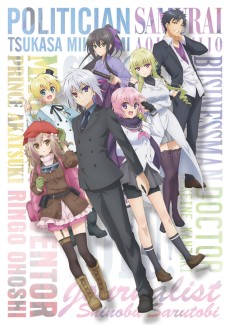
The smell of gunpowder hangs thick in the air—not from a battlefield, but from a sun-dappled courtyard where a teenage girl with fox ears adjusts the sights on a bolt-action rifle she designed herself, while two classmates debate inflation rates in the newly formed provisional government. No magic sparkles. No grand monologue about destiny. Just chalk dust, blueprints, and the quiet weight of responsibility settling onto shoulders that should still be worrying about college entrance exams.
That’s the heartbeat of High School Prodigies Have It Easy Even In Another World: competence without fanfare, power without spectacle, agency without ego. It doesn’t feel like an isekai—it feels like watching gifted, slightly exhausted young adults rebuild infrastructure after war. The fantasy setting isn’t escapism; it’s scaffolding. What lingers isn’t the kemonomimi or the ecchi gags (which land with the awkward sincerity of real teens fumbling through intimacy), but the gravitas of logistics—how a single policy shift in grain distribution affects border patrol rotations, how espionage isn’t cloak-and-dagger theatrics but cross-referencing tax ledgers and intercepted supply manifests. You don’t feel wonder. You feel urgency, precision, and the low hum of trust—the kind earned not through loyalty oaths, but through shared spreadsheets and synchronized watch-checks before a raid.
That emotional DNA pulses strongest in Desperados 2: Cooper's Revenge, where “tactical warfare” isn’t about brute force but layered timing—freezing a guard’s patrol path with a thrown bottle while another character slips past a window exactly as a shadow crosses the floor. Its description calls it “a beautiful 3D env” built on “brand new tactical possibilities,” and that mirrors the anime’s own spatial intelligence: characters don’t just fight—they orchestrate, using terrain, schedules, and social roles like levers. A player review admits the first game was beloved but finds this one less satisfying—“It was made during a time when everything…”—and that hesitation echoes the anime’s own tension: brilliance deployed in a world that’s still messy, underfunded, politically brittle. There’s no clean victory, only calibrated risk.
Then there’s Helldorado, described as a standalone expansion to Desperados 2, set in 1883 Santa Fe, where peace shatters after a kidnapping and you “gather your men and ride on a series of challenging missions to stop treacherous, marauding outlaws.” That phrase—gather your men—is key. Like the anime’s ensemble cast, this isn’t solo heroics. It’s delegation, role specialization, reading a town’s fractures like a dossier. The player review bluntly states it’s “Desper...”, confirming its kinship—not as spectacle, but as systemic pressure: lawlessness isn’t defeated with a sword swing, but by triangulating witness testimony, bribing a corrupt sheriff, and cutting off an outlaw’s supply line before the shootout begins. The anime’s military tag isn’t about uniforms—it’s about that same granular chain-of-command thinking.
Even Assassin's Creed™: Director's Cut Edition, with its “political thriller” dimension, resonates—not in parkour or creed dogma, but in its description’s claim that it “redefines the action genre” by merging “impressive graphics and physics” with something deeper: consequence. A player review notes dated models but says “no issues with me”—because the weight remains. In the anime, every diplomatic overture carries the scent of betrayal; every ceasefire treaty has three footnotes and a contingency clause. That’s the same texture: action as negotiation, stealth as diplomacy, violence as last-resort arithmetic.
Who lives for this? The viewer who rewatches the scene where the economics prodigy rewrites tariff codes not for profit, but to prevent famine in a rival province—and feels their chest tighten. The player who spends twenty minutes positioning a sniper, not for the kill, but so a civilian can slip unseen through a checkpoint. Not fans of power fantasies—but people who find thrill in precision, comfort in competence, and profound respect in quiet collaboration. They don’t want to save the world. They want to run it right. And they’ll do it with coffee-stained blueprints, a well-oiled rifle, and the unspoken certainty that the next crisis won’t wait for applause.
🎮19 Games That Match the Vibe









Match Dimensions Explained
❓Frequently Asked Questions
Why does High School Prodigies Have It Easy Even In Another World feel so similar to Desperados 2 and Helldorado?
Because all three lean hard into tactical, pause-and-plan gameplay where timing, positioning, and character-specific abilities matter—like Desperados 2’s Cooper using dynamite to clear a saloon hallway while Kate snipes from the balcony, or Helldorado’s mission where you coordinate your posse to flank outlaw camps in Santa Fe. Both Western tactical titles share that same deliberate, consequence-heavy pacing and ensemble-driven problem-solving that mirrors how the anime’s prodigies methodically dismantle political and magical threats.
Is there a visual novel or anime-style game adaptation of High School Prodigies?
No official visual novel or direct anime-style game adaptation exists—but The Sims™ 4 comes closest in vibe if you’re after that 'prodigy building their ideal life' energy: you can create genius-level Sims with maxed Logic and Charisma, throw lavish academic galas, romance classmates like Tsukasa or Mio, and even mod in fantasy-themed magic careers. It’s not canon, but it nails the slow-life, relationship-focused, self-actualization core fans love.
How does Prince of Persia compare to High School Prodigies in terms of romance and emotional pacing?
Prince of Persia (2008 reboot) shares that same Healing & Slow Life + Romance & Shoujo dimension with High School Prodigies—it’s all about quiet moments between high-stakes action, like the Prince and Elika sharing tender glances mid-climb or healing wounds together after battle. Unlike the anime’s ensemble banter, PoP focuses on deepening one central bond through gentle dialogue and synchronized movement, making it perfect if you want that soft, emotionally resonant rhythm without school politics.
What’s the best game like High School Prodigies if I just want to relax and watch smart characters thrive without stress?
The Sims™ 4 is your go-to—if you skip the buggy DLCs and stick to base-game academics, you can build a Tsukasa-like genius Sim who breezes through university, mentors younger Sims like Rintaro, and hosts low-key tea parties with Mio in a sun-drenched Kyoto-inspired neighborhood. No timers, no fail states—just slow, satisfying mastery and wholesome vibes, exactly like the anime’s chillest classroom scenes.