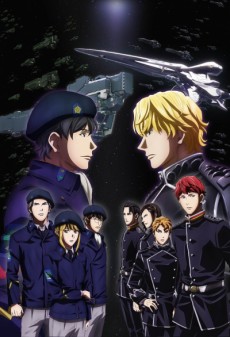
Legend of the Galactic Heroes: Die Neue These
In humanity's distant future, two interstellar states—the monarchic Galactic Empire and the democratic Free Planets Alliance—are embroiled in a never-ending war. The story focuses on the exploits of rivals Reinhard von Müsel and Yang Wen Li as they rise to power and fame in the Galactic Empire and the Free Planets Alliance.
📺Anime Details
📝Editorial Analysis
The hum of a starship’s bridge—low, resonant, almost subsonic—fills the silence just before the fleet maneuvers. Reinhard von Müsel stands motionless at the observation window, his reflection fractured across the reinforced transparisteel, while behind him officers whisper calculations in hushed, urgent tones. No music swells. No heroic pose. Just light catching the edge of his uniform epaulette, and the slow, deliberate blink of a man who has already weighed ten thousand lives against one strategic objective. That stillness—not peace, not calm, but gravity—is where Legend of the Galactic Heroes: Die Neue These begins its work on you.

It doesn’t feel like war as spectacle. It feels like war as architecture: vast, cold, inevitable. You don’t cheer victories—you trace their cost in the hollows under Yang Wen Li’s eyes after a battle he won by exploiting bureaucratic inertia, or in the way Reinhard’s smile never reaches his pupils when he signs an execution order that secures his throne. This is a world where politics isn’t backdrop—it’s the oxygen you breathe, where philosophy isn’t debated in seminars but enforced through fleet deployments and propaganda broadcasts, where every tactical decision echoes with centuries of ideological rot and reform. It makes you feel small, not because of scale—but because of consequence. Every promotion, every retreat, every quiet conversation in a dimly lit corridor carries the weight of systems collapsing and reassembling. You think about power not as force, but as friction: between institutions, between generations, between what people say they believe and what they do when survival demands compromise.
That same gravitas lives in Assassin's Creed™: Director's Cut Edition, where the player moves through Jerusalem not as a warrior, but as a political actor embedded in layered, competing factions—Templars, Assassins, Saracens, Crusaders—each with doctrines, hierarchies, and unspoken rules. The description calls it a Political Thriller, Tactical Warfare experience, and the player review acknowledges its age but insists “no issues with me”—because what lingers isn’t the texture fidelity, but the texture of consequence: every assassination ripples through governance, every alliance is transactional, every rooftop perch offers not just vantage, but perspective on how ideology calcifies into architecture. Like Reinhard navigating the Imperial Court or Yang parsing Alliance Senate transcripts, you’re constantly reading subtext, weighing leverage, understanding that victory isn’t landing the blow—it’s controlling the narrative after.
Then there’s BioShock™, tagged explicitly as Political Thriller, Sci-Fi & Space—a rare alignment, given its underwater setting, yet unmistakably resonant. Its description positions it as a shooter “unlike any you’ve ever played,” loaded with “weapons and tactics never seen”—but what players remember isn’t the plasmids or the Big Daddies’ roar. It’s the slow dawning that Rapture isn’t ruined by monsters, but by the logical endpoint of unchecked individualism, dressed in Art Deco grandeur and broadcast over crackling PA systems. The player review calls it “one of the most revolutionary games ever!”—not for mechanics, but for how it makes ideology inescapable, how its world forces you to confront the hollowness of slogans when they’re carved into dying walls and whispered by broken voices. That’s the same air Die Neue These breathes: the suffocating clarity of seeing democracy erode from within, monarchy ossify into pageantry, and both systems produce heroes who are also architects of suffering—all without moral shorthand.
Who loves this pairing? Not the casual viewer who wants catharsis in a final explosion. Not the player chasing adrenaline spikes or loot drops. It’s the person who replays Yang’s debate with Julian Mintz not for the rhetoric, but for the silence between sentences—the pause where you realize neither man believes the other is lying, only tragically consistent. It’s the one who walks away from BioShock humming Andrew Ryan’s speech, then opens a history textbook and feels a chill. It’s the reader who highlights passages about institutional memory in Clausewitz and underlines them twice. They crave stories where ideas have mass, where choices echo not in scoreboards, but in the quiet resignation of a subordinate officer signing a transfer order, or the flicker of doubt in a scientist’s eye as they calibrate a weapon they know will kill children. They don’t want heroes—they want vectors. And when they find them—in a starfield, a rain-slicked alley, or the crumbling halls of an underwater city—they don’t look away. They lean in. They listen.
🎮18 Games That Match the Vibe





Match Dimensions Explained
❓Frequently Asked Questions
Why is Assassin's Creed: Director's Cut Edition listed as similar to Legend of the Galactic Heroes: Die Neue These?
Because both hinge on political maneuvering amid large-scale warfare—think Reinhard von Lohengramm’s calculated coups mirrored in Altaïr’s infiltration of Templar-controlled Acre and Damascus. The game’s ‘Political Thriller’ dimension matches LOTGH’s tense diplomacy scenes, like the Imperial Court conspiracies in Episode 12, while its tactical city-based combat echoes fleet positioning in the Battle of Amritsar.
Is there a video game adaptation of Legend of the Galactic Heroes: Die Neue These?
No—there’s no official game based directly on *Die Neue These*. The closest matches are games sharing its core DNA: *Assassin’s Creed: Director's Cut Edition* (for its layered political intrigue and military command feel) and *BioShock* (for its ideological world-building, like Andrew Ryan’s Rapture echoing the Free Planets Alliance’s democratic ideals vs. the Empire’s authoritarianism).
How does BioShock compare to Assassin’s Creed: Director’s Cut Edition for LOTGH fans?
If you love LOTGH’s philosophical depth and morally gray factions, *BioShock* hits harder—its audio logs from Atlas and Ryan mirror the ideological duels between Yang Wen-li and Reinhard, especially during the Iserlohn Corridor debates. *Assassin’s Creed*, meanwhile, delivers more of the ‘tactical warfare’ vibe: scaling rooftops to survey enemy positions feels like plotting fleet movements from a bridge console—but with less dialogue-driven statecraft.
What’s the best game like Legend of the Galactic Heroes if I want that slow-burn, cerebral sci-fi vibe?
Go straight to *BioShock*: its underwater dystopia, dense lore delivery via audio logs (like Dr. Tenenbaum’s confessions), and themes of utopian collapse echo Yang’s quiet strategic brilliance and the series’ focus on ideology over explosions. It’s not space opera—but that haunting, thoughtful sci-fi weight? Exactly what makes Episode 23’s ‘The Fall of the Goldenbaum Dynasty’ land so hard.