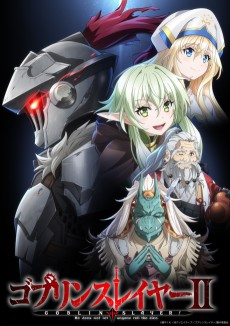
GOBLIN SLAYER II
The second season of Goblin Slayer.
📺Anime Details
📝Editorial Analysis
The smell of wet iron and burnt hair clings to the air after the goblin nest collapses—not from fire, but from the crunch of a steel boot grinding a skull into damp earth. No music swells. No triumphant breath is drawn. Just the Guild clerk’s ink-stained fingers counting copper coins while the Goblin Slayer wipes his sword on a dead goblin’s tunic, his face unreadable beneath the helm. That silence—thick, unbroken, heavy—is where GOBLIN SLAYER II lives.

This isn’t fantasy as escape. It’s fantasy as weight. The world doesn’t sparkle; it sags: under grief, under ritualized brutality, under the sheer, grinding exhaustion of surviving in a place where magic doesn’t uplift—it festers, and elves don’t glide—they endure, scarred and watchful. The gore isn’t spectacle; it’s forensic. The body horror isn’t grotesque for shock—it’s intimate, inevitable, the physical echo of trauma that won’t stay buried. You don’t feel heroic watching this. You feel responsible. Responsible for remembering what was lost. Responsible for not looking away when the sword bites deep—not because it’s thrilling, but because turning away is the first step toward forgetting what goblins do.
That emotional DNA—the raw, unvarnished confrontation with consequence, decay, and moral gravity—pulses in several games, not by accident, but by shared texture. Take Red Dead Redemption 2: Arthur Morgan doesn’t ride into sunsets—he rides through mud, coughs blood, watches friends rot from within while occult symbols stain forgotten caves. The description nails it: Western & Frontier, Body Horror & Occult. And that player review? “A roller coaster of emotions… my words can’t even describe the feeling inside me right now”—that’s the same choked awe you get when Goblin Slayer kneels beside a child’s grave, not speaking, just being present in the silence that follows atrocity. Both refuse catharsis. They demand witness.
Then there’s Dark Messiah of Might & Magic, steeped in Dark Fantasy, Emotional Narrative, Body Horror & Occult. Its combat isn’t clean slashes—it’s visceral, physics-driven mayhem where limbs twist, bones snap, and magic warps flesh in real time. The player review calls it “a fantastic melee combat game that still holds up,” but what endures isn’t just the engine—it’s the tone: every parry feels earned, every spell carries cost, every corridor smells like old blood and damp stone. Like GOBLIN SLAYER II, it treats violence as labor, not flair—and treats grief as something you carry in your shoulders, not your backstory.
And Heretic: Shadow of the Serpent Riders—a Sidhe elf mage hunting three brothers who’ve corrupted a realm. The description names you “one of the last Sidhe elves, and a capable mage,” framing survival itself as defiance. That player review urges you to “Pick up the remaster”—not for nostalgia, but because the core ache remains: being the last keeper of memory in a world actively unmaking beauty. Just like the elf in GOBLIN SLAYER II, who doesn’t wield grace as power—but as quiet, stubborn resistance against erasure.
These aren’t matches because they’re “dark” or “gritty.” They match because they share a moral temperature: low, steady, unblinking. They trust you to sit with discomfort. To feel the grit of dried blood under fingernails, the weight of a sword that’s seen too much, the hollow behind the eyes of someone who’s buried more than they’ve saved.
You’ll love these pairings if you’ve ever paused mid-episode—not to check your phone, but because the silence after a goblin’s death felt too real, too close to something you’ve carried yourself. If you replay Red Dead Redemption 2’s epilogue not for the ending, but for the way Arthur’s hands tremble holding a letter he’ll never send. If you boot up Heretic not for the spells, but for the sound of wind howling through ruined elven towers—lonely, ancient, unforgiving. This is for the ones who don’t seek fantasy to forget the world—but to remember, with clarity, what it costs to protect even one fragile, flickering light inside it.
🎮37 Games That Match the Vibe







Match Dimensions Explained
❓Frequently Asked Questions
Why does Red Dead Redemption 2 keep coming up in GOBLIN SLAYER II recommendations?
Because both lean hard into grim, grounded brutality with occult-tinged dread—like when Arthur Morgan stumbles upon that cursed campsite full of twisted, half-transformed bodies, echoing GOBLIN SLAYER II’s goblin lairs where body horror isn’t just flavor, it’s narrative weight. RDR2’s morally gray world and visceral melee takedowns (especially with the knife or lasso) mirror the unflinching, tactical violence you get in Dark Messiah of Might & Magic—where dismembering a cultist mid-swing feels just as raw and consequential.
Is there a GOBLIN SLAYER II anime or movie adaptation coming soon?
No—there’s no official GOBLIN SLAYER II anime, game, or film adaptation in development. The ‘II’ in the search is actually misleading: people often type it when they mean ‘games like GOBLIN SLAYER’ *with that same dark fantasy + body horror + frontier grit vibe*—which is why titles like Heretic: Shadow of the Serpent Riders (with its Sidhe elf mage battling serpentine eldritch horrors) and Dark Messiah (featuring brutal close-quarters combat against grotesque cultists and demons) keep popping up in the match list.
How does Dark Messiah of Might & Magic compare to Heretic: Shadow of the Serpent Riders for dark fantasy vibes?
Dark Messiah hits harder on emotional narrative and physical immediacy—you’re right in the mud with Raynor, feeling every bone-crunching kick and spell-scorched limb, while Heretic leans into eerie, mythic dread: you’re a lone Sidhe elf stalking gothic ruins, hurling fireballs at Serpent Rider acolytes whose bodies melt into oily smoke. Both nail Body Horror & Occult, but Dark Messiah’s Source Engine physics and first-person melee make it feel more like GOBLIN SLAYER II’s claustrophobic dungeon crawls, whereas Heretic’s retro-modern remaster channels that same oppressive, ancient-magic atmosphere.
What’s the best game like GOBLIN SLAYER II if I want that bleak, rain-soaked Western tension mixed with occult dread?
GUN™ is your answer—Colton White’s revenge quest across desolate frontier towns, haunted by ghostly visions and occult rituals (like the eerie ‘spirit walk’ sequences), matches GOBLIN SLAYER II’s tone beat-for-beat. It shares the same 82-score and ‘Western & Frontier + Body Horror & Occult’ dimensions as Call of Juarez and Red Dead Redemption 2, but GUN™’s cult-classic status and Neversoft’s gritty, tactile gunplay (think slow-motion revolver spins amid blood-slicked saloons) give it that uniquely oppressive, myth-bleeding realism fans love.