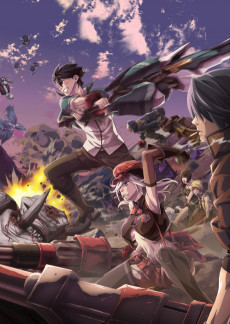
God Eater
The Far East, 2071.
The domain of the mad gods.
In the early 2050s, unknown life forms called “Oracle cells” begin their uncontrolled consumption of all life on Earth.
Their ravenous appetite and remarkable adaptability earn them first dread, then awe, and finally the name “aragami”.
In the face of an enemy completely immune to conventional weapons, urban civilization collapses, and each day humanity is driven further and further toward extinction.
One single ray of hope remains for humanity.
Following the development of “God Arcs”—living weapons which incorporate Oracle cells—their wielders are organized into an elite force.
In a world ravaged by mad gods, these “God Eaters” fight a desperate war...
(Source: Daisuki)
📺Anime Details
📝Editorial Analysis
The sky over Tokyo isn’t blue—it’s ash-grey, thick with drifting Oracle cell spores that catch the weak sun like suspended static. A God Eater kneels in the ruins of Shinjuku Station, breathing hard, visor cracked, blood mixing with black ichor down their forearm. Their arm isn’t just wounded—it’s changing: veins pulse with bioluminescent violet, tendons twitch without command, and for one breathless second, the line between weapon and wound dissolves. That’s not a battle cry. That’s the sound of your own body forgetting how to be human.
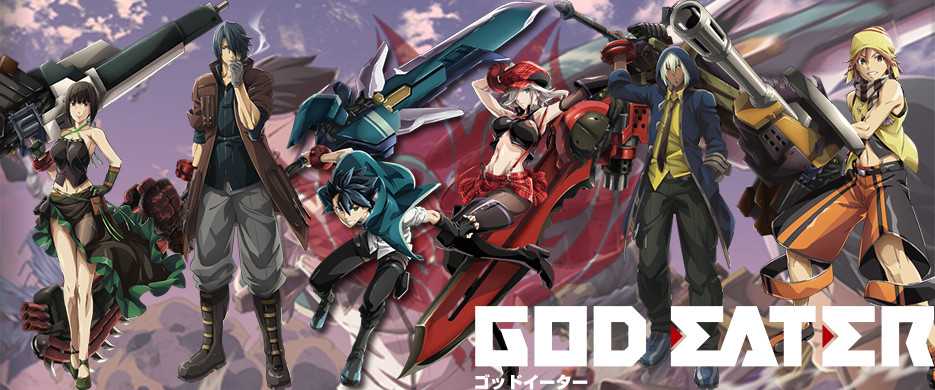
What makes God Eater ache so deeply isn’t its kaiju-scale destruction or military protocol—it’s the quiet horror of intimacy with annihilation. This isn’t apocalypse as spectacle; it’s apocalypse as slow infection—of cities, of flesh, of identity. You don’t just fight aragami—you harvest them, fuse with them, carry their cells inside you, trusting they won’t rewrite your nervous system while you sleep. The CGI isn’t a limitation; it’s a feature—the uncanny stiffness of motion, the glassy sheen on mutated skin, the way light doesn’t quite settle on a god-eater’s armor—all reinforce a world where biology has gone off-script, and every victory smells faintly of decay. It makes you feel unmoored, thinking about what loyalty means when your allies are literally built from the enemy’s DNA.
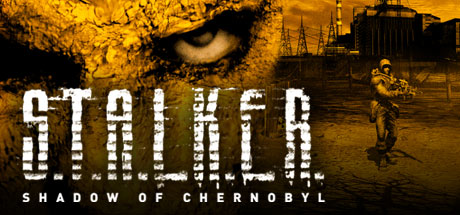
That same unmoored dread pulses through S.T.A.L.K.E.R.: Shadow of Chernobyl. Its Zone isn’t just dangerous—it’s alive in the wrong way: radiation bleeds into time, anomalies warp physics mid-step, and creatures aren’t monsters but consequences—biological experiments unspooling in real time. Like God Eater, it treats survival as a trembling negotiation: you don’t conquer the Zone—you negotiate passage, scavenging artifacts that hum with unstable energy, trusting gear that might fail because the rules keep shifting. A player says it’s a place where you fear “not only the radiation, anomalies and deadly creatures, but other S.T.A.L.K.E.R.s”—that layered paranoia mirrors how God Eater’s soldiers distrust not just aragami, but each other’s implants, their own reflexes, even the silence between comms checks. Both make safety feel like borrowed time.
Then there’s Rust, raw and relentless. Its description says the only aim is to survive—and everything wants you dead: wildlife, environment, other survivors. No grand ideology, no heroic speeches—just cold pragmatism under a hostile sky. That echoes God Eater’s Far East, 2071: no last stand anthems, just squads moving through collapsed subway tunnels with ration packs half-empty and God Arcs overheating. A player review nails it: “I’ve never played a game that simulates emotional damage this accurately. Rust is less of a survival game and more of a full-time job where everyone…”—yes. That exhaustion, that grinding weight of vigilance, that sense that trust is a luxury your body can’t afford? That’s the emotional frequency God Eater hums at during its quietest moments—when the camera lingers on a character wiping grime from their visor, not knowing if it’s ash… or something growing.
Even Nuclear Dawn, flawed and server-dead, shares this DNA—not in polish, but in architecture. Its “war-torn post-apocalyptic landscapes” and “fight against enemies using various weapons” aren’t generic backdrops. They’re fractured terrain, where cover is rubble, visibility is smoke and static, and every firefight feels like improvisation inside a collapsing system. Like God Eater, it forces you to adapt mid-collapse: no clean lines of control, no stable frontlines—just shifting ground, compromised tech, and the constant question: what part of me is still mine?
This pairing isn’t for fans of tidy endings or power fantasies. It’s for the ones who linger on loading screens, listening to distant wind and distorted radio chatter. For players who pause mid-game to stare at a rusted satellite dish jutting from a collapsed mall roof—not because it’s pretty, but because it hurts to remember what it used to mean. For viewers who feel their throat tighten when a God Eater removes their helmet and stares at their own reflection—seeing not a face, but a threshold. These are stories for people who understand that the most terrifying thing about the end of the world isn’t the roar of the aragami… it’s the silence after, when you realize your heartbeat sounds too much like theirs.
🎮25 Games That Match the Vibe




Match Dimensions Explained
❓Frequently Asked Questions
Why does God Eater feel so different from S.T.A.L.K.E.R. even though both are about surviving in a ruined world?
Great question — it’s all about *how* survival hits you. In God Eater, survival is visceral and fast: you’re dodging Aragami tail swipes mid-air, switching weapons on the fly, and healing with blood pills while your partner shouts warnings. S.T.A.L.K.E.R., on the other hand, makes you sweat over radiation zones, anomaly fields, and bullet-dodging stalkers in near-silence — that haunting Zone vibe where even your Geiger counter’s click feels like dread. Both score high on Survival & Crafting + Cyberpunk & Dystopia, but S.T.A.L.K.E.R. leans into oppressive realism (82 Metacritic), while God Eater leans into anime-powered action.
Is there a God Eater anime or movie adaptation I should watch before playing?
No official anime or movie adaptation exists — unlike Monster Hunter, which got multiple films and series, God Eater’s storytelling lives entirely in-game through its lore logs, character bonds (like Alisa and Lindow), and those intense, dialogue-heavy mission briefings. That said, fans often compare its tone to the grounded-yet-mysterious world-building of S.T.A.L.K.E.R.: Shadow of Chernobyl (82), where story unfolds slowly through environmental clues and cryptic radio chatter — not cutscenes.
Rust vs. God Eater: which one gives better monster-hunting catharsis?
God Eater — hands down. Rust makes you fear *other players* more than wildlife: you’ll spend hours fortifying a base just to get griefed at dawn, and its ‘monsters’ (like bears or wolves) lack personality or spectacle. God Eater delivers cinematic, multi-phase hunts — think tearing off a Grendel’s armored plates, then going for the weak point while your partner distracts it with a lightning strike. Even Rust’s 72-score review admits it’s 'less of a survival game and more of a full-time job' — no room for Aragami-style drama.
What’s the best God Eater-like game if I want that lonely, atmospheric dystopian vibe instead of flashy co-op action?
S.T.A.L.K.E.R.: Shadow of Chernobyl is your perfect match — it nails that isolated, haunting atmosphere where every rustle could be a pseudogiant, every abandoned lab hides secrets, and your own breath sounds loud in your headset. It shares God Eater’s Survival & Crafting + Cyberpunk & Dystopia dimensions (and scores 82), but swaps sword-swinging combos for tense scavenging, artifact hunting, and eerie Zone lore. One player put it perfectly: 'The map is big and beautiful... and you never quite trust what’s behind the next hill.'