
Aoashi
Ashito Aoi is a young, aspiring soccer player from a backwater town in Japan. His hopes of getting into a high school with a good soccer club are dashed when he causes an incident during a critical match for his team, which results in their loss and elimination from the tournament. Nevertheless, he catches the eye of someone important who happened to be visiting from Tokyo. How will things turn out for Ashito?
(Source: Shogakukan Asia)
📺Anime Details
📝Editorial Analysis
The smell of wet grass and cheap polyester jerseys. Ashito Aoi’s knees burning as he scrambles after a loose ball in the final minutes of that fateful match—his cleats slipping, his breath ragged, his teammates’ voices fraying into static—then the whistle. Not for a foul. For the end. The tournament over. His town’s hopes gone. His own future, in that instant, collapsing like a net ripped from its frame.
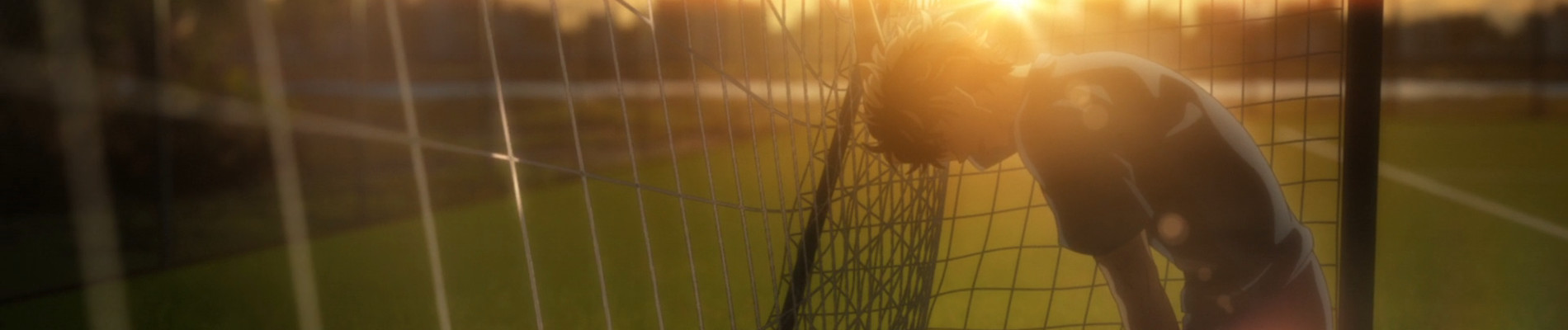
That moment isn’t about failure—it’s about weight. The crushing, silent gravity of consequence when you’re seventeen and every misstep feels like it echoes across your whole life. Aoashi doesn’t romanticize youth; it presses its palm flat against the bruise of growing up in a world that doesn’t pause for second chances. There’s no triumphant montage after the loss—just Ashito walking home alone, shoulders hunched, the fluorescent buzz of convenience store lights reflecting off rain-slicked pavement. The show’s atmosphere is tense, unforgiving, yet strangely tender—not because it softens reality, but because it watches Ashito breathe through it. It makes you feel the grit under your fingernails, the ache in your thighs after sprinting too hard, the quiet shame of being seen at your worst—and then, crucially, the slow, unshowy recalibration of self-worth when someone else sees something in you before you do.
That emotional DNA—the raw nerve of competitive striving fused with mature, almost weary introspection—is why Team Fortress Classic, Quake III Arena, and Call of Duty® 4: Modern Warfare® (2007) resonate so deeply. Not because they’re about soccer—but because they share Aoashi’s competitive spirit and adult & dark seinen texture. These aren’t games about flawless victory. They’re about learning your limits in real time, under pressure, with real people watching—and sometimes judging—you. In Team Fortress Classic, the description calls out “over nine character classes… enlisted in a unique style of online team” play—and the player review nails it: “simply the best nostalgic game, i have dreams about this game.” That devotion isn’t to polish or story—it’s to the visceral memory of coordination, miscommunication, last-second flares, and the weight of letting your team down—or pulling them up—when the clock’s ticking. Like Ashito’s botched tackle, it’s not the error itself that lingers, but how you reassemble yourself mid-match.
Same with Quake III Arena: “The greatest warriors… summoned to battle for the amusement of an ancient alien race.” That framing isn’t heroic—it’s existential. You’re not saving the world; you’re performing, surviving, adapting in a system that doesn’t care about your backstory. The player review says servers are “still online as of typing this”—a testament to endurance, to showing up again and again despite fatigue, despite past losses. That’s Ashito returning to training the day after his humiliation, sweat stinging old scrapes, no music swelling, just the thud of the ball against concrete.
And Call of Duty® 4: Modern Warfare® (2007)? Its description promises “the most intense and cinematic action experience ever”—but the player review reveals the truth beneath: “To me, this is the best CoD game ever made… I used to play the cracked version and probably have around 6,000 hours in it.” Six thousand hours—not for spectacle, but for ritual. For the muscle memory of reload timing, the shared silence before a push, the way trust forms not through dialogue, but through covering fire you didn’t ask for. That’s the same quiet loyalty blooming between Ashito and his new Tokyo teammates—not through speeches, but through shared exhaustion, corrected passes, unspoken adjustments on the pitch.
This pairing isn’t for fans of easy wins or wish-fulfillment arcs. It’s for the person who still remembers the exact sting of their first real defeat—not as tragedy, but as orientation. The one who replays a five-minute firefight not to win, but to understand where they hesitated. The one who watches Ashito tighten his bootlaces for the third time before practice, and feels that knot in their own throat—not because it’s sad, but because it’s true. They’re the kind of viewer who pauses the anime to check if their favorite TF2 server is up. The kind of player who boots up ioquake3 not for nostalgia’s sake, but because the physics still feel honest. They don’t want stories about becoming invincible. They want stories—and games—where growth is measured in millimeters: a cleaner pass, a steadier aim, a breath held just a half-second longer before stepping forward. That’s where Aoashi lives. And that’s where these games still breathe.
🎮48 Games That Match the Vibe























Match Dimensions Explained
❓Frequently Asked Questions
Why does Aoashi's 'Kanto vs. Tokyo' match feel so intense compared to other soccer anime games?
That match hits hard because it mirrors the high-stakes, emotionally raw tension of Team Fortress Classic’s objective-based rounds—like pushing the payload on Dustbowl while your Medic desperately tries to keep you alive under fire. Both hinge on role synergy (Aoashi’s playmaking as the ‘Scout’-like catalyst, Tachibana as the ‘Heavy’-style anchor) and sudden momentum swings, not just skill—but pressure, sacrifice, and unspoken team trust.
Is there an Aoashi anime or game adaptation in development?
No official Aoashi game exists yet—but if you’re craving that same gritty, competitive spirit with adult stakes and sharp character dynamics, Quake III Arena nails it: imagine Aoashi’s intense training montage scored over the arena’s brutal, no-respawn duels, where every frag feels like a hard-won tactical victory against elite rivals. The player review even calls it ‘ruthless combat’—just like Coach Tachibana’s philosophy.
How is Need for Speed Undercover different from Call of Duty 4: Modern Warfare (2007) for Aoashi fans?
Undercover trades CoD4’s tight, grounded gunplay and squad-based tension (think Gaz and Soap’s bond mirroring Aoashi/Tachibana’s mentorship) for high-speed, morally ambiguous infiltration—more like Aoashi’s ‘undercover’ arc at Blue Lock’s periphery. But both share that Adult & Dark Seinen dimension: CoD4’s ‘All Ghillied Up’ stealth sequence has the same quiet dread as Aoashi’s solo night drills, while Undercover’s chase physics echo HL2DM’s chaotic, physics-driven unpredictability.
What’s the best game like Aoashi if I want that ‘gritty, nostalgic, team-first’ vibe?
Team Fortress Classic is your answer—no question. It’s got that same scrappy, class-dependent teamwork (Medic healing under fire = Tachibana yelling encouragement mid-match), the 90s-era authenticity players rave about in their reviews ('I have dreams about this game'), and zero hand-holding—just pure Competitive Spirit, exactly like Aoashi’s early Kanto League grind before the spotlight hit.