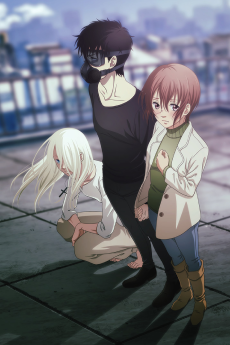
Devils' Line
Everything you thought you knew about vampires is wrong. They can walk in the daylight and holy water doesn't burn them. In fact, vampires can pass as normal humans so perfectly that even other vampires have trouble spotting them. Until they drink human blood, that is; then they transform into monstrous beasts who mindlessly rape and murder. But not all vampires are evil. The secret task force that patrols Tokyo's vampire population has several fanged operatives, including half-human Yuuki Anzai, who believes that his human heritage lets him resist his species' basest cravings. But after Yuuki rescues college student Tsukasa Taira from a vampire stalker, he realizes that he's succumbing to urges he's never felt before.
(Source: Sentai Filmworks)
📺Anime Details
📝Editorial Analysis
Rain slicks the Tokyo pavement like oil under sodium-vapor streetlights. Yuuki An stands motionless in a narrow alley, breath shallow, knuckles white around the grip of his service pistol—not aimed at a threat, but at himself. His fangs are already pricking through his gums. A single drop of blood from a cut on his palm pulses like a beacon. He doesn’t move to lick it. He watches it well up, trembling—not from fear, but from the sheer, grinding weight of restraint. That’s the core of Devils’ Line: not fangs or bloodlust as spectacle, but the quiet, suffocating horror of holding your own humanity together, one second at a time.
What makes this anime’s atmosphere singular isn’t its vampire lore—it’s the claustrophobia of control. It’s the way sunlight doesn’t purify; it just exposes. Vampires walk among us, yes—but so do surveillance cameras, bureaucratic task forces, and the ever-present risk of slipping mid-sentence, mid-embrace, mid-breath. There’s no grand prophecy, no ancient curse whispered in Latin—just biology weaponized by policy, desire tangled with duty, and intimacy that feels less like romance and more like shared hostage negotiation. You don’t feel awe here. You feel tense. You feel watched. You feel the slow, cold dread of knowing your deepest hunger is also your most dangerous secret—and that someone, somewhere, is always measuring how close you are to snapping.
That same emotional DNA thrums in The Witcher 3: Wild Hunt, where Geralt tracks Ciri across a continent rotting from war and monstrosity—not because he believes in destiny, but because love is the only compass he trusts in a world that rewards neither mercy nor certainty. The player review calls it a game that “keeps getting better” over eleven years—not because it’s polished, but because its moral weight ages, deepens, accumulates like scar tissue. Like Yuuki choosing silence over confession, Geralt chooses action over ideology, and both carry the exhaustion of doing right in systems designed to break you.
Then there’s Vampire: The Masquerade – Bloodlines, where the RPG doesn’t just let you play a vampire—it forces you to negotiate the Masquerade in real time: lying to cops, seducing informants, suppressing blood frenzy during a tense dialogue—all while your stats visibly erode your self-control. The player review’s frantic note—“*BUY IT ON GOG; if you want to use the steam version you need to download the unofficial patch…”—isn’t just tech advice. It’s a testament to how fragile* the experience is: like Yuuki’s restraint, the game’s coherence depends on constant, invisible maintenance. Both demand you live inside the cracks—not as a hero, but as someone who knows how easily the mask slips when the lights go out.
Even Assassin’s Creed™: Director’s Cut Edition, though set in a historical sandbox, shares that same physical tension: Altaïr moving through crowded Damascus markets, fingers brushing hidden blades, every glance from a guard a potential trigger. The player review admits the models are “dated”—but notes “no issues with me.” Why? Because the game’s power lies not in fidelity, but in proximity: the way architecture funnels you, how sound cues betray presence, how a single misstep unravels hours of patience. That’s Yuuki navigating subway platforms, Tsukasa reading micro-expressions in elevator reflections—the same hyper-awareness, the same razor’s-edge choreography of survival.
Who lives for this? Not the fantasy escapist craving power fantasies or clean moral binaries. It’s the viewer who replays the scene where Yuuki washes blood from his hands twice, then stares at his reflection until his pupils shrink back to human size—not for catharsis, but to feel that relief. It’s the player who reloads after failing a persuasion check not to win, but to understand what made the NPC flinch. They’re drawn to stories where desire and danger wear the same face, where intimacy is indistinguishable from interrogation, and where the most terrifying monster isn’t the one in the shadows—it’s the one breathing steadily beside you, counting heartbeats, waiting to see if you blink first. They don’t want monsters vanquished. They want the ache of holding the line—exactly where it trembles.
🎮21 Games That Match the Vibe





Match Dimensions Explained
❓Frequently Asked Questions
Why does Devils' Line match with Assassin's Creed Director's Cut Edition?
Because both lean hard into brooding, morally gray protagonists navigating shadowy conspiracies — Altair’s silent intensity and rigid code mirror Yuuta’s internal struggle with his vampiric instincts and police duty. The rooftop parkour chases in Damascus and Acre echo the tense, rain-slicked Tokyo alley pursuits in Devils’ Line, especially that scene where Yuuta corners a rogue vampire near Shinjuku Station.
Is there a Devils' Line anime or game adaptation?
No official Devils' Line video game exists — it’s strictly a manga and anime series. But if you’re craving that same dark, adult-toned vampire noir vibe with tactical tension and emotional restraint, Vampire: The Masquerade – Bloodlines is your closest match: play as a newly Embraced vampire in L.A., juggling clan politics like the Devils’ Line’s Public Safety Division while dealing with visceral, unforgiving combat — just remember to grab the GOG version with the unofficial patch baked in.
How does The Witcher 3 compare to The Witcher Enhanced Edition Director's Cut for Devils' Line fans?
Both deliver mature, consequence-driven storytelling and morally complex monster hunting, but The Witcher 3 expands Geralt’s world with richer dialogue choices and Ciri’s arc — think of her as the 'high-stakes human anchor' like Tsukasa in Devils’ Line. Meanwhile, the Enhanced Edition feels more intimate and raw (especially that brutal fight against the Botchling in Vizima), echoing the claustrophobic, character-first pacing of early Devils’ Line episodes.
What’s the best game like Devils’ Line if I want slow-burn tension and restrained romance?
Go straight to The Witcher: Enhanced Edition Director's Cut — Geralt’s quiet chemistry with Yennefer (and that iconic bathhouse scene where words barely pass between them) nails the same charged, unspoken yearning you get from Yuuta and Tsukasa’s stolen glances and suppressed instincts. It’s not flashy, but every pause, every hesitation, every choice carries weight — exactly like when Yuuta chooses duty over instinct in Episode 7’s train platform standoff.