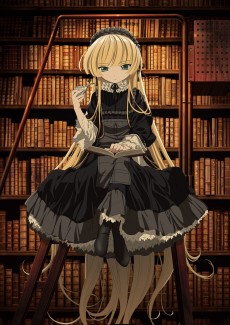
Gosick
Kazuya Kujou is a foreign student at Saint Marguerite Academy, a luxurious boarding school in the Southern European country of Sauville. Originally from Japan, his jet-black hair and dark brown eyes cause his peers to shun him and give him the nickname "Black Reaper," based on a popular urban legend about the traveler who brings death in the spring.
On a day like any other, Kujou visits the school's extravagant library in search of ghost stories. However, his focus soon changes as he becomes curious about a golden strand of hair on the stairs. The steps lead him to a large garden and a beautiful doll-like girl known as Victorique de Blois, whose complex and imaginative foresight allows her to predict their futures, now intertwined.
With more mysteries quickly developing—including the appearance of a ghost ship and an alchemist with the power of transmutation—Victorique and Kujou, bound by fate and their unique skills, have no choice but to rely on each other.
(Source: MAL Rewrite)
📺Anime Details
📝Editorial Analysis
The library’s dust motes hang suspended in a single shaft of afternoon light—golden, thick as honey—as Kazuya Kujou steps past the velvet rope into the forbidden upper stacks. His fingers brush the spine of a leather-bound volume titled Chronicles of the Black Spring, and for a breath, the air cools. Not from chill, but from recognition: something old is watching back. That moment isn’t about solving a case yet—it’s about standing at the threshold of a world where history doesn’t stay buried, where elegance masks rot, and where every polished floorboard in Saint Marguerite Academy hums with unspoken grief.
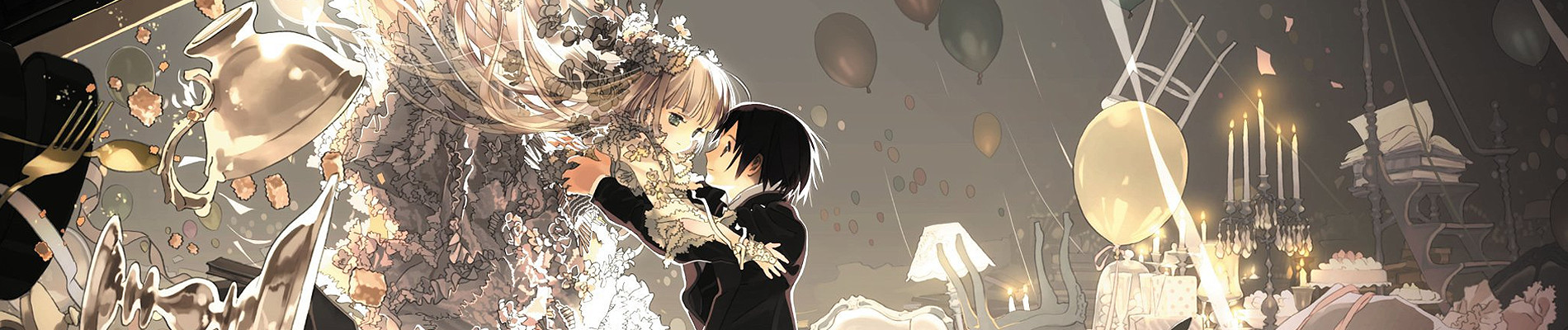
What makes Gosick ache so deeply isn’t its detective framework or even its wartime Europe setting—it’s the weight of memory. Not nostalgia, not romance-as-escape, but memory as architecture: ceilings frescoed with forgotten treaties, gardens laid over mass graves, tea served in porcelain stamped with royal insignia that no longer means anything. You feel it in the silence between Victorique’s sharp retorts and her sudden, quiet stillness—like a held breath before thunder. You feel it in Kazuya’s quiet observation, his foreignness not just cultural but temporal, as if he’s arrived decades too late to prevent something inevitable. This isn’t mystery as puzzle; it’s mystery as lament. Every clue is a shard of a broken vow. Every confession, a delayed funeral.
That emotional DNA pulses strongest in Disco Elysium - The Final Cut, where the city of Revachol doesn’t just hold secrets—it digests them. Like Sauville, it’s a place where capital, class, and colonial ghosts are baked into street names and crumbling facades. The game’s description calls it a Political Thriller and Neon Noir, but what mirrors Gosick isn’t the neon—it’s the way ideology wears lace gloves and serves poisoned cordial. The player review nails it: “Capital has the ability to subsume all critiques into itself. Even those who would critique capital end up reinforcing it instead.” That’s Victorique’s tragedy in miniature—the genius who sees the gears turning behind the throne, yet whose brilliance is weaponized by the very system she dissects. Both works make you feel complicit, not because you chose wrong, but because you’re breathing air thick with inherited consequence.
Then there’s Max Payne 2: The Fall of Max Payne, described as “a violent, film-noir love story. Dark, tragic and intense”, where love doesn’t save—it haunts. Kazuya and Victorique’s bond isn’t built on grand declarations, but on shared silences in rain-slicked courtyards and glances across candlelit tables where words are unnecessary because the truth is already written in the tremor of a teacup. The player review says it’s “a stellar sequel… successfully improving on many of the original's key mechanics.” But what resonates isn’t the gunplay—it’s the fall: the slow, elegant collapse of dignity, the way tragedy isn’t sudden but accreted, like frost on glass. Victorique’s tsundere armor, Kazuya’s stoic restraint—they’re not tropes. They’re survival tactics in a world that punishes feeling openly. So is Max’s voiceover, weary and poetic, narrating his own unraveling.
And though Assassin's Creed™: Director's Cut Edition scores equally high, its resonance is quieter, structural: both Gosick and this early Assassin’s Creed treat history not as backdrop but as living conspiracy. The description notes it “redefines the action genre” by merging “impressive graphics and physics” with something deeper—ideology made kinetic. In Gosick, every coded letter, every vanished diplomat, every whispered name in the academy’s halls points to a web older than nations. The player review admits the models are “dated”, yet finds no issue—because the power isn’t in fidelity, but in texture: the grit of stone under fingertips, the weight of a hidden blade, the rustle of a silk glove concealing a knife. That tactile sense of buried truth? That’s Saint Marguerite’s marble stairs echoing with footsteps from 1918.
This pairing isn’t for fans of tidy resolutions or triumphant reveals. It’s for the person who rereads the same paragraph three times because the sentence broke them—not with shock, but with recognition. For the one who pauses mid-game not to reload, but to stare at a rain-streaked window in Revachol or pause Kazuya’s walk home, listening to the wind carry the scent of linden blossoms and gunpowder. They love stories where beauty and sorrow share the same breath, where every solved case leaves a scar shaped like a question mark, and where the most devastating line isn’t shouted—it’s whispered, then swallowed whole by the silence that follows.
🎮40 Games That Match the Vibe








Match Dimensions Explained
❓Frequently Asked Questions
Why is Disco Elysium recommended for Gosick fans despite having no anime-style art or school setting?
Gosick fans love its layered mystery, morally grey dialogue, and deeply literary detective work—just like Victorique’s cryptic deductions in the library or the way Kazuya pieces together fragmented truths. Disco Elysium delivers that same cerebral, atmosphere-heavy sleuthing through skill checks like Logic or Empathy, and its rain-soaked, politically charged city of Revachol feels as richly symbolic as Gosick’s Belle Rive—especially during scenes like the ‘Inland Empire’ investigation where ideology and personal trauma blur.
Is there a visual novel or anime adaptation of Crash Time 2?
No—Crash Time 2 isn’t an anime or visual novel at all; it’s an open-world arcade racing game where you play as a German highway police officer chasing criminals on the Autobahn. It shares Gosick’s moody neon-noir aesthetic and emotional narrative weight (like its tense, rain-lit escort missions through foggy industrial zones), but it has zero anime ties—unlike Gosick, which *is* an anime adaptation of a light novel.
How does Max Payne 2 compare to Disco Elysium for someone who loves Gosick’s tragic romance and slow-burn mystery?
Max Payne 2 nails Gosick’s brooding, fatalistic romance—think Monokuma’s doomed love story mirroring Victorique and Kazuya’s restrained, high-stakes bond—but swaps deduction for bullet-time action and noir monologues. Its mystery unfolds through fragmented flashbacks and morally compromised allies (like Mona Sax), much like Gosick’s slow-reveal structure, whereas Disco Elysium leans harder into political philosophy and internal dialogue—more like reading Victorique’s encrypted journal than living her world.
What’s the best game like Gosick if I want that melancholy, rain-drenched, intellectually stylish vibe?
Disco Elysium — The Final Cut is your top pick: its decaying port city of Revachol drips with the same gothic melancholy as Gosick’s snowbound Belle Rive, and every conversation—from the haunted cop station to the crumbling wharf—feels like stepping into Victorique’s candlelit library. The game’s writing, voice acting, and oppressive-yet-beautiful atmosphere (especially during the ‘Riverside’ district’s downpour sequences) captures Gosick’s signature blend of elegance, sorrow, and razor-sharp intellect better than any other title on the list.