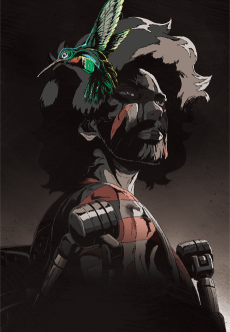
MEGALOBOX 2: NOMAD
The second season of Megalo Box.
In the end, “Gearless” Joe was the one that reigned as the champion of Megalonia, a first ever megalobox tournament. Fans everywhere were mesmerized by the meteoric rise of Joe who sprung out from the deepest underground ring to the top in mere three months and without the use of gear. Seven years later, “Gearless” Joe was once again fighting in underground matches. Adorned with scars and once again donning his gear, but now known only as Nomad.
(Source: TMS Entertainment)
📺Anime Details
📝Editorial Analysis
The rain in the opening shot of MEGALOBOX 2: NOMAD doesn’t fall—it settles, thick and greasy, on Nomad’s knuckles as he leans against a rusted freight container in the ruins of Old Tokyo. His breath fogs, his left arm—mechanical, scarred, humming faintly—hangs slack at his side. He doesn’t flinch when a stray dog barks from a collapsed overpass. He just watches the flicker of a broken neon sign spelling “NO NAME” in jagged katakana. That silence isn’t empty. It’s weighted—with seven years, with gear that no longer feels like armor but like a cage, with a name he refuses to reclaim.

This isn’t dystopia as spectacle. It’s dystopia as texture: the grit under fingernails, the low thrum of failing infrastructure, the way light never quite reaches the alley where Nomad trains alone at 3 a.m. The show doesn’t ask you to marvel at its world—it asks you to breathe its air, stale and metallic, and feel how exhaustion settles into your bones. What makes it unique isn’t the boxing or the cybernetics—it’s how deeply it treats rehabilitation not as plot device, but as daily, grinding, unglamorous labor. Every punch Nomad throws is measured—not just for power, but for control, for memory, for whether his body will betray him this time. You don’t root for victory here. You root for continuance.
That emotional gravity finds echoes in BioShock Infinite, where Booker DeWitt carries debt not just in coin, but in time and memory—a man trying to outrun consequences that loop back like scar tissue. The player review notes how some still mourn “the Bioshock Infinite we could have gotten,” mirroring how Nomad lives in the shadow of “Gearless Joe”—a version of himself that no longer exists, yet haunts every decision. Both refuse easy redemption; both trap their protagonists in recursive moral weight, where every choice feels less like progress and more like reckoning. And like Nomad’s mechanical arm, Elizabeth isn’t just a companion—she’s a destabilizing force tied to fractured chronology, making the past physically present, just as Nomad’s scars do.
Then there’s TimeShift™, where Dr. Aiden Krone’s reckless Time Jump births a “disturbing alternate reality”—not through grand apocalypse, but quiet erosion: familiar streets warped, logic frayed, identity unmoored. The player calls it “a little 4 hour game… but it takes a little work to get it into a playable state.” That line lands like a gut punch next to Nomad’s story: rehabilitation is that kind of labor—patching systems (body, mind, reputation) that weren’t built to last, relying on community fixes (like checking “the community pages for help”) just to function. Neither story glorifies the tech; both treat it as fragile scaffolding holding up a self that’s perpetually at risk of collapse.
And Unreal Tournament: Game of the Year Edition? Its legacy isn’t just competitive fire—it’s the ritual of return. The player review says it’s “an excellent classic… to remind you of the good’ole days.” Nomad doesn’t fight for glory—he fights because the ring is the only place where his body remembers how to move with intention, where the rhythm of round timers and bell chimes reasserts order against entropy. That same muscle-memory devotion lives in UT’s arena loops: not about winning forever, but showing up, again and again, to test yourself within strict, sacred boundaries—even when the world outside has lost all structure.
This pairing isn’t for fans of “cool fights” or “cyberpunk aesthetics.” It’s for the ones who’ve sat with regret until it calcified into routine. For the person who’s worn a prosthetic limb and learned to hate the sound it makes on tile floors. For the ex-athlete who still hears the crowd noise in silence. For anyone who’s ever had to rebuild their identity not once, but daily, without fanfare—just the hum of machinery, the sting of rain, and the stubborn, quiet refusal to disappear.
🎮29 Games That Match the Vibe













Match Dimensions Explained
❓Frequently Asked Questions
Why does the final fight in MEGALOBOX 2: NOMAD feel so much like BioShock Infinite’s Columbia rooftop sequence?
It’s all about fractured time and moral weight crashing into physical combat—just like Booker and Elizabeth’s confrontation atop Columbia, where memory bleeds into reality. Both scenes force the protagonist to confront their past failures while fighting in a collapsing, symbol-laden space (the rusted stadium in NOMAD vs. Columbia’s decaying sky-temple), and BioShock Infinite’s 85-scored 'Time & Memory' dimension mirrors how NOMAD uses flashbacks mid-brawl to reframe Joe’s choices.
Is there a MEGALOBOX 2: NOMAD anime adaptation of TimeShift™?
No—TimeShift™ is a standalone 2007 time-manipulation FPS with no anime tie-in, but its DNA *does* echo NOMAD’s themes: Dr. Aiden Krone’s reckless time jump and the resulting dystopian alternate reality (scored 85 in both 'Time & Memory' and 'Cyberpunk & Dystopia') directly parallel how NOMAD fractures Joe’s present with echoes of his Nomad past—especially during those slow-motion, gravity-defying dodge sequences.
How does Tribes: Ascend compare to Unreal Tournament GOTY for capturing NOMAD’s competitive grit?
Both nail the 'Competitive Spirit' dimension (84 each), but Tribes: Ascend leans harder into NOMAD’s exhausted, high-stakes arena energy—think Joe’s brutal, stamina-draining sprints across the ring versus Tribes’ jetpack-fueled, map-control skirmishes where positioning and endurance decide matches. Unreal Tournament’s raw 1999 fragfest vibe is iconic, but Tribes’ momentum-based movement and team-reliant chaos (like the ‘Base Assault’ mode) better mirror how NOMAD frames boxing as tactical, breathless warfare—not just spectacle.
What’s the best game like MEGALOBOX 2: NOMAD if I want that lonely, rain-soaked, morally heavy vibe?
TimeShift™ is your answer—its grimy, neon-drenched alternate reality and Dr. Krone’s isolation as he rewinds time alone in ruined cityscapes (85 in 'Cyberpunk & Dystopia') hit the same notes as NOMAD’s Yokohama alleyways and Joe’s silent walks through flooded train yards. Even the player review admits it’s a ‘little 4 hour game’—tight, focused, and emotionally drained, just like NOMAD’s 13-episode run.