
When They Cry
After moving into the quiet town of Hinamizawa, Maebara Keiichi spends his days blissfully in school often playing games with his local friends. However, appearances can be deceiving. One fateful day, Keiichi stumbles upon news of a murder that had occurred in Hinamizawa. From this point on, horrific events unfold in front of Keiichi, as he soon learns his close friends may not be all that they seem. Based on the amateur mystery game by 07th Expansion, the story is told in a series of different scenarios.
📺Anime Details
📝Editorial Analysis
The cicadas scream. Not the gentle hum of summer dusk, but a shrill, unbroken shriek—like metal dragged across bone—pulsing behind Keiichi’s ears as he crouches in the school shed, breath ragged, clutching a baseball bat slick with something warm and coppery. His knuckles are white. His vision swims—not from exhaustion, but from the wrongness of the air: thick, humid, charged with the scent of wet earth and iron, while the world outside remains sun-drenched and absurdly cheerful. That dissonance—the unbearable weight of knowing something is broken while everyone smiles—is where When They Cry lives. Not in jump scares, but in the slow, suffocating collapse of trust, memory, and time itself.
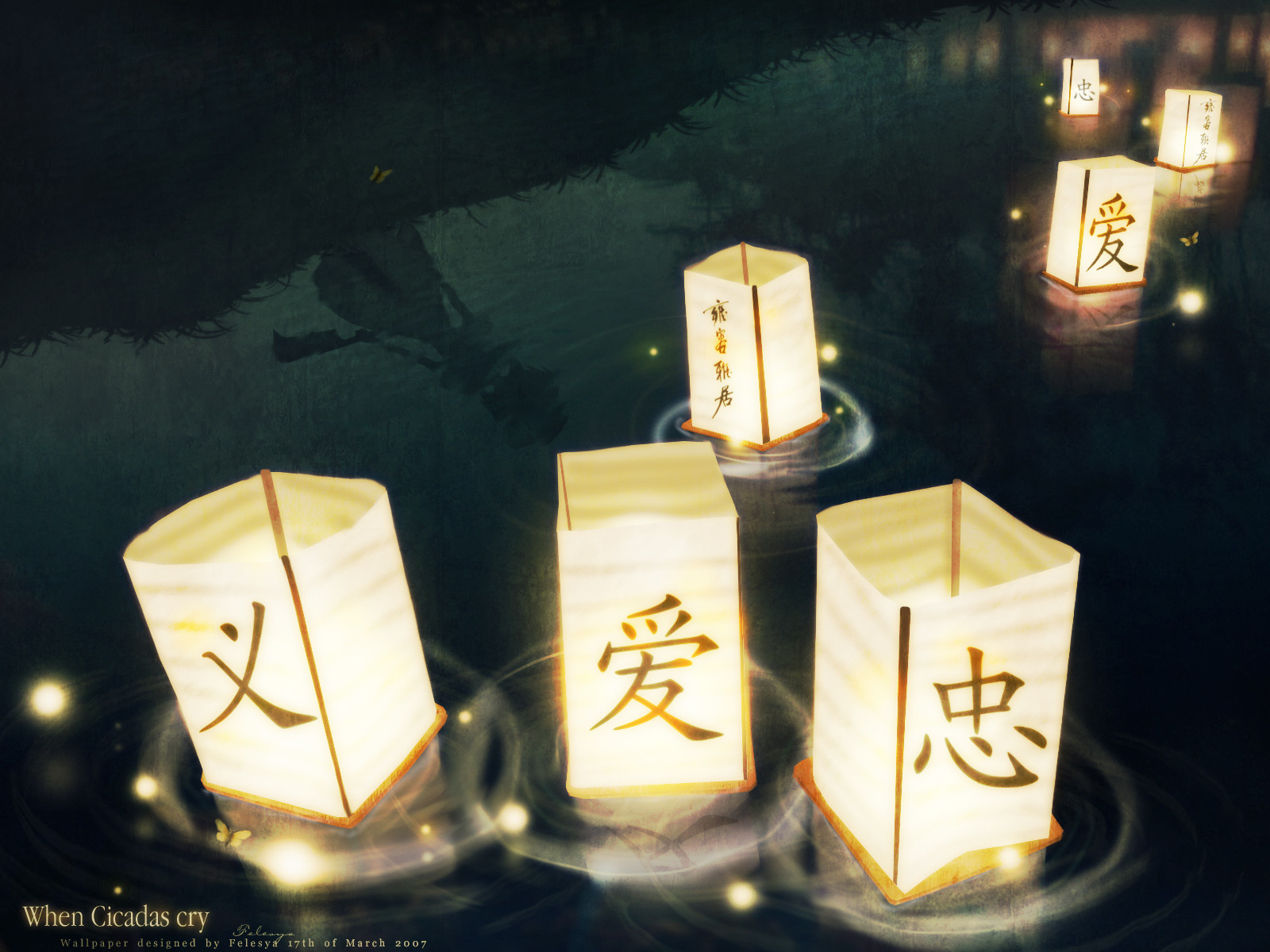
This isn’t horror as spectacle. It’s horror as erosion. The feeling isn’t dread of what’s coming—it’s the dread of remembering wrong, of realizing your best friend’s laugh might be a mask over something ancient and hungry, or that the comforting rhythm of Hinamizawa’s festivals hides a cycle older than the town’s map. The achronological order isn’t a gimmick; it’s how trauma feels—fragments snapping into place with sickening clarity, each new episode not advancing the plot but unspooling a deeper layer of betrayal. You don’t watch to solve the mystery—you watch to survive the recognition: that safety is a story we tell ourselves, and Hinamizawa is the place where the story starts bleeding through the cracks. It makes you question every shared glance, every offhand comment, every moment of laughter—what if it’s all performance? What if I’m already inside the loop?
That same visceral, destabilizing resonance thrums through BioShock Infinite. Its description names the core tension: “Indebted to the wrong people… must rescue Elizabeth, a myst…”—but the player review cuts deeper: “I know that some people are still bitter about the Bioshock Infinite we could have gotten.” That phrase—we could have gotten—is pure When They Cry DNA. Both works weaponize possibility, making you ache for alternate outcomes only to reveal those alternatives were always poisoned, always part of the same tragic architecture. The “Time & Memory” dimension isn’t just mechanics—it’s the emotional wound: Booker’s guilt, Keiichi’s paranoia, both rooted in the unbearable weight of choices that feel free until the loop snaps shut.
Then there’s Prince of Persia: Warrior Within, hunted by Dahaka—an “immortal incarnation of Fate.” The player review calls the chase “still as goated as it was before,” but what lingers isn’t just adrenaline—it’s the inescapability. Dahaka doesn’t stalk the Prince across sandstone corridors; it stalks him through time, a physical manifestation of consequence closing in. Like Keiichi sprinting down Hinamizawa’s winding roads, knowing no turn will truly escape the next Watanagashi Festival, the Prince’s frantic parkour isn’t about victory—it’s about delaying the inevitable reckoning. The “Body Horror & Occult” tag mirrors the anime’s grotesque transformations—not just gore, but the horror of your own flesh becoming alien, your mind unraveling under the strain of temporal recursion.
And TimeShift™, where Dr. Krone’s “reckless act” births a “disturbing alternate reality”—that’s Hinamizawa’s curse distilled. The game’s description doesn’t promise salvation; it promises consequences, a reality warped beyond recognition by tampering with causality. The player review calls it “a blast” but admits it “takes a little work to get it into a playable state”—a perfect echo of When They Cry’s demand on the viewer: you must struggle to orient yourself, to reconcile contradictory timelines, to accept that coherence is the illusion, not the fracture.
These aren’t for the casual viewer who wants clean answers or heroic arcs. They’re for the person who keeps rewatching the first episode of When They Cry, not to catch clues, but to feel that initial, sunlit innocence before the cicadas start screaming—and then watches again, knowing exactly when the light begins to curdle. For the player who replays Warrior Within not for mastery, but to feel that gut-punch of Dahaka’s hand closing on their shoulder again, because the horror isn’t in escaping—it’s in understanding you were never meant to. They love the ache of memory, the weight of time, the sickening thrill of realizing the monster isn’t outside the door—it’s in the reflection, in the friend’s smile, in the very rhythm of your own heartbeat counting down to the next loop.
🎮27 Games That Match the Vibe




Match Dimensions Explained
❓Frequently Asked Questions
Why does Prince of Persia: Warrior Within feel so much like When They Cry despite having no visual novels or crying scenes?
It’s all about that oppressive, guilt-soaked time-loop dread—like when Shiki in *Higurashi* keeps reliving the same summer night, only here it’s the Dahaka hunting you across crumbling timelines. The game’s dark fantasy tone, body horror (those grotesque time-corrupted enemies), and how your choices literally fracture memory and identity hit the same emotional nerve as *When They Cry*’s psychological unraveling—especially during those breathless rooftop chases where past and present bleed together.
Is there an anime or live-action adaptation of TimeShift like there is for Higurashi or Umineko?
Nope—TimeShift has never been adapted beyond its original 2007 release, unlike *When They Cry*’s sprawling anime/manga universe. It’s a self-contained, tightly wound time-paradox thriller: Dr. Aiden Krone jumps into a warped alternate reality where his own experiments birthed body-horror monstrosities, and the whole 4-hour experience leans hard into occult sci-fi ambiguity—not exposition or lore dumps—so it never needed (or got) a spin-off series.
How does BioShock Infinite compare to Prince of Persia: The Two Thrones for fans of When They Cry’s tragic romance and time twists?
Both hinge on doomed love across fractured timelines—but *Two Thrones* gives you the Prince’s internal split (light/dark selves) mirroring Kaileena’s fate, while *Infinite* makes Elizabeth *literally* a multiversal anchor whose memories collapse like *Umineko*’s ‘truths’. Booker’s final baptism scene hits with the same devastating weight as Rika’s loop-breaking sacrifice—just swapped out for lighthouses and quantum grief instead of rice cakes and shrine bells.
What’s the best When They Cry-like game if I want that heavy, melancholy ‘adult dark seinen’ vibe with slow-burn tragedy—not jump scares or action?
Go straight to *Prince of Persia: The Sands of Time*. Yes, it’s got parkour—but listen to the Prince’s weary, reflective narration as he recounts how the Dagger’s power corrupted him and cost him Farah, and how every rewind feels less like a cheat and more like a desperate, failing act of atonement. Its ‘Adult & Dark Seinen’ dimension matches *When They Cry*’s tonal gravity, especially in quiet moments like the ruined palace gardens where time itself feels like a character whispering regrets.