Kuromukuro
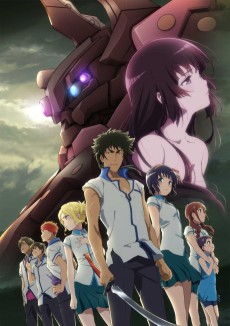
During the construction of the Kurobe Dam, an ancient artifact was discovered, and so the United Nations Kurobe Research Institute was established. Intellectuals from all over the world gathered to study the object, and the children of those researchers attend Mt. Tate International Senior High School, including the institute head's daughter, Yukina Shirahane. In the summer of 2016, a lone samurai once again awakens!
(Source: Pony Canyon USA)
📺Anime Details
📝Editorial Analysis
The hum of the Kurobe Dam’s turbines vibrates through concrete and bone—not as background noise, but as a pulse, low and ancient, like something buried deep is remembering how to breathe. That’s the first real feeling of Kuromukuro: not explosion, not speech, not even Yukina Shirahane stepping onto the sun-baked courtyard of Mt. Tate International Senior High School—but the weight of time pressing down, then snapping sideways when the artifact stirs and the samurai rises, not from myth, but from geology. His armor isn’t polished steel—it’s fused with sediment, lichen, and the slow crush of millennia. He doesn’t speak in proverbs. He moves like tectonic plates shifting: deliberate, irreversible, heavy.

What makes Kuromukuro’s atmosphere singular isn’t its mecha or aliens—it’s how it treats scale as emotion. The UN research institute isn’t just a lab; it’s a cathedral built over a wound in time. The school isn’t a trope—it’s a fragile bubble of adolescence suspended above that wound, where calculus homework and alien incursions share the same fluorescent lighting. You feel the tension between the ordinary and the epochal—not as spectacle, but as dread, wonder, and quiet, stubborn care. This isn’t war as heroism or tragedy alone. It’s war as continuity: scientists calibrating sensors while their children rehearse for cultural festivals, soldiers adjusting targeting arrays while listening to radio static that sounds eerily like wind through dam spillways. The feeling is grounded awe—like standing at the base of a glacier and realizing you’re not watching ice melt—you’re watching time leak.
That grounded awe echoes sharply in Lost Planet™: Extreme Condition, where humanity fights not on starships or neon cities, but on ice-covered wastelands—a frozen, hostile Earth analogue where survival means reading terrain like scripture. Its description names “gargantuan alien Akrid” and “treacherous Snow Pirates,” but what resonates is the physicality: the crunch of snow under armored boots, the way heat signatures flicker in subzero air, the sheer bodily cost of combat in an environment that predates human memory. A player review laments Capcom’s failure to fix “Colonies Edition”—a longing for coherence, for systems that hold up under pressure, just as Kuromukuro’s characters strain against the weight of inherited duty and unstable chronology.
Then there’s Supreme Commander, where war isn’t won in minutes but centuries, waged across continents by machines that dwarf cities. Its description frames “The Infinite War” as ideological absolutism made manifest—“There can be no room for compromise: their way is the only way.” That’s the chilling parallel: Kuromukuro’s aliens don’t invade for resources or conquest—they operate on a logic so vast and alien it renders diplomacy geologically irrelevant, like arguing with continental drift. A player review praises how “the scale of the battles” feels different even today—not flashy, but architectural, where every unit placement echoes consequence. That’s the same gravity that makes Yukina’s classroom debates about temporal ethics land with the weight of treaty negotiations.
Even Team Fortress 2, at first glance pure cartoon chaos, shares a sliver of this DNA—not in tone, but in structure. Its description highlights “nine distinct classes [that] provide a broad range of tactical abilities and personalities,” and a player review notes the “fun and chaotic” energy—but crucially, the community described is wildly, messily human: “gay, racist, sexist, gay, artistic, gay, furries, and love men.” That unfiltered, contradictory, living ensemble—flawed, loud, irreverent, fiercely loyal—is the emotional bedrock of Kuromukuro’s Mt. Tate student body and military staff alike. They don’t bond over shared ideology; they bond over shared space, shared pressure, shared lunchboxes under the shadow of something far older than nations.
This pairing isn’t for fans of “mecha action” as genre wallpaper. It’s for the person who pauses mid-battle in Lost Planet™ to watch steam rise from a fallen mech into the violet twilight—and feels small, not scared. It’s for the one who watches Supreme Commander’s orbital strike ripple across a continent-sized map and thinks, that’s how history actually happens: slowly, then all at once. It’s for the viewer who hears Yukina recite a physics equation while a time fracture glows behind her classroom window—and doesn’t look away, because the ordinary is where the awe lives. They’re the ones who don’t want to win the war. They want to understand what it sounds like when time remembers itself—and who shows up, armed with notebooks and rifles and terrible jokes, to listen.
🎮30 Games That Match the Vibe







Match Dimensions Explained
❓Frequently Asked Questions
Why does Kuromukuro’s final battle with the Kurogane Unit feel so similar to Lost Planet: Extreme Condition’s Akrid boss fights?
Because both hinge on high-stakes, mobile mecha combat against colossal, biomechanical threats in hostile environments—like Kuromukuro’s snowbound clash with the Kurogane Unit mirroring Lost Planet’s frozen wastelands and Akrid battles where you dodge sweeping tentacle swipes while managing thermal loss. The frantic pace, environmental hazards (blizzards vs. ice quakes), and emphasis on weak-point targeting on massive armored foes are dead ringers—reviewers even noted how Lost Planet ‘makes you feel tiny but scrappy against god-sized aliens,’ just like Kuromukuro’s underdog mecha duels.
Is there a Kuromukuro video game adaptation?
No—there’s no official Kuromukuro game, which is why fans lean hard into matches like Supreme Commander or Lost Planet: Extreme Condition for that same blend of tactical mecha warfare and interstellar stakes. Supreme Commander delivers the scale and ideological weight (think Kuromukuro’s UN vs. rogue AI conflict), while Lost Planet nails the visceral, close-quarters survival vibe—but neither is a direct adaptation, just spiritually aligned stand-ins.
How does Tribes: Ascend compare to Mr. Robot in terms of mecha storytelling and sci-fi tone?
Tribes: Ascend is pure kinetic, team-based arena chaos—no story, no characters like Asimov from Mr. Robot, just fast-paced jetpack-and-rifle mayhem across sci-fi battlefields. Mr. Robot, meanwhile, is a quiet, retro-futuristic narrative adventure with light Mega Man Battle Network–style exploration and melancholy AI themes aboard the colony ship Eidolon. One’s about squad tactics and movement; the other’s about isolation, malfunction, and mechanoid identity—same mecha & military sci-fi dimension, totally different vibes.
What’s the best game like Kuromukuro if I want that intense, grounded tactical mecha vibe—not flashy anime energy, but boots-on-the-ice realism?
Lost Planet: Extreme Condition is your pick: it drops you into frozen hellscape missions where you’re constantly managing heat, ammo, and terrain while fighting Akrid that *feel* as physically imposing and threatening as Kuromukuro’s Kurogane Units. Reviewers called it ‘brutal survival’ with ‘no hand-holding’—exactly the grounded, desperate, gear-grinding tension you get when Kenji pilots the Yatsurugi in those blizzard-battered city ruins.