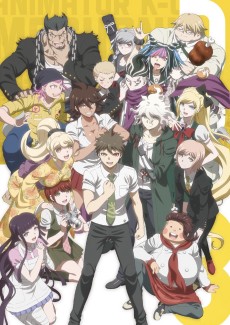
Danganronpa 3: The End of Hope's Peak High School - Hope Arc
The Future Foundation is in shambles after the Final Killing Game and the revelation of the true culprit. As a desperate plot arises from one of the survivors to rid the world of despair once and for all, the remaining Future Foundation members must band together to stop it. Fortunately, they find themselves with help from a group of unlikely allies as they race against the clock to stop their world from being changed.
As a direct continuation of Mirai-hen, Kibou-hen serves as the finale to the Hope's Peak storyline of the Danganronpa series.
📺Anime Details
📝Editorial Analysis
The air in the Future Foundation’s ruined command center tastes like burnt wiring and old blood—metallic, acrid, thick with the silence after a scream has been cut off. Not the scream itself, but the hollow, ringing vacuum left behind when someone you trusted pulls the trigger—not at an enemy, but at the last fragile thread holding hope together. That’s the heartbeat of Danganronpa 3: The End of Hope's Peak High School - Hope Arc: not despair as spectacle, but despair as procedure—calmly administered, logically justified, dressed in tactical gear and grief-soaked speeches.
What makes it ache so deeply isn’t the gore or the guns—it’s how adult the pain feels. These aren’t students playing at tragedy; they’re survivors who’ve already buried friends, rewritten their own memories, and now face a final choice where every “right” answer demands a sacrifice that hurts more than dying. The school is gone. The classroom debates are over. What remains is a war room lit by flickering monitors, where loyalty is measured in milliseconds, and love is weaponized as both motive and alibi. You don’t just watch characters break—you hear the crack in their voices when they lie to protect someone, and you know the lie will cost them everything. It’s psychological weight made physical: the tremor in a hand reloading a pistol, the way a sword is drawn not for flair, but because it’s the only thing left that still means something.
That same suffocating gravity lives in BioShock™, where Rapture isn’t just a setting—it’s ideology made concrete, then shattered. Like the Future Foundation, it’s a utopia built on brilliant ideals that curdled into dogma, enforced by weapons and warped logic. The player review calls it “revolutionary”—and it is, because it forces you to inhabit the collapse: every plasmid upgrade, every audio diary, every corpse slumped beside a broken Little Sister machine whispers the same truth Hope Arc screams in its quietest moments—that hope, when untethered from empathy, becomes just another kind of control. Both make you question whether salvation requires erasure—and whether you’d pull the trigger if you believed hard enough.
Then there’s BioShock Infinite, where Booker DeWitt doesn’t storm Columbia to win, but to unmake—to erase a timeline where love curdled into tyranny, where a girl became a weapon, and a savior became a symbol of infinite suffering. Its description names Elizabeth as “a myst[ery]”—just as Hope Arc treats Makoto Naegi not as a hero, but as a catalyst, a living paradox whose very presence destabilizes certainty. The player review admits bitterness—but also says, “after…” —that trailing ellipsis is the emotional signature shared with Hope Arc: the exhaustion of surviving multiple endings, the dizziness of realizing your victory might be someone else’s damnation. Both refuse catharsis. They offer reckoning instead.
And Uplink—oh, Uplink—with its cool, precise hacking interface and that player review quoting “It was hot, the night we burned Chrome”: it shares Hope Arc’s obsession with systems. Not just dystopian systems, but human ones—firewalls of trust, encryption protocols of denial, backdoors of memory. In Hope Arc, characters don’t just fight enemies—they bypass each other’s psychological firewalls, deploy counter-narratives like zero-day exploits, and sometimes, tragically, choose to crash the whole network rather than let it run corrupted. Uplink doesn’t give you armies or speeches—it gives you a terminal, a deadline, and the chilling freedom to decide whose truth gets deleted. That cold, focused dread? That’s the same pulse thrumming beneath Hope Arc’s most devastating silences.
This pairing isn’t for fans of “cool fights” or “twisty plots.” It’s for the person who watches Makoto lower his gun—not because he’s won, but because he’s finally understood the cost—and then boots up BioShock™, not to shoot splicers, but to stare at Andrew Ryan’s corpse and whisper, “I see you.” It’s for the player who runs Uplink at 3 a.m., fingers hovering over the “wipe server” command, heart pounding—not from adrenaline, but from the weight of knowing no system is neutral, no choice clean, and every act of preservation is also an act of erasure. They’re the ones who don’t flinch at gore, but lean in at the moment a character chooses mercy over logic—and then quietly closes the laptop, staring at the ceiling, thinking about what they’d burn to keep one person alive.
🎮38 Games That Match the Vibe













Match Dimensions Explained
❓Frequently Asked Questions
Why is BioShock often compared to Danganronpa 3: Hope Arc despite having no trial mechanics?
Because both use tightly wound, morally claustrophobic narratives where hope is weaponized and then shattered—like when Booker DeWitt realizes Elizabeth’s true nature in BioShock Infinite’s lighthouse scene, or when Makoto Naegi confronts the twisted logic of 'hope' in Hope Arc’s final classroom confrontation. They share that same Adult & Dark Seinen intensity, layered world-building, and a gut-punch twist that recontextualizes everything you thought you knew.
Is there a Danganronpa 3 anime adaptation that covers the Hope Arc faithfully?
Yes—the 2016 anime *Danganronpa 3: The End of Hope's Peak High School - Hope Arc* is the official adaptation, and it sticks closely to the game’s script, especially key scenes like Hajime Hinata’s silent breakdown after learning about Izuru’s betrayal and the final broadcast where Chiaki’s AI voice echoes over the ruined school. It’s not a game, but it’s the definitive visual companion—and if you loved that tone, BioShock Infinite delivers similar emotional whiplash with its Columbia reveal and Songbird motif.
How does Uplink compare to Danganronpa 3’s Hope Arc in terms of tone and pacing?
Uplink trades Hope Arc’s rapid-fire dialogue and theatrical despair for slow-burn cyberpunk tension—think late-night hacking sessions instead of classroom trials—but both nail that oppressive, ‘no way out’ vibe: Uplink’s ‘It was hot, the night we burned Chrome’ review quote mirrors how Hope Arc makes you sweat through every countdown to disaster. Neither offers easy hope; they just let you choose how deep into the system you want to go—whether it’s Rapture’s lies or Hope’s Peak’s final lie.
What’s the best game like Danganronpa 3: Hope Arc if I want that same desperate, high-stakes ‘last stand’ feeling?
BioShock 2 fits that mood perfectly—especially the harrowing Little Sister rescue sequences where you’re hunted through Rapture’s flooded halls by Big Daddies, echoing Hope Arc’s ticking-clock tension during the final broadcast. The player review calling it ‘crash-prone but unforgettable’ nails it: it’s flawed, urgent, and emotionally raw—just like watching Kazuo Tengan’s plan unfold while Makoto tries to hold everyone together in that crumbling school.