
Nekomonogatari Black
First season of the Monogatari Series, part 6/6. Contains the arc Tsubasa Family from the Nekomonogatari Black light novel.
On his way to the bookstore, Koyomi Araragi encounters Tsubasa Hanekawa whose face is covered with a bandage. The incident allows Koyomi to learn what has been happening in the Hanekawa household, but Tsubasa begs him not to tell anyone about it, saying she’ll do anything to keep him quiet. Without revealing her family’s circumstances, Koyomi tells of the day’s incident - he and Tsubasa buried a “cat” that had been hit by a car- to Meme Oshino. Meme tells Koyomi that he must immediately go to confirm Hanekawa’s safety. He heads to her house, only to find...
So begins the nightmarish nine days of Golden Week.
(Source: Aniplex)
📺Anime Details
📝Editorial Analysis
The bandage. Not the blood beneath it, not the silence that follows—but the bandage: white, too clean, wound tight around Tsubasa Hanekawa’s face like a vow she didn’t choose to make. Koyomi Araragi sees it on a sidewalk outside a bookstore, ordinary light catching its edges, and in that second, time doesn’t just stutter—it fractures. There’s no music swell, no dramatic pause—just the low hum of city air, the weight of unspoken violence clinging to her posture, and the quiet, suffocating dread of knowing something is wrong but being told—pleaded—not to name it.
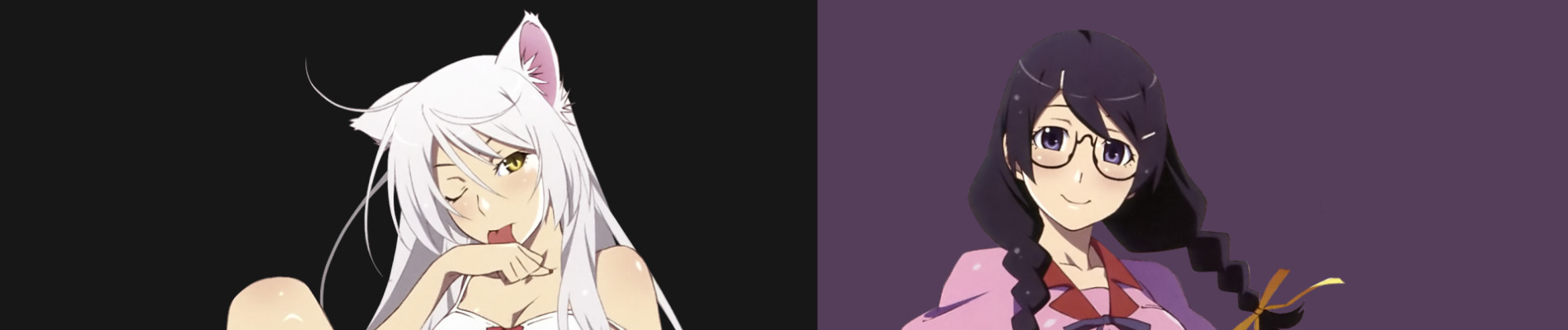
That’s Nekomonogatari Black: not horror as spectacle, but horror as proximity. It doesn’t live in jump scares or monster reveals—it lives in the gap between what’s said and what’s withheld, in the way a teenage girl folds her hands just so to hide trembling fingers, in the way memory loops backward not for style, but because trauma refuses linear time. This isn’t urban fantasy dressed up—it breathes urban fantasy: rain-slicked alleys where streetlights flicker like failing synapses, classrooms humming with repressed panic, conversations that coil like smoke—evasive, thick, half-remembered. You don’t watch it; you inhabit its dissonance. It makes you feel unmoored, then hyper-aware, then guiltily complicit—as if your own silence, your own hesitation to look too closely, is part of the architecture holding the world together. It asks: What does it cost to witness? What does it cost not to?
Vampire: The Masquerade - Bloodlines shares that same suffocation. Its Dark Fantasy isn’t about castles or curses—it’s about the body turning against itself (Body Horror & Occult), about identity dissolving under pressure (Dissociative Identities), about choosing which truth to bury to survive (Adult & Dark Seinen). Like Koyomi walking past Hanekawa’s house, hearing muffled shouts through thin walls but stepping faster—so too does Bloodlines force you into morally compromised silences: feeding to live, lying to blend in, watching systems collapse while your own reflection fractures in a grimy club mirror. The player review’s plea—“BUY IT ON GOG; if you want to use the steam version you need to download the unofficial patch…”—mirrors the anime’s own unstable infrastructure: both demand active, almost archival engagement—not passive consumption, but reconstruction. You’re not handed coherence. You patch it together, breath held.
Alice: Madness Returns doesn’t just visit Wonderland—it unravels there. Its Victorian London isn’t backdrop; it’s a nervous system made brick and fog, where every cobblestone pulses with suppressed grief. Like Hanekawa’s bandaged face hiding fractures no doctor can suture, Alice’s world bleeds psychological rupture into physical space: teeth sprout from floorboards, dolls whisper in distorted voices, and the line between asylum and asylum is the story. The description nails it: “Visit the grim reality… and travel to the beautiful yet ghastly Wonderland to uncover the root…” That “root” isn’t plot—it’s cause, buried deep in childhood violation, mirrored in Nekomonogatari Black’s refusal to let Hanekawa’s home life stay offscreen. And the player’s frustrated, devoted tone—“I will not refund this game because it ‘kinda’ works for me (after editing config files manually)”—echoes how fans of the anime don’t watch for ease, but for resonance in the brokenness: the willingness to tinker, to adjust, to sit with glitchy, imperfect delivery because the feeling—raw, jagged, true—is worth the labor.
Thief: Deadly Shadows completes the triad—not with gore or transformation, but with the weight of observation. Garrett doesn’t fight to win; he moves through spaces saturated with consequence. Every creak of floorboard, every guard’s idle mutter, every locked drawer behind velvet rope carries history, shame, power. Like Koyomi listening at Hanekawa’s door, knowing what he hears could shatter everything—and choosing, agonizingly, how much to know. The review calls it “rich atmosphere and the world feels alive…”—and that’s the key: not “alive” as in cheerful, but alive as in breathing, watching, remembering. A hallway isn’t empty. A silence isn’t neutral. Both Nekomonogatari Black and Thief: Deadly Shadows treat space as testimony.
This pairing isn’t for fans of tidy resolutions or heroic arcs. It’s for the ones who pause mid-scene—not to check their phone, but to replay the glance, the hesitation, the way light falls just wrong on a wall. It’s for people who’ve ever swallowed a scream, edited a confession, or walked past a closed door they knew shouldn’t be closed—and felt the echo in their ribs. They don’t want escape. They want recognition. And in that bandage, that vampire’s fang, that thief’s shadow, that doll’s grin—they find it: sharp, aching, and unforgettably real.
🎮29 Games That Match the Vibe







Match Dimensions Explained
❓Frequently Asked Questions
Why does Vampire: The Masquerade - Bloodlines keep coming up in Nekomonogatari Black comparisons?
Because both dive deep into psychological unraveling and morally gray urban occultism—like when Neko’s fragmented identity mirrors the Kindred’s degeneration mechanics in Bloodlines, where your vampiric nature physically warps you (think Gangrel claws or Nosferatu deformities) as sanity erodes. The game’s rain-slicked, neon-drenched Los Angeles feels like a live-action version of Nekomonogatari’s distorted, emotionally claustrophobic Tokyo streets.
Is there an anime or visual novel adaptation of Heretic: Shadow of the Serpent Riders?
No—Heretic is purely a classic 90s FPS with no official anime, manga, or VN spin-offs. But its vibe *feels* like a lost Monogatari side story: you play a Sidhe elf cursed by the Serpent Riders’ body horror magic, and that ‘last heretic’ isolation echoes Neko’s self-loathing monologues in Black—especially during boss fights where your own form starts twisting mid-spellcast, just like Neko’s unstable physicality during emotional breakdowns.
How does Alice: Madness Returns compare to Thief: Deadly Shadows for Nekomonogatari Black fans?
Alice leans into surreal psychological disintegration—like Neko’s hallucinatory shifts between reality and delusion—while Thief nails atmospheric dread and quiet tension, mirroring Neko’s predatory stillness before she strikes. Both use Victorian London and steampunk-tinged shadows respectively, but Alice’s Wonderland glitches (e.g., teeth sprouting from wallpaper, time stuttering in asylum corridors) hit closer to Neko’s reality-bending narration than Thief’s grounded stealth—though Garrett’s moral ambiguity and voiceover monologues are *very* Monogatari-esque.
What’s the best game like Nekomonogatari Black if I want that same unsettling, intimate, emotionally raw vibe?
Go straight to Alice: Madness Returns—it’s the closest match for that fragile, first-person-psychological intimacy. When Alice stares into cracked mirrors and sees her reflection peel away layer by layer, it’s pure Neko energy; the way Victorian London bleeds into grotesque Wonderland (with clockwork limbs, screaming teacups, and decaying dolls) mirrors how Neko’s cuteness masks rotting self-hatred. Even the janky config-file fixes players mention? Feels like part of the experience—like Neko’s deliberately unstable, glitchy delivery.