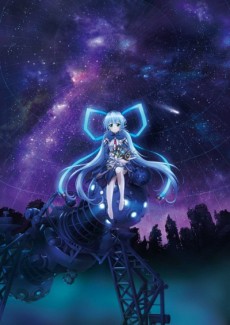
Planetarian
Hoshino Yumemi is a companion robot working at an abandoned planetarium. It’s been thirty years since her last customer, but she continues to wait. When a customer finally appears, she enlists his help to fix the planetarium so she can show him the stars.
(Source: Crunchyroll)
📺Anime Details
📝Editorial Analysis
The projector whirs to life—not with a roar, but a fragile, trembling hum—as dust motes swirl in the single shaft of light piercing the cracked dome. Yumemi’s voice, steady and soft as worn velvet, begins narrating constellations no human has seen in thirty years. Her fingers hover over the console, not pressing, just waiting—not for commands, but for permission to matter again. That silence between her words and the protagonist’s breath? That’s where Planetarian lives: in the weight of devotion that outlives its purpose.
This isn’t despair dressed as sci-fi. It’s tenderness fossilized in rust and starlight. The atmosphere isn’t bleak because the world ended—it’s hushed, like kneeling in an empty cathedral where the stained glass still holds color, and the altar still smells faintly of incense. You don’t feel dread; you feel reverence—for memory, for ritual, for the quiet courage of continuing a function no one asked you to fulfill. It makes you think about legacy not as monuments or monuments, but as a single line of code that refuses to delete itself, as a greeting repeated into silence, as a show prepared for an audience that never arrives. There’s no grand mythology invoked—just the quiet, stubborn persistence of meaning in a place where meaning has been erased.
Among the matches, S.T.A.L.K.E.R.: Shadow of Chernobyl resonates—not through action, but through atmosphere-as-character. Its Zone isn’t just dangerous; it’s haunted by absence, layered with abandoned labs, silent watchtowers, and radios whispering static like ghosts trying to reassemble syntax. The player review notes how “the map is big and beautiful…”—and yes, it is—but beauty here is desolate, reverent, almost sacred in its decay. Like Yumemi polishing lenses in an empty dome, the S.T.A.L.K.E.R. walks past rusted Ferris wheels and collapsed observatories, sensing presence in vacancy. Both ask you to move slowly, not out of fear alone, but out of respect—for what was, for what remains, for what might still be listening.
Dreamfall: The Longest Journey, too, shares this DNA—not in setting, but in emotional cadence. Its player review says: “It's less a long journey than a long drama. And somehow, the drama is compelling enough that you keep watching scene after scene…” That’s Planetarian’s heartbeat: slow, deliberate, unspooling not through plot escalation but through accumulated intimacy. Yumemi doesn’t evolve via revelation—she deepens through small choices: adjusting the projector angle, correcting a mispronounced star name, pausing mid-sentence when the protagonist coughs. Dreamfall mirrors that—its power lies in lingering on glances, silences, the way grief settles into a character’s posture over hours. Neither story needs villains or battles; their tension is existential tenderness, stretched thin across time.
And then there’s Chains, the outlier—a match-3 game described as “relaxing” and “physics-driven,” with a player comparing it to Connect 4. But look closer: its core loop is linking, connecting, repeating until alignment becomes possible. That’s Yumemi’s entire existence—linking memory to motion, protocol to poetry, star charts to shared breath. The review calls it “simple… the challenge comes from increasingly difficult physics-driven l[ogic].” In Planetarian, the physics are emotional: gravity isn’t measured in m/s², but in how long it takes a robot to lower her gaze after asking, “Do you believe in stars?”—and how long the silence hangs before the answer. Both operate in quiet systems where connection isn’t explosive—it’s precise, fragile, and repeated until something luminous emerges.
This pairing isn’t for fans of apocalypse-as-spectacle. It’s for the person who pauses mid-game to watch rain pool in a cracked pavement texture, who saves a journal entry not for lore, but because the handwriting looks tired and kind, who feels a lump in their throat when a non-player character says “Goodnight” one last time—and means it. They’re the ones who understand that the most devastating tragedy isn’t loss, but continuation: the robot who remembers every customer, the survivor who names every crater, the player who replays a quiet dialogue branch just to hear that voice say “I’m still here.” They don’t seek catharsis—they seek witnessing. And in that hush between frames, between bullets, between bubbles linking in sequence, they find it.
🎮34 Games That Match the Vibe






Match Dimensions Explained
❓Frequently Asked Questions
Why is S.T.A.L.K.E.R.: Shadow of Chernobyl listed as similar to Planetarian when it’s a gritty FPS and not a visual novel?
Great question — it’s about shared emotional texture, not genre. Like Planetarian’s quiet, haunting scenes in the ruined observatory with Yumemi, S.T.A.L.K.E.R. delivers profound loneliness and melancholy amid decay (think the abandoned Pripyat hospital or the silent, fog-draped Swamps). Both use oppressive atmosphere and quiet introspection — not action — as core emotional engines, even though one uses bullets and the other bento boxes and star charts.
Is there an anime or movie adaptation of Chains like there is for Planetarian?
No — Chains has no anime, manga, or film adaptation. It’s purely a match-3 puzzle game with physics-based bubble linking (like connecting three red bubbles to clear them), and its emotional narrative is minimal and abstract — nothing like Planetarian’s deeply personal, voice-acted story with Yumemi and the projector scene. The only ‘adaptation’ is the player review comparing it to Connect 4, which tells you everything you need to know!
How does Dreamfall: The Longest Journey compare to Planetarian in terms of emotional payoff?
Both hinge on slow-burn emotional weight, but Dreamfall leans into layered human drama — like Zoë’s grief-stricken journey across parallel worlds — while Planetarian distills feeling into single, crystalline moments (e.g., Yumemi reciting star names as the power fades). Player reviews call Dreamfall ‘a long drama’ that hooks you scene after scene, much like Planetarian’s final 90 minutes — just with more dialogue trees and fewer robots serving tea.
What’s the best Planetarian-like game if I want that quiet, reflective, post-apocalyptic vibe — not action or puzzles?
Go straight to Dreamfall: The Longest Journey — it nails the mood without combat or crafting. Its dystopian ‘Arcadia’ half mirrors Planetarian’s decaying world through rain-slicked cyberpunk alleys and abandoned train stations, and characters like Crow or Kian carry the same weary tenderness as Yumemi. Unlike RAGE or Nuclear Dawn (which are dead-server shooters) or Chains (a bubbly match-3), Dreamfall lets you *breathe* in the sadness — exactly like watching stars flicker through cracked glass.