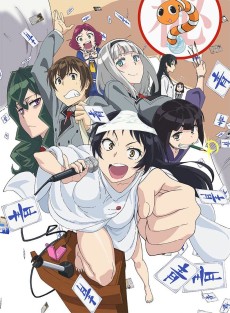
SHIMONETA: A Boring World Where the Concept of Dirty Jokes Doesn’t Exist
The novel's story is set 16 years after the "Law for Public Order and Morals in Healthy Child-Raising" banned coarse language in the country. Tanukichi Okuma enrolls in the country's leading elite public morals school and is soon invited into the Anti-Societal Organization (SOX) by its founder, Ayame Kajou. As a member blackmailed into joining by Ayame, Tanukichi ends up taking part in obscene acts of terrorism against the talented student council president Anna (for whom Tanukichi has a crush).
(Source: Anime News Network)
📺Anime Details
📝Editorial Analysis
The fluorescent lights of the school hallway hum like trapped wasps—too bright, too sterile—as Tanukichi Okuma stands frozen, clipboard in hand, while Ayame Kajou presses a freshly printed flyer against his chest: “SOX Declares War on Semantic Purity”, the headline rendered in dripping, ink-smeared kanji. Her smile doesn’t reach her eyes—not because it’s cold, but because it’s loaded: every syllable she speaks is a live wire stripped of insulation, every gesture a calculated detonation in a world where even the word “thigh” triggers a morality audit. You don’t laugh at the absurdity—you laugh because your throat tightens, because the joke lands like a slap you didn’t know you needed.
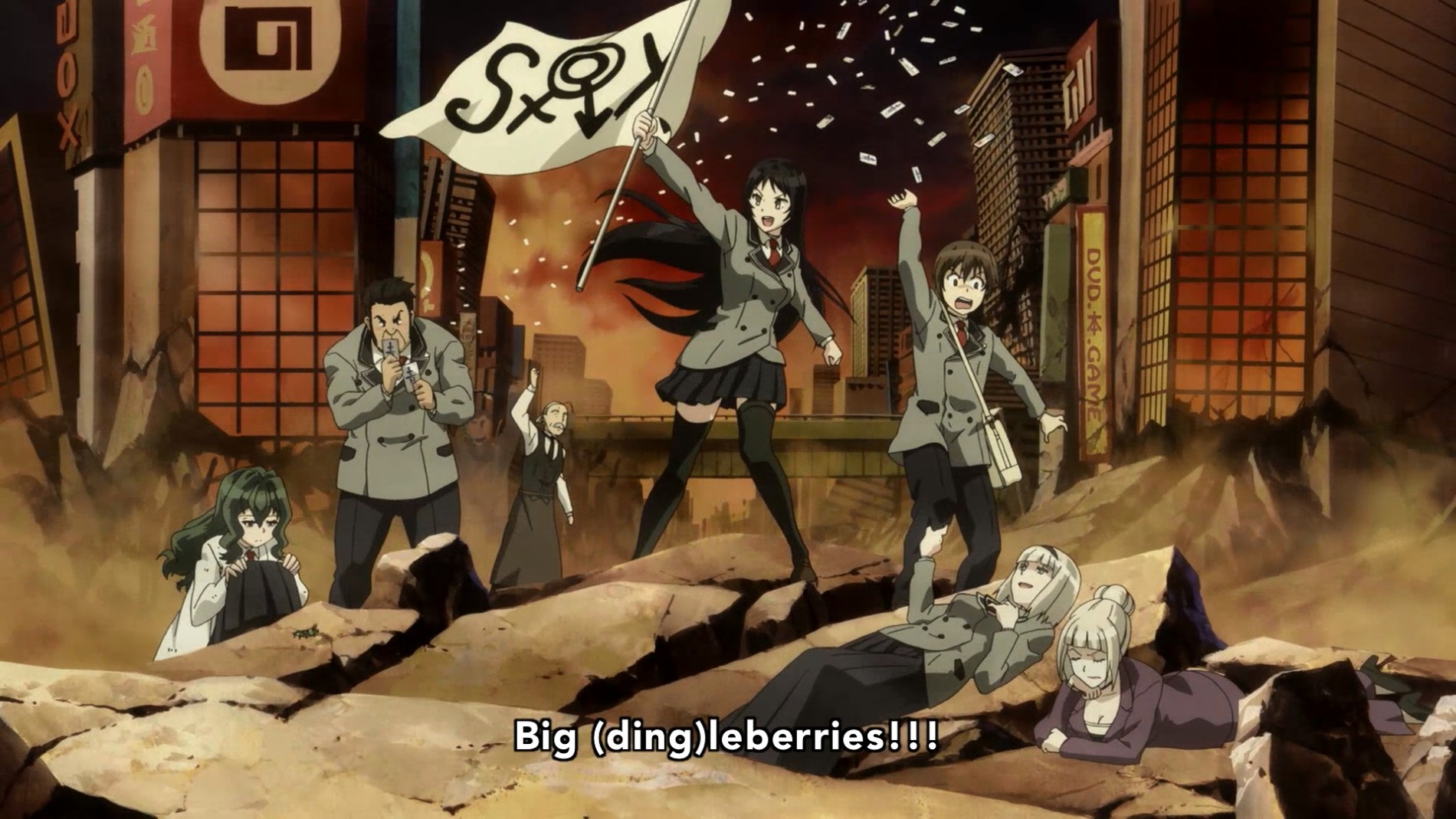
That’s the feeling SHIMONETA lives inside: tense euphoria. Not just satire, but satire with sweat on its upper lip—where political control isn’t enforced by tanks or surveillance drones, but by grammar police and mandatory euphemism drills. It’s not dystopia as ruin; it’s dystopia as over-polished surface, where repression wears a blazer and recites poetry about “the sanctity of unambiguous nouns.” You feel the itch of suppressed language in your molars. You think about how power doesn’t always shout—it edits, redacts, and then rewards compliance with extra pudding at lunch. The comedy isn’t despite the stakes—it is the stakes. Every double entendre smuggled into a student council debate, every “obscene act of terrorism” that’s really just a well-placed pun chalked on a statue—it all pulses with the giddy, dangerous thrill of linguistic sabotage.
That same voltage crackles through Disco Elysium - The Final Cut, where ideology isn’t abstract—it’s a skill tree you roll dice against, a voice in your head arguing whether “capital can subsume all critiques into itself.” The player review nails it: “It’s a cruel irony…”—just like SHIMONETA’s world, where moral purity laws are weaponized by the very elites who profit from their enforcement. Both works trap you in systems so absurdly rigid they become surreal, yet never lose their emotional weight: the exhaustion of performing virtue, the relief of slipping a forbidden thought past the censors—even if it’s just a sigh disguised as static.
Then there’s BioShock™, where Rapture’s gleaming Art Deco decay mirrors SHIMONETA’s elite public morals school: both are utopias built on a single, brittle idea—objectivism in one, linguistic hygiene in the other—and both collapse under the weight of their own dogma. The player review calls it “one of the most revolutionary games ever”—not for its guns, but for how it makes ideology visceral, turning philosophy into splicers, plasmids, and echoing hallways. SHIMONETA does the same: Anna Nishikinomiya isn’t just a rival; she’s the living embodiment of the Law’s flawless logic—so perfect, so hollow, she becomes terrifying. Both works make you question whether rebellion is liberation… or just swapping one orthodoxy for another.
And The Sims™ 4, yes—that one. Not the DLC-bloated mess the player review complains about (“insanely expensive and often broken”), but the core fantasy it promises: “Play with life and discover the possibilities.” That’s SHIMONETA’s secret engine. SOX doesn’t blow up buildings—they recode reality: reassigning meaning to words, hijacking PA systems to broadcast innuendo, turning school festivals into semiotic flashpoints. Like dragging a Sim into a shower mid-argument just to watch social needs glitch, SHIMONETA treats society as a sandbox where rules are editable, not absolute. The frustration in the review—the sense of something almost free, almost alive, but throttled by design—mirrors Tanukichi’s own arc: a boy who learns that freedom isn’t absence of law, but the craft of bending it until it sings.
This pairing isn’t for fans of “edgy” jokes or easy shock. It’s for the person who rewatches the scene where Ayame redefines “public service” as “publicly servicing metaphors” and feels a jolt—not just laughter, but recognition. For the player who spends three hours in Disco Elysium debating whether truth is a skill or a flaw. For the one who walks away from BioShock humming Andrew Ryan’s speech, then pauses, unsettled, because part of it makes sense. They’re the kind of viewer who doesn’t just want satire—they want surgery, precise and scalpel-sharp, cutting open language, power, and the quiet violence of consensus. They don’t seek escape. They seek ammunition. And they’ll find it—in a flyer pressed to a chest, in a skill check rolled behind closed doors, in the echo of a phrase that shouldn’t land… but does.
🎮48 Games That Match the Vibe










Match Dimensions Explained
❓Frequently Asked Questions
Why is Prince of Persia listed as similar to SHIMONETA when it’s not even a comedy anime adaptation?
Great question—it’s the *tone and subversion* that matches: Prince of Persia (2023 reboot) leans hard into romantic-comedy banter between the Prince and Zola, with exaggerated physical gags, fourth-wall-breaking asides, and parody of shoujo tropes—like when the Prince trips mid-confession and accidentally knocks over a ceremonial fountain *twice* in one cutscene. Its ‘Romance & Shoujo’ + ‘Comedy & Parody’ dimensions align tightly with SHIMONETA’s satire of repressed desire and social awkwardness.
Is there an official SHIMONETA video game adaptation?
No—there’s never been an official SHIMONETA game. The matches you see (like Prince of Persia or The Sims 4) are algorithmic recommendations based on shared thematic DNA: taboo-bending humor, romance-as-social-sabotage, and systems where ‘innocent’ choices backfire hilariously. For example, in The Sims 4, trying to flirt while your Sim has ‘Inappropriate’ trait active triggers cringe-worthy dialogue like ‘Your aura smells like expired miso soup’—very SHIMONETA energy.
How does Disco Elysium compare to BioShock for someone who loves SHIMONETA’s mix of absurdity and heavy ideology?
Disco Elysium wins on *tonal whiplash*: its skill checks let you argue Marxist theory with a pigeon *then* fail a roll to tie your shoes—just like SHIMONETA’s classroom debates about ‘the socio-linguistic suppression of onomatopoeic vulgarity’. BioShock’s more consistent dystopian gravitas (Rapture’s crumbling art deco, Andrew Ryan’s monologues) lacks that intentional silliness—though both share ‘Political Thriller’ dimension, only Disco Elysium delivers the ‘Neon Noir’ absurdism + ‘Romance & Shoujo’ awkward intimacy (e.g., your detective’s doomed fling with the communist bartender Kim Kitsuragi).
What’s the best SHIMONETA-like game if I want chaotic, socially disastrous flirting vibes?
The Sims 4—especially with the ‘Inappropriate’ and ‘Good’ traits enabled—is your best bet. Watch your Sim attempt a heartfelt confession… only to blurt out ‘I find your earwax aesthetically compelling’ mid-sentence, triggering a public meltdown that spreads across three neighborhoods. It nails SHIMONETA’s core joke: romance as systemic failure. And unlike Assassin’s Creed or BioShock, it’s built entirely around those messy, escalating, tone-deaf social interactions—not just as flavor, but as *core mechanics*.