Place to Place
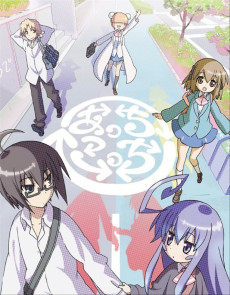
Everyone has a circle of friends they hang out with. But even within a small group there are smaller groups of friends, best friends and, here's where it gets complicated, boyfriends and girlfriends. Sometimes relationships just develop in a way where you're not exactly sure what you are to the other person. Which is the problem Tsumiki has when it comes to Io. Io's as tall and easygoing as Tsumiki is short in both temper and stature, but he also seems to be totally clueless about how she's starting to feel. Yet, at times, he's almost too affectionate. It's just confusing and irritating. And their prankster friends Mayoi and Sakaki aren't much help. Especially Mayoi, as it gives her one more thing to tease Tsumiki over. Hime, the fifth member of their usual gang of five isn't much better, because she's not really well connected to reality anyway. Which leaves Tsumiki stuck in a quandary. Are she and Io just best friends? And is it worth risking that for what Tsumiki wants?
(Source: Sentai Filmworks)
📺Anime Details
📝Editorial Analysis
The sound of Tsumiki’s slipper hitting Io’s head—thwip—echoes not as violence but as punctuation: a tiny, breathless pause in the humid afternoon air of their classroom, sunlight catching dust motes above the chalkboard. She’s already turning away, cheeks burning, hands balled at her sides, while he blinks slowly, unfazed, scratching the back of his neck like he just remembered he left the stove on. No dramatic music swells. No confession follows. Just the quiet shush of a fan spinning overhead and the unspoken weight of something tender, tangled, and stubbornly unnameable between them.

That’s the heartbeat of Place to Place: not romance as destination, but romance as atmosphere—a low-grade, persistent warmth you feel in your collarbones when someone remembers how you take your tea, or laughs just a half-second too long at your terrible pun, or lets you nap against their shoulder during club meeting without asking why. It’s iyashikei not because it soothes with silence, but because it treats emotional ambiguity like weather—something you step into, adjust to, wear lightly. The slapstick isn’t cartoonish chaos; it’s the physical language of flustered proximity—the way Tsumiki’s temper flares because she’s so close to him, the way Io’s easygoing calm isn’t indifference but deep, quiet attention disguised as obliviousness. You don’t watch to find out what happens next—you watch to feel the soft friction of two people orbiting each other in the same small, sunlit room, never quite colliding, never quite drifting apart.
Which is why The Sims™ 4, despite its jarringly negative player review about DLC costs and bugs, shares its soul with Place to Place. Its official description invites you to “Play with life and discover the possibilities”—not grand quests, but small, iterative, deeply personal rhythms: choosing a Sim’s favorite snack, watching them yawn after a nap, seeing how long it takes for two Sims to go from “acquaintance” to “best friends” to “romantically interested” through subtle, emergent interactions. That’s the same DNA: relationships unfolding in granular, unforced increments. A player complains the base game feels hollow without DLC—but that complaint itself mirrors Tsumiki’s frustration: the longing for more, not in spectacle, but in texture, in the quiet accumulation of shared glances, inside jokes, and unspoken understandings. Both ask you to invest in the mundane until it becomes sacred.
Then there’s Prince of Persia, whose description promises “an all-new epic journey” but whose listed dimensions include Healing & Slow Life—a startling, almost paradoxical pairing for a platformer. Yet the player review hints at why it resonates: it’s the third reboot, built on legacy but refusing to repeat itself—much like how Place to Place treats tsundere and kuudere archetypes not as rigid tropes, but as living, breathing contradictions. Io isn’t clueless—he’s present, in a way that makes Tsumiki’s fluster feel earned, not frustrating. That same grounded presence lives in Prince of Persia’s movement: the deliberate weight of a wall-run, the breath before a leap, the way time slows not for drama, but for precision and recovery. It’s healing not through escape, but through rhythm—just as Tsumiki heals not by resolving her feelings, but by living inside them, day after sunlit day.
And yes—even Team Fortress Classic, with its chaotic nine-class mayhem and nostalgic player review calling it “simply the best nostalgic game,” fits. Because beneath the rocket-jumping and spy-backstabbing lies something quieter: the deep, wordless camaraderie of teammates who know each other’s rhythms—the Medic who always covers the Heavy, the Scout who baits enemies just so. That’s the harem not as conquest, but as constellation: a group held together by affectionate friction, inside jokes, and the unspoken trust that even when you’re yelling at each other mid-battle, you’ll still cover each other’s flank. Place to Place’s female harem isn’t romantic competition—it’s a warm, messy ecosystem of care, where Io’s calm and Tsumiki’s fire aren’t opposites, but frequencies tuning the same wavelength.
This is for the person who replays the same 10-minute stretch of a Sim’s morning routine just to watch them make coffee exactly right, who saves before a dialogue choice not to win, but to savor the hesitation—and who, after watching Tsumiki miss Io’s hand three times trying to pass him a pencil, smiles like they’ve been handed something real, fragile, and enough.
🎮35 Games That Match the Vibe
























Match Dimensions Explained
❓Frequently Asked Questions
Why does Prince of Persia show up in 'Games Like Place to Place' matches?
It shares Place to Place’s core 'Healing & Slow Life' dimension—like wandering ancient ruins at your own pace, solving environmental puzzles with deliberate, almost meditative movement—and also taps into the same 'Adult & Dark Seinen' tone through morally ambiguous choices and weighty, character-driven stakes. Plus, both lean into 'Comedy & Parody' via witty, self-aware narration (think the Prince’s sarcastic inner monologue mirroring Place to Place’s dry, observational humor).
Is there a mobile or VR adaptation of any game like Place to Place?
No official mobile or VR versions exist for any of the top matches—Prince of Persia (2024) is console/PC-only, The Sims 4 has no native mobile port (just the stripped-down Sims Mobile), and classics like Indiana Jones: Fate of Atlantis and Sam & Max 103 remain desktop-only. Even Team Fortress Classic stays firmly rooted in its original PC multiplayer roots—no VR reboots, no mobile ports, just pure nostalgic LAN-energy.
How does The Sims 4 compare to Indiana Jones: Fate of Atlantis for slow-paced, story-driven play?
They’re opposites in pacing but share that 'Comedy & Parody' DNA: TS4 lets you luxuriate in tiny domestic rituals—baking bad pies, arguing with ghosts over Wi-Fi—while Fate of Atlantis drops you into rapid-fire, dialogue-driven puzzles where Indy cracks wise while dodging booby-trapped temples. Both reward patience, but TS4 is 'slow life' by design (healing through routine), whereas Fate of Atlantis is 'slow life' by necessity—you’ll stare at that hieroglyph puzzle for 20 minutes, laughing at Indy’s exasperated sighs.
What’s the best Place to Place-like game if I want something darkly funny but also calming to play before bed?
Go with Prince of Persia—it’s got that rare blend: the soothing rhythm of acrobatic traversal across sun-drenched cliffs (very 'Healing & Slow Life'), layered with dry, wry narration ('Adult & Dark Seinen' meets 'Comedy & Parody') that lands like a warm, slightly cynical bedtime story. Unlike the chaotic energy of Team Fortress Classic or the DLC-fatigue of The Sims 4, PoP’s 2024 iteration is self-contained, visually serene, and paced like a deep breath—no grinding, no pop-ups, just you, a dagger, and a very patient sandstorm.