
JUJUTSU KAISEN Season 2
The second season of Jujutsu Kaisen.
The past comes to light when second-year students Satoru Gojou and Suguru Getou are tasked with escorting young Riko Amanai to Master Tengen. But when a non-sorcerer user tries to kill them, their mission to protect the Star Plasma Vessel threatens to turn them into bitter enemies and cement their destinies—one as the world’s strongest sorcerer, and the other its most twisted curse user!
(Source: Crunchyroll)
📺Anime Details
📝Editorial Analysis
The air in the Kyoto schoolyard doesn’t just crackle—it tears. Not with lightning, but with the sudden, sickening unspooling of Suguru Getou’s cursed technique: flesh peeling like wet parchment, bones snapping into jagged new geometries, a human silhouette dissolving into something that should not hold shape. That moment—when Getou’s ideology curdles into physical abomination—isn’t spectacle for its own sake. It’s grief made anatomical. It’s the sound of a friendship snapping inside your ribs.
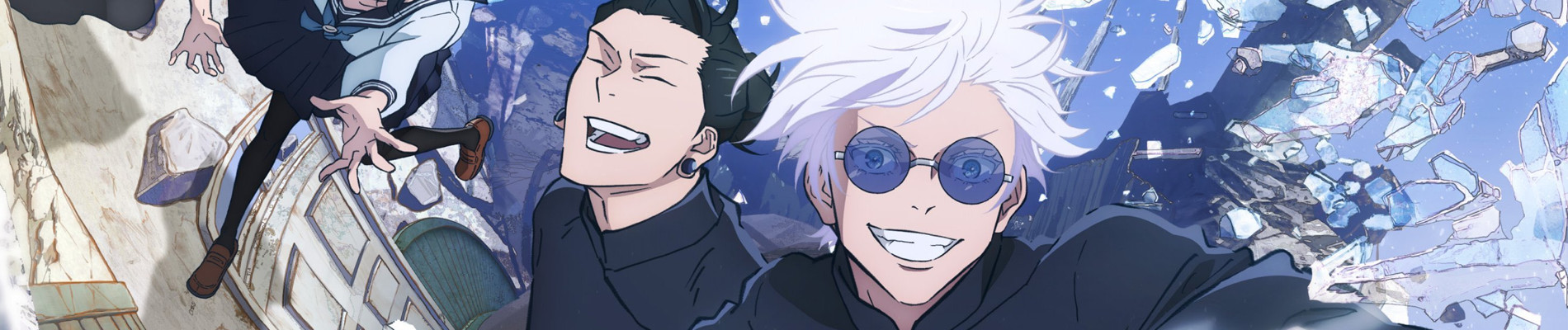
JUJUTSU KAISEN Season 2 doesn’t trade in clean victories or heroic certainty. Its atmosphere is dense, thick with the weight of irreversible choices—the way Satoru Gojou’s laughter rings hollower each time he blinks past Getou’s descent, how Riko Amanai’s quiet breaths feel like borrowed time in a world that already treats her as a vessel, not a person. This isn’t urban fantasy as backdrop; it’s urban decay as psychology—concrete, subway tunnels, and tatami rooms all humming with the low thrum of inevitability. You don’t just watch tragedy unfold—you taste its metallic aftertaste. It makes you think about loyalty as a kind of slow poison, about power as a lens that magnifies not strength, but what you’re willing to erase to keep it.
That same visceral, almost biological intensity lives in DOOM + DOOM II, where the description names “Body Horror & Occult” as core dimensions—and the player review nails why: “This game was the reason my dad and I built our first computer.” That raw, foundational urgency mirrors Season 2’s emotional architecture: no cutscenes, no exposition dumps—just the immediate, gut-punch collision of sacred duty and profane mutation. When a Baron of Hell erupts from the floor in DOOM, its limbs distending like over-stretched sinew, it echoes Getou’s transformation—not as monster design, but as rupture. Both demand your body react before your brain catches up. The horror isn’t abstract. It’s wet. It’s close. It’s happening now, and stopping it means moving faster than thought.
Then there’s Shank, described as a “sidescrolling beat-em-up” drenched in “grindhouse” excess, where player reviews confess, “I must have rose tinted glasses back then because I enjoy this in the past.” That wistful, slightly aching nostalgia is key—not for simpler times, but for the clarity of violence when stakes are personal and immediate. Shank’s combos aren’t flashy for flashiness’ sake; they’re cathartic releases, each hit echoing the brutal finality of Gojou’s domain expansion—a technique so overwhelming it doesn’t just win fights, it ends conversations. Both Shank and Season 2 weaponize rhythm: the staccato of a chainsaw revving, the split-second pause before a cursed technique detonates. They share that same physical grammar: punch, dodge, reload, breathe, then break something vital.
And Quake III Arena, with its alien gladiatorial arena and “Action Spectacle” dimension, lands with eerie precision. Its description frames combat as ritual—“the greatest warriors… summoned to battle for the amusement of an ancient alien race.” That’s the chilling subtext of Kyoto vs. Tokyo: two elite sorcerer factions clashing not for territory, but for ideological supremacy, their battles staged like rites beneath indifferent, cosmic eyes. A player review notes “ioquake3” still runs servers “as of typing this”—a testament to endurance, much like how Season 2’s emotional wounds linger, unhealed, long after the credits roll. The speed, the disorientation, the sheer velocity of movement in Quake III—strafing, rocket-jumping, map control—mirrors Gojou’s effortless dominance: not just power, but temporal arrogance, bending fight-time itself. You don’t outfight him—you get unmade in the gap between his intention and your reaction.
This pairing isn’t for casual fans. It’s for the viewer who replays the Kyoto arc’s final hallway sequence—not to see the punches, but to count how many times Gojou’s expression shifts between breaths. It’s for the player who still boots up Unreal Tournament 2004 just to feel the thunk of a shock rifle hitting at 120fps, because that tactile feedback is the only thing that matches the thud of Getou’s curse landing on someone’s soul. These are people who understand that tragedy isn’t sadness—it’s the slow, grinding realization that some doors, once opened, can’t be closed. Who find beauty in the precision of devastation. Who don’t flinch when the horror gets personal, when the magic stops being wonder and starts feeling like surgery without anesthesia. They don’t want escape. They want resonance—sharp, true, and unforgettable.
🎮31 Games That Match the Vibe



Match Dimensions Explained
❓Frequently Asked Questions
Why does JUJUTSU KAISEN Season 2's Shibuya Incident arc feel so much like a Quake III Arena deathmatch?
Because both throw you into chaotic, high-stakes arenas where speed, spatial awareness, and split-second dodges define survival—just like Yuji vs. Mahito’s cursed energy clashes or Gojo’s domain expansion showdowns. Quake III Arena mirrors that with its lightning-fast movement, rocket-jump combos, and arena-based 1v1 duels where every frame matters—plus it shares the same 'Body Horror & Occult' and 'Action Spectacle' intensity that makes Shibuya’s collapsing streets and warped realities hit so hard.
Is there a JUJUTSU KAISEN Season 2 video game adaptation?
No—not yet. There’s no official JUJUTSU KAISEN Season 2 game, but if you’re craving that same visceral, fast-paced combat and occult-infused chaos, DOOM + DOOM II nails it: its relentless demon hordes, grotesque enemy designs (think Cacodemons as cursed spirits), and adrenaline-fueled movement feel like playing through Sukuna’s rampage or Geto’s possession spree—all while hitting the same 73-score sweet spot in Body Horror & Occult and Action Spectacle.
Shank vs. Unreal Tournament 2004: which one captures JUJUTSU KAISEN’s over-the-top fight choreography better?
Shank wins for raw, cinematic melee flair—its brutal combo chains, screen-shaking boss fights (like the Chainsaw Twins echoing Mahito’s dismemberment tactics), and grindhouse-style gore match Gojo’s Domain Expansion visuals and Yuji’s frenetic hand-to-hand brawling. Unreal Tournament 2004 delivers more tactical FPS spectacle and team-based gladiatorial energy, but Shank’s sidescrolling chaos leans harder into the same 'Body Horror & Occult' and 'Action Spectacle' vibe that defines Season 2’s most iconic scenes.
What’s the best game like JUJUTSU KAISEN Season 2 if I just want to feel unstoppable and cathartic after watching Gojo’s domain?
Unreal Tournament 2004: Editor's Choice Edition—it’s pure power fantasy with ten distinct game modes, lightning-fast movement, and that legendary 'instagib' mode where one perfectly timed shot drops an opponent instantly, just like Gojo erasing enemies from existence. Its arena design, weapon variety (like the shock rifle mimicking cursed energy blasts), and 73-score alignment in Body Horror & Occult and Action Spectacle make it the closest thing to strutting through Shibuya with infinite confidence—and yes, players still call it mind-blowing even 20+ years later.