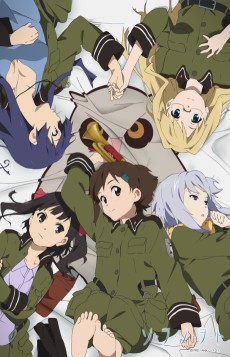
Sound of the Sky
In a lonely corner of the world, on the edge of No Man's Land, sits Clocktower Fortress. It's home to the 1121st Platoon of the Helvetian Army, and their newest member is a 15-year-old volunteer named Kanata Sorami, who enlisted to learn how to play the bugle. When she was a child, Kanata was saved by a beautiful soldier and found inspiration in the clear, golden sound of her trumpet. From that day forward, Kanata decided music would be her life.
As the other platoon members train her how to be a bugler and a soldier, Kanata's enduring optimism will inspire them to look for happiness and beauty, even in a world haunted by war.
(Source: Right Stuf, Inc.)
📺Anime Details
📝Editorial Analysis
The first note Kanata blows on her bugle at Clocktower Fortress isn’t perfect—it wobbles, thin and hesitant, swallowed by the wind off the rust-colored cliffs. But the camera holds on her face: eyes closed, breath steady, cheeks flushed not from exertion but recognition. That sound—fragile, human, insistently alive—isn’t just music. It’s a lifeline thrown across silence so deep it hums.
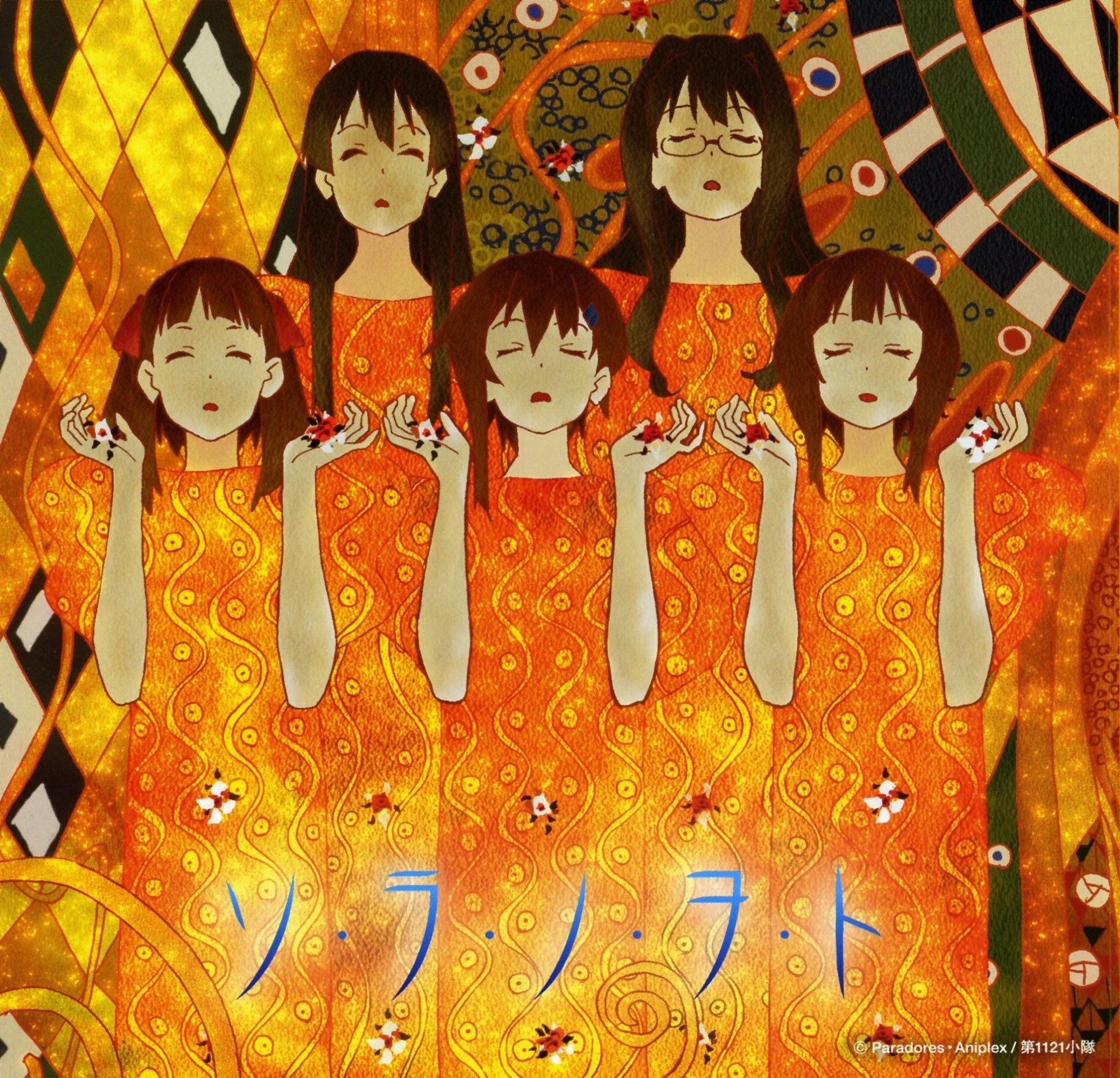
Sound of the Sky doesn’t treat post-apocalypse as spectacle. There are no crumbling megacities or roving warlords—just dust motes dancing in slanted afternoon light through the fortress’s high, grimy windows; the rhythmic clank-hiss of steam valves in the mess hall; the way Kanata’s fingers fumble over cold brass while Miu patiently counts beats aloud. The lost civilization isn’t mourned in ruins—it’s remembered in half-remembered lullabies, in the way the platoon’s commander keeps a single, warped vinyl record she never plays, in the quiet awe with which they watch auroras bleed across the violet-black sky. This is sci-fi stripped bare: no exposition dumps, no grand reveals—just presence. You feel the weight of time—not as threat, but as texture. The loneliness isn’t desolate; it’s tender. The military structure isn’t oppressive—it’s scaffolding, holding space for laughter, burnt stew, shared headphones, and the slow, stubborn bloom of trust. It makes you think about how meaning isn’t found in answers, but in the act of tuning—to others, to instruments, to the fragile, resonant frequency of ordinary days.
That tuning echoes unmistakably in AudioSurf. Its description says: “Ride your music. Audiosurf is a music-adapting puzzle racer where you use your own music to create your own experience.” Like Kanata learning the bugle, you don’t master the track—you listen, then move with the waveform’s rise and fall. A player review calls it “superior… despite its godawful UI, unskippable menu animations, crashing”—and that’s the point: the friction isn’t a flaw, it’s part of the ritual. Just as Kanata’s early notes are raw and imperfect, AudioSurf demands patience with its own clunky interface, asking you to lean into the process, not the polish. Both ask: what does it feel like to let sound carry you, even when the vehicle is slightly broken?
Then there’s Chains, described as “a relaxing arcade match 3 casual game” where “the challenge comes from increasingly difficult physics-driven links.” Its player review notes it’s “basically link 3 or more of the same color and clear enough till you can proceed.” That gentle, tactile rhythm—finding connection, clearing space, moving forward one small, deliberate chain at a time—mirrors the platoon’s daily life. No grand battles, just the quiet precision of Miu adjusting a valve, Kona folding laundry with geometric care, Kanata practicing the same five-note phrase until it breathes right. The “physics-driven” difficulty isn’t chaos—it’s gravity, inertia, the soft resistance of the world itself, met with calm attention. It’s healing not because it’s easy, but because it asks for presence, not power.
And Prince of Persia, described as offering “melancholic exploration,” with a player review noting it introduces “a new prince, new lands and a brand new story completely separate from the sands timeline.” That word—melancholic—is key. Not despairing, but luminous with loss. Like Kanata gazing at the horizon where her savior vanished, the Prince moves through sun-drenched, abandoned palaces where beauty persists because memory lingers. The exploration isn’t about conquest—it’s about witnessing, about letting wonder settle in the hollows left by absence. The animation’s fluidity, the weight of each step on ancient stone—it’s all calibrated to make solitude feel sacred, not empty.
This isn’t for someone who wants lore dumps or power fantasies. It’s for the person who pauses mid-scroll to watch rain trace paths down a windowpane. For the listener who replays a single verse of a song for three weeks, not to memorize it, but to feel its grain. For the player who spends an hour arranging a bookshelf in The Sims™ 4, not for points, but for the quiet satisfaction of order—even if the game’s DLC costs sting and the bugs frustrate (“TS4 has become awful… this game is no fun without dlc”). They’ll recognize Kanata’s reverence for a single, true note—and understand why healing isn’t loud. It’s the hush after the last bubble clears in Chains, the resonance lingering after the bugle falls silent, the golden weight of a moment, held, just long enough.
🎮47 Games That Match the Vibe




























Match Dimensions Explained
❓Frequently Asked Questions
Why does AudioSurf match Sound of the Sky so well despite being a rhythm racer?
Because both lean hard into that dreamy, melancholic-yet-healing vibe—like riding through quiet twilight skies with headphones on. AudioSurf’s music-driven tracks shift shape and pace with your song’s emotional arc (think slow-building synth swells mirroring Kanata’s quiet walks across the plains), and its ‘Healing & Slow Life’ dimension scores perfectly alongside Sound of the Sky’s gentle pacing and introspective tone.
Is there an anime adaptation of Chains or Stardew Valley like Sound of the Sky had?
Nope—neither Chains nor Stardew Valley has an anime adaptation. Sound of the Sky is rare in that sense: it’s one of the few games-turned-anime (2010, 12 eps) with deep worldbuilding around sky-faring girls like Tsukasa and Kuroda. Chains is purely a minimalist bubble-matching arcade game, and Stardew Valley’s charm lives entirely in its pixel-farm life—not licensed anime spin-offs.
How is Prince of Persia similar to Sound of the Sky but different from The Sims 4?
Both Prince of Persia (2023 reboot) and Sound of the Sky share that 'Melancholic Exploration' dimension—think long, silent walks through ancient ruins or misty cloudscapes, where mood matters more than action. The Sims 4, while also 'Healing & Slow Life', swaps solitude for social simulation: you’re juggling relationships like Harvey’s shy clinic chats or Emily’s poetry club—not wandering alone like the Prince or Kanata.
What’s the best game like Sound of the Sky if I want that quiet, reflective mood after a stressful day?
Chains is your go-to—it’s literally built for breathwork-level calm. Linking those soft-colored bubbles with gentle physics, watching them pop in slow cascades, feels like tending to a zen garden. It shares Sound of the Sky’s 'Healing & Slow Life' core (same as Stardew Valley and The Sims 4), but without farming schedules or household management—just pure, tactile, meditative flow.