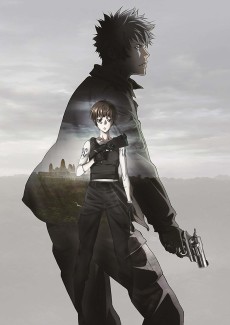
PSYCHO-PASS: The Movie
Year 2116 – Confident with the success of the Sybil System, the Japanese government begins exporting the technology to other countries. However, when foreign terrorists begin slipping through the System's security and attacking from within, Inspector Akane Tsunemori is sent overseas to investigate. When her hunt for justice forces her into a standoff with an old ally, will she be able to pull the trigger?
(Source: Crunchyroll, edited)
📺Anime Details
📝Editorial Analysis
The desert wind howls across the cracked tarmac of a ruined airfield—dust stings Akane Tsunemori’s eyes, her breath shallow beneath the weight of her Dominator. She stands alone, weapon raised, not at a faceless terrorist, but at Shinya Kogami—his silhouette sharp against the bruised orange sky of Southeast Asia, his expression unreadable, his loyalty fractured. The System’s hum is gone. No Sibyl voice calibrates her hue. Just silence, heat, and the unbearable weight of a choice that isn’t about guilt or innocence—but about what justice looks like when the architecture holding it up has been shipped overseas and sold as export-grade certainty.
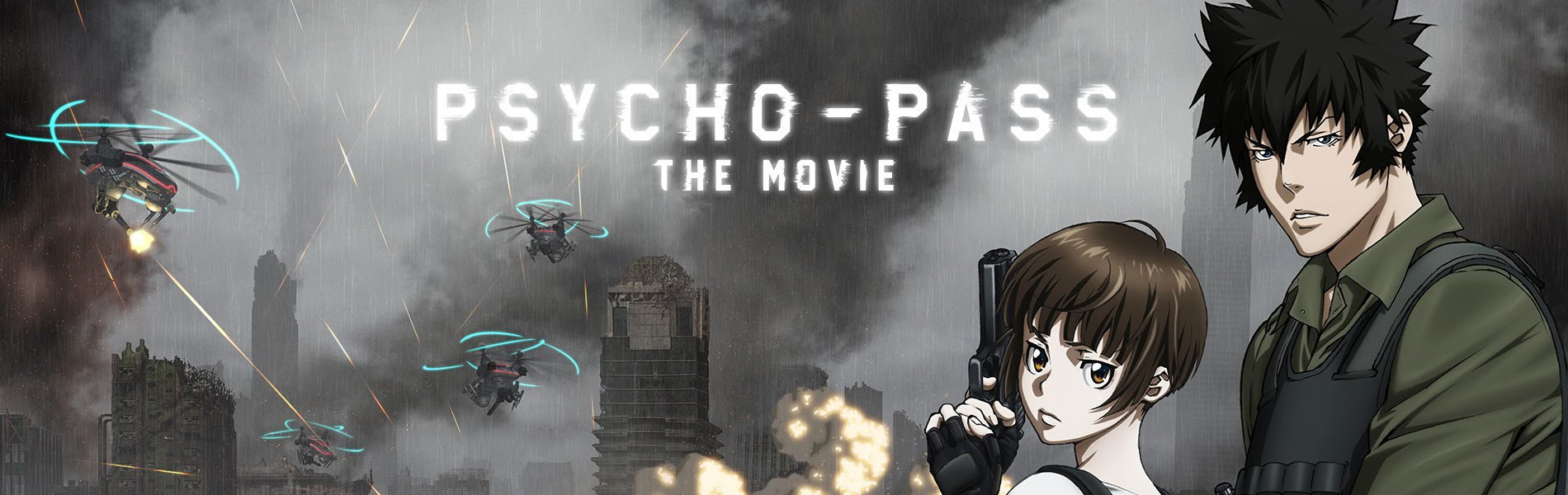
That moment isn’t dystopia as backdrop—it’s dystopia as disorientation. PSYCHO-PASS: The Movie doesn’t unsettle you with neon rain or towering megacorps alone. It unsettles you by stripping away the System’s quiet omnipresence—the very thing that made Tokyo feel safe, even as it suffocated dissent. Here, in 2116, the Sybil System isn’t just flawed; it’s commodified, its logic exported like firmware, its moral calculus repackaged for foreign militaries and unstable regimes. You don’t feel oppressed by surveillance—you feel orphaned by it. The horror isn’t that the System sees everything. It’s that, abroad, it doesn’t see enough—and worse, that it was never meant to see people at all, only metrics. That hollow, gut-level loneliness—of walking through war-torn urban ruins where the rules have been outsourced—is what lingers. Not dread. Not awe. Dislocation. As if your moral compass had been quietly recalibrated without your consent—and then taken away.
Which is why Nuclear Dawn, despite its dead servers and barren lobbies, shares that same emptiness. Its description calls it a “FPS/RTS hybrid” set in “war-torn post-apocalyptic landscapes”—but the player review nails the emotional residue: “the servers are 100% dead with 0 active players.” That absence isn’t a bug—it’s the atmosphere. Like Akane navigating a foreign city where local cops don’t trust her badge and Sybil’s data streams flicker with latency, Nuclear Dawn forces you into tactical warfare where coordination collapses not from enemy fire, but from sheer isolation. You’re not fighting chaos—you’re fighting the silence after the infrastructure fails.
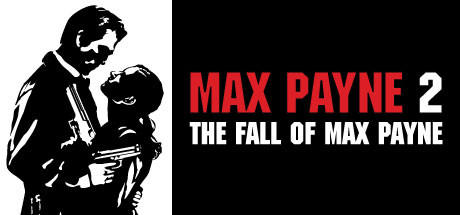
Then there’s Max Payne 2: The Fall of Max Payne, whose description frames it as a “violent, film-noir love story… dark, tragic and intense.” That phrase—film-noir love story—is the key. Not romance, but devotion twisted by system failure. Max’s world isn’t policed by algorithms, but by collapsing institutions, betrayals baked into procedure, and a protagonist who keeps pulling the trigger not out of conviction, but because every alternative has already been foreclosed. The player review mentions “clearing a room full of en…”—that trailing ellipsis feels intentional, like the sentence itself can’t bear the weight of what comes next. Just like Akane’s standoff with Kogami: no clean resolution, no cathartic shot—just the suspended breath before consequence. Both works trap you in the aftermath of certainty, where every decision bleeds into moral static.
And Crysis Warhead®, though its description focuses on “a standard combat mission behind enemy lines” turning “critical,” carries that same geopolitical vertigo. Sergeant Sykes doesn’t fight for ideology—he fights because the mission parameters shifted mid-air, because the line between ally and asset blurred in the haze of jungle heat and compromised intel. The player review admits the lore isn’t the draw—“you aren’t missing anything if you want more story/lore.” What is there? Tactical precision under destabilizing conditions. The physicality of armor, recoil, terrain—all rendered with oppressive fidelity—mirroring Akane’s hyper-awareness in a land where her Dominator’s diagnostics glitch, where her training is suddenly contextual, not absolute. It’s not about winning. It’s about holding position while the ground redefines itself beneath you.
This isn’t for fans of clean utopias or bullet-time power fantasies. It’s for the viewer who watches Akane lower her weapon—not in surrender, but in refusal to let the System’s export license dictate her humanity. It’s for the player who boots up Nuclear Dawn just to hear the wind whistle through serverless ruins, or who replays Max Payne 2’s final corridor not for the shoot-out, but for the way Max’s voice cracks on a single line about trust. It’s for anyone who’s ever stood in an airport terminal, passport in hand, and felt the quiet panic of realizing your entire sense of order was jurisdictional—not universal. These pairings speak to the ones who find poetry in broken protocols, who recognize dislocation not as failure, but as the first honest sensation in a world that’s long since stopped telling the truth about itself.
🎮40 Games That Match the Vibe












Match Dimensions Explained
❓Frequently Asked Questions
Why is Max Payne 2 recommended for PSYCHO-PASS: The Movie fans despite being a 2003 game?
Because its neon-noir aesthetic, morally gray detective work, and tragic romance between Max and Mona mirror the film’s tension between justice and personal desire—especially during the rain-slicked, slow-mo hallway shootouts where you’re constantly weighing consequence over instinct. It nails that same 'system vs. soul' vibe as Shinya Kogami’s arc in the movie, and the branching dialogue choices in key scenes (like the warehouse confrontation) echo the film’s psychological tightrope.
Is there a PSYCHO-PASS video game adaptation with a story mode like the movie?
No—there’s no official PSYCHO-PASS game adaptation that expands on *The Movie*’s storyline or features characters like Risa and the SEAUn conflict. The closest thing is *Mata Hari*, which shares the espionage-driven deception and ‘trust no one’ paranoia, but it’s set in WWI-era Europe and lacks any PSYCHO-PASS lore or mechanics—plus, as one player bluntly put it: 'Ce jeu est une vraie daube...' so don’t expect polish.
How does Crysis Warhead compare to Nuclear Dawn for someone who loved the SEAUn invasion scenes in PSYCHO-PASS: The Movie?
Crysis Warhead gives you Sergeant Sykes’ boots-on-the-ground chaos in dense, ruined urban zones—think the Manila airport assault—with nanosuit-powered tactical repositioning and environmental destruction that *feels* like dodging drones while chasing insurgents. Nuclear Dawn tries for similar scale but has zero active players (per that brutal review: 'servers are 100% dead'), so you’ll get cinematic intensity in Warhead, but total radio silence in Nuclear Dawn—no squad coordination, no shared dread.
What’s the best game like PSYCHO-PASS: The Movie if I want that oppressive, rain-soaked, system-is-watching-you vibe?
Max Payne 2 is your top pick—it’s dripping with that same oppressive, rain-lashed neon-noir mood, especially in the abandoned subway tunnels and flickering office lobbies where every shadow feels surveilled. Its Tactical Warfare dimension pairs with Mystery & Detective pacing to recreate the movie’s suffocating tension, like when Max interrogates suspects under flickering fluorescents—no Sibyl System needed, just guilt, memory, and bad decisions echoing off wet concrete.