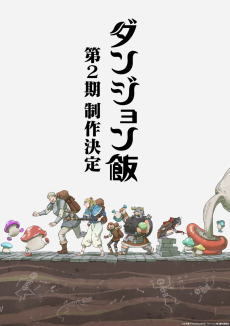
Dungeon Meshi 2nd Season
📺Anime Details
📝Editorial Analysis
The smell of roasted griffin thigh—crispy skin, iron-rich meat, a faint herbal smoke from crushed moon-moss rubbed into the fat—hangs in the air as Laios stirs the pot, his knuckles scarred, his voice calm. Beside him, Marcille adjusts her spectacles, muttering about optimal heat dispersion for dragon-egg custard, while Chilchuck nervously checks the dungeon’s tremor frequency on a cracked brass gauge. No grand battle. No last-minute save. Just this: a shared meal, prepared in the belly of a living, breathing, hungry mountain. That’s where Dungeon Meshi 2nd Season lives—not at the edge of a sword, but at the lip of a simmering cauldron, inches from teeth that could swallow you whole.
What makes it ache so deeply isn’t the fantasy—it’s the weight. The weight of adult responsibility worn like ill-fitting armor: Laios’ quiet grief folded into portion control; Marcille’s precision masking exhaustion; Chilchuck’s pragmatism fraying at the edges when the dungeon shifts just wrong. This isn’t escapist whimsy. It’s tired, resourceful, deeply attentive—a world where magic is just another variable in the recipe, and cosmic horror isn’t about eldritch gods screaming from the void, but about realizing the dungeon’s walls are digesting your footsteps. You feel the low hum of ancient stone, the damp chill of corridors that remember every fallen adventurer, the way laughter catches—brief, warm, then swallowed by silence. It’s resilient, not triumphant. Grounded, not epic. And above all: necessary.
That same emotional texture pulses through Into the Breach, where every turn is a negotiation—not with fate, but with consequence. Its JRPG Narrative doesn’t unfold in cutscenes; it’s written in the rubble left after you redirect a magma golem into your own mech to save a civilian housing unit. Player reviews call it “a chess match against entropy,” and that’s exactly what Dungeon Meshi 2nd Season feels like: cooking under geological time, making do with what the dungeon gives, not what you wish it had. Both treat survival as an act of quiet, stubborn care—no fanfare, just recalibration.
Then there’s Runic Rampage, tagged explicitly as Adult & Dark Seinen, its Action RPG pacing mirroring the anime’s rhythm: long stretches of tense preparation—scouting, inventory management, spell calibration—punctuated by sudden, brutal, physical stakes. One player review nails it: “It doesn’t reward power fantasy—it rewards pattern recognition, like noticing how a goblin’s cough changes before it spits acid.” That’s Marcille measuring pH levels in slime before fermenting it into vinegar. That’s Chilchuck recalibrating his crossbow sight because humidity warped the string again. Both demand hyper-attentiveness—not to win, but to endure.
And Inscryption, with its Adult & Dark Seinen core and layered, unsettling intimacy, shares the anime’s most unsettling truth: the dungeon isn’t just a place. It’s relational. In Inscryption, the dealer watches you blink, remembers your hesitation, adapts the deck because you flinched. In Dungeon Meshi 2nd Season, the dungeon breathes with them—the moss blooms brighter near Laios’ voice, the echo patterns shift when Marcille hums a lullaby to stabilize volatile mana crystals. Neither offers mastery. Both offer dialogue: with systems that watch back, remember, and respond—not with malice, but with indifferent, ancient logic. A player wrote of Inscryption: “It feels less like playing a game and more like being studied by one.” So does sitting cross-legged in a cavern, tasting a mushroom that knows your blood type.
This pairing won’t thrill someone chasing dopamine spikes or heroic arcs. It’s for the viewer who replays the scene where Shuro quietly skins a cave-lizard not for combat prep—but to patch a tear in Laios’ cloak, her fingers steady, her expression unreadable. It’s for the player who spends ten minutes optimizing a single card draw in Slay the Spire, not for victory, but because getting the math right feels like holding something fragile together. It’s for people who find solace in competence practiced in low light—those who understand that care is the most radical form of resistance in a world that keeps shifting underfoot, and that the deepest warmth isn’t found in firelight, but in the shared, quiet certainty of knowing how to feed each other, even here.
🎮81 Games That Match the Vibe
























Match Dimensions Explained
❓Frequently Asked Questions
Why does Into the Breach feel so much like Dungeon Meshi’s second season despite having no food themes?
Because both lean hard into tactical, consequence-heavy decision-making—like when Lao and Mithra weigh whether to collapse a tunnel to trap goblins or save a village, Into the Breach forces you to choose between saving a civilian unit or blocking a Vek’s path, with every move echoing that same grounded, high-stakes pragmatism. Its JRPG Narrative dimension shines in how each island mission ties into the larger lore of the Chronovore threat, mirroring how Dungeon Meshi 2nd Season weaves dungeon logistics into character growth.
Is there a video game adaptation of Dungeon Meshi 2nd Season?
No official video game adaptation exists—but games like Runic Rampage capture its *vibe* uncannily: imagine Gobrou grilling monster meat over a campfire while you dodge a minotaur’s axe swing in real-time combat, all wrapped in that same dark-seinen tone where humor and horror share the same breath. It’s not licensed, but fans consistently call it ‘Dungeon Meshi with a sword in hand’ for good reason.
How does Slay the Spire compare to Last Epoch for someone who loved Dungeon Meshi’s balance of cooking logic and dungeon grit?
Slay the Spire leans into the ‘cooking logic’ side—building decks feels like crafting recipes: combining Frostbite + Chill to freeze enemies is just as satisfying as pairing Slime Jelly with Wild Boar Fat in Episode 12. Last Epoch, meanwhile, mirrors the ‘dungeon grit’: its skill tree lets you specialize as a necromancer who reanimates fallen monsters *and* cooks them mid-battle, echoing Mithra’s pragmatic alchemy under pressure.
What’s the best game like Dungeon Meshi 2nd Season if I want that cozy-but-tense vibe—like sharing stew in a collapsing ruin?
Inscryption nails that exact feeling: early acts have you huddled at a dimly lit table, trading cards like rare ingredients, making uneasy bargains with the squirrel-like Leshy—just like Lao negotiating for saffron in the Underworld Bazaar. Its Roguelike & Dungeon structure means every run feels like another night in the dungeon, where warmth and danger sit side-by-side, and even your deck-building choices carry that same weighty, almost culinary intentionality.