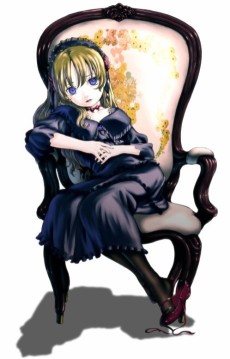
Le Portrait de Petit Cossette
📺Anime Details
📝Editorial Analysis
The first time you see her—not Cossette, but the painting—it’s not her face that chills you. It’s the way the light catches the cracks in the varnish, how the oil seems to breathe, how the pigment swells just slightly at the edge of her collarbone, as if something beneath the canvas is pressing up from the void. That’s when you realize: this isn’t a portrait of a girl. It’s a wound dressed in lace and pigment.
Le Portrait de Petit Cossette doesn’t unsettle with jump scares or shrieking spirits—it sinks into you like damp velvet, slow and suffocating. Its atmosphere is grief made tactile: the weight of unspoken guilt, the eroticism of decay, the quiet horror of loving something that cannot love back—because it was never alive to begin with. You don’t fear Cossette’s ghost; you fear your own hunger for her, the way your pulse quickens when she leans in, even as her fingers leave frost on your wrist and her smile doesn’t reach eyes that hold centuries of stillness. This is psychological intimacy as violation, romance as possession, and tragedy not as loss—but as consent withheld, then overwritten. Every frame feels like turning a page in a forbidden sketchbook where the drawings remember being drawn.
That same visceral unease lives in Vampire: The Masquerade - Bloodlines, where body horror isn’t just gore—it’s transformation as erosion. The description calls it “brutal combat” and “Dark Fantasy,” but what lingers is the physical cost of power: your skin splitting during frenzy, your reflection vanishing, your voice hollowing out—not as spectacle, but as quiet surrender. A player review urges you to “BUY IT ON GOG” because the game demands immersion, and the unofficial patch isn’t about fixing bugs—it’s about reclaiming coherence in a world that keeps fraying at the edges, just like Mochizuki’s grip on reality as Cossette’s presence bleeds into his apartment walls, his dreams, his bones. Both refuse to let you feel safe inside your own skin.
Then there’s Heretic: Shadow of the Serpent Riders, where you’re not a hero—you’re a heretic, the last Sidhe elf, wielding magic that twists flesh and unravels time. The description frames it as vengeance against corrupting brothers, but the emotional core mirrors Cossette’s own trapped rage: ancient, elegant, unresolved. Like her, you move through spaces that remember violence—corrupted realms where architecture itself pulses with occult rot. A player’s terse note—“Pick up the remaster”—isn’t just advice; it’s reverence for texture, for materiality: the way remastered glyphs gleam with unstable light, the way corrupted terrain buckles underfoot—exactly how Cossette’s painted world buckles when Mochizuki finally tries to touch her, and his hand sinks into the canvas like water.
And Layers of Fear 2—its title alone is a whisper of obsession. The description cites “Emotional Narrative” and “Adult & Dark Seinen,” but what binds it to Cossette is the architecture of denial: hallways that reconfigure themselves around suppressed memory, rooms blooming with floral decay, a protagonist whose artistic drive curdles into self-erasure. Like Mochizuki sketching Cossette over and over, trying to fix her before she fades—or before she fixes him—the game’s horror lives in the gap between intention and outcome, where every brushstroke is both prayer and curse. There’s no jump-scare climax—just the slow, inescapable realization that you’ve been painting yourself into the frame all along.
This pairing isn’t for fans of ghosts who rattle chains. It’s for people who linger in the silence after a confession, who trace the rim of a teacup while wondering if the steam rising from it is theirs—or hers. It’s for those who understand that the most terrifying kind of possession isn’t violent—it’s tender, patient, and dressed in mourning black. Who find beauty in the wrongness of a smile that lasts three seconds too long. Who know that love, grief, and horror aren’t separate rooms—they’re doors in the same hallway, and sometimes, the key fits all three.
🎮56 Games That Match the Vibe































Match Dimensions Explained
❓Frequently Asked Questions
Why is Vampire: The Masquerade – Bloodlines recommended for fans of Le Portrait de Petit Cossette?
Because both lean hard into Gothic melancholy and psychological decay—think Cossette’s fragile, otherworldly presence mirrored in Bloodlines’ Embrace mechanic and the haunting, rain-slicked streets of Santa Monica where characters like Jeanette and Therese unravel your sanity. The game’s adult & dark seinen tone, body horror transformations (like the Nosferatu’s grotesque visage), and morally grey storytelling hit the same emotional notes as Cossette’s tragic, occult-tinged romance.
Is there a visual novel adaptation of Le Portrait de Petit Cossette?
No—Le Portrait de Petit Cossette was originally a Japanese OVA (anime), not a visual novel, so there’s no official VN adaptation. But if you love its mood, Amnesia: Rebirth delivers that same emotionally raw, intimate descent into occult dread—especially in scenes where protagonist Aline uncovers fragmented memories while navigating decaying Algerian ruins, much like Cossette’s slow revelation of her own cursed nature.
How does Layers of Fear 2 compare to Heretic: Shadow of the Serpent Riders for someone who loved Cossette’s surreal, dreamlike horror?
Layers of Fear 2 leans into psychological fragmentation and theatrical, emotionally charged set-pieces—like the collapsing opera house or shifting backstage corridors—mirroring Cossette’s hallucinatory, memory-laced tragedy. Heretic, meanwhile, trades atmosphere for mythic action: you’re a Sidhe elf wielding eldritch magic against serpentine gods, with visceral body horror in enemy designs (e.g., the writhing Serpent Riders themselves) but far less narrative intimacy than Cossette or Layers of Fear 2.
What’s the best game like Le Portrait de Petit Cossette if I want something deeply sad and beautiful, not just scary?
Amnesia: Rebirth—it nails that bittersweet, elegiac vibe: Aline’s quiet grief, the tender flashbacks with her son, and the way light filters through cracked desert ruins all echo Cossette’s fragile grace and sorrow. Unlike REMNANT II’s combat-heavy chaos or Bloodlines’ cynical noir, Rebirth sustains that hushed, emotionally resonant tone across its entire runtime, especially in moments like the lantern-lit cave sequences where hope and despair blur together.