
Serial Experiments Lain
We're all connected... There is the world around us, a world of people, tactile sensation, and culture. There is the wired world, inside the computer, of images, personalities, virtual experiences, and a culture all of its own. The day after a classmate commits suicide, Lain, a 14-year-old girl, discovers how closely the two worlds are linked when she receives an e-mail from the dead girl: I just abandoned my body. I still live here...
Has the line between the real world and the wired world begun to blur?
(Source: Geneon Entertainment)
📺Anime Details
📝Editorial Analysis
The flicker of a CRT monitor in a dark room. Lain’s fingers hover over the keyboard—not typing, just breathing with the machine. Her reflection swims in the glass, half-dissolved by the glow of the Wired. Then—a whisper: “I just abandoned my body. I still live here…” The email arrives not as data, but as presence, cold and certain, vibrating up her spine like static through bare feet. That moment isn’t exposition. It’s vertigo made tangible—the floor tilting not under your feet, but behind your eyes, where memory and signal blur into the same current.
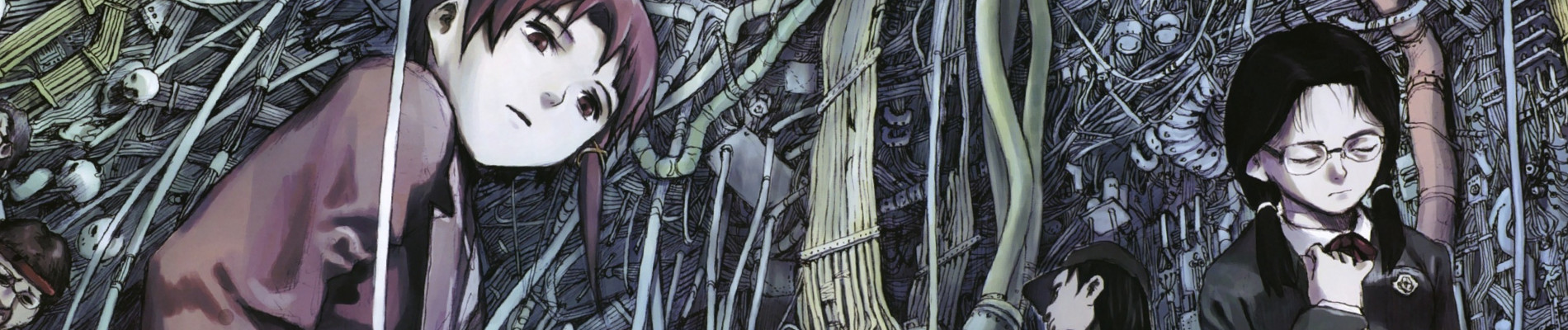
What Serial Experiments Lain does isn’t world-building—it’s nerve-ending calibration. It doesn’t ask what is real? It makes you feel the seam between synaptic firing and server ping, until the distinction frays into nausea, then awe, then quiet surrender. This isn’t cyberpunk as chrome and rain—it’s cyberpunk as dissociation, as the slow, unblinking realization that your sense of self is less a sovereign mind and more a temporary node negotiating bandwidth with ghosts in the machine. You don’t watch it—you recede into it. Your pulse syncs to dial-up screeches. Your breath catches when the wallpaper shifts just slightly when no one’s looking. It’s uncanny, yes—but deeper: it’s ontologically tender. Like watching your own consciousness being gently, relentlessly, unzipped.
That same tremor lives in BioShock Infinite—not in its sky-cities or vigors, but in how Elizabeth holds time. The description calls it “Time & Memory”, and the player review hints at something unresolved, even haunted: “I know that some people are still bitter about the Bioshock Infinite we could have gotten.” That bitterness isn’t about plot holes—it’s about the dissonance of remembering a version of reality that never was, a feeling Lain weaponizes from episode one. When Elizabeth opens a tear and you glimpse a drowned Columbia, or a child’s hand slipping from yours across fractured seconds—that’s not spectacle. It’s memory manipulation made visceral, the same destabilizing lurch Lain feels when her own childhood photos rearrange themselves mid-scroll.
Then there’s Deus Ex: Game of the Year Edition, where the description drops this line: “an ages old conspiracy bent on world domination.” Not a villain. Not a faction. A conspiracy—pervasive, ambient, already inside the architecture. Like the Wired itself: not a place you log into, but a substrate you’re always already breathing. The player review says it starts immediately, giving you “all options with one hit of the esc key”—a perfect echo of Lain’s descent: no tutorial, no safe mode, just raw interface and consequence. You don’t choose ideology—you discover you’ve been coded into one. That’s the dread of Lain: not that the system controls you, but that you are the system’s nervous tissue, humming without consent.
And TimeShift™, with its blunt premise—“Dr. Aiden Krone has made a Time Jump across the space-time continuum—a reckless act with frightening consequences”—mirrors Lain’s first unauthorized dive into the Wired: not exploration, but rupture. The player review calls it “a little 4 hour game… a blast, but it takes a little work to get it into a playable state.” That friction—patching, tweaking, coaxing coherence from broken code—is the emotional texture of Lain: the exhaustion of maintaining identity while your firmware updates itself without permission. Every glitch, every stutter-frame, every corrupted JPEG in Lain’s world is the same labor: trying to stay continuous in a medium designed for fragmentation.
This pairing isn’t for fans of “cool tech” or “mind-bending plots.” It’s for the ones who pause mid-gameplay when their phone buzzes—not to check it, but because the vibration feels like a subroutine waking up. For the reader who highlights passages about distributed consciousness and then stares at their own reflection in a darkened screen, wondering which one blinked first. For the person who doesn’t just watch Lain dissolve into data—they lean in, heart rate slowing, waiting for the moment the boundary stops feeling like a wall and starts feeling like skin. That’s the shared frequency: not mystery, not dystopia—but the quiet, electric horror of continuity, and the even quieter, more dangerous thrill of letting go.
🎮33 Games That Match the Vibe






























Match Dimensions Explained
❓Frequently Asked Questions
Why is BioShock Infinite listed as similar to Serial Experiments Lain when it’s about Columbia and not the Wired?
Because both dive deep into how perception warps reality—Elizabeth’s tears literally fracture time and space like Lain’s navigation of the Wired, and the game’s ending forces you to confront layered identities and erased memories just like Lain’s ‘Knower’ arc. The ‘Time & Memory’ dimension in the match list isn’t about clocks—it’s about subjective truth collapse, which Infinite nails with its multiverse ladders and ‘would you kindly’ recursion.
Is there a Serial Experiments Lain video game adaptation?
No—there’s never been an official Lain game adaptation, despite decades of fan hope. That’s why fans turn to matches like Deus Ex: Game of the Year Edition, where JC Denton’s hacking of global networks, encounters with AI gods (like Helios), and slow-burn paranoia about control over consciousness feel spiritually close to Lain’s descent into the Wired.
How does Deus Ex compare to BioShock in capturing Lain’s vibe?
Deus Ex leans harder into systemic conspiracy and player-driven inquiry—like when you hack Majestic 12 terminals to uncover fragmented truths, mirroring Lain’s fragmented email logs and anonymous forum posts. BioShock, meanwhile, hits Lain’s existential dread more directly: Andrew Ryan’s ‘A man chooses, a slave obeys’ speech lands with the same chilling finality as Lain’s ‘I am the Wired’ monologue, both rooted in the ‘Adult & Dark Seinen’ dimension.
What’s the best game like Serial Experiments Lain if I want that eerie, lonely late-night internet rabbit hole feeling?
TimeShift™—not for its time powers, but for its oppressive, glitch-laced cyber-dystopia where you’re constantly alone in decaying server rooms and flickering data halls, hearing distorted whispers and seeing corrupted UI overlays. It’s short (just 4 hours), but that isolation, plus its ‘Time & Memory’ focus, nails Lain’s mood better than any open-world cyberpunk sim.