
Claymore
A brutal scourge stalks the land. Yoma, monsters driven by a hunger satisfied by only one quarry - Humanity. The dark breed knows but a singular foe: Claymore. Human-Yoma hybrids of extraordinary strength and cunning, the Claymores roam from skirmish to skirmish delivering salvation by the edge of a blade.
Thus begins the twisting tale of Clare, one such sister of the sword driven by pain in both victory and defeat. A child silent and suffering hidden in her past, Clare's march toward vengeance unfolds along a path marked by violence, solitude and scorn. In a land where even the predator is prey, the haunted hearts of hunter and hunted alike wear the scars of the age.
(Source: Funimation)
📺Anime Details
📝Editorial Analysis
The wind doesn’t howl in Claymore—it scours. It carries the iron-tang of old blood across frozen plains where snow doesn’t melt so much as stain, grey and rust-colored where bodies lie half-buried, limbs twisted not by impact but by something that unmade them from within. Clare stands there—not triumphant, not broken yet, just still, her blade dripping slower than her breath, eyes already scanning the tree line not for the next yoma, but for the next betrayal. That silence after the scream cuts off? That’s where the show lives. Not in the slash, but in the hollow second before the wound opens—and the longer one waits, the more one hears the hum of the yoma’s hunger vibrating in their own bones.
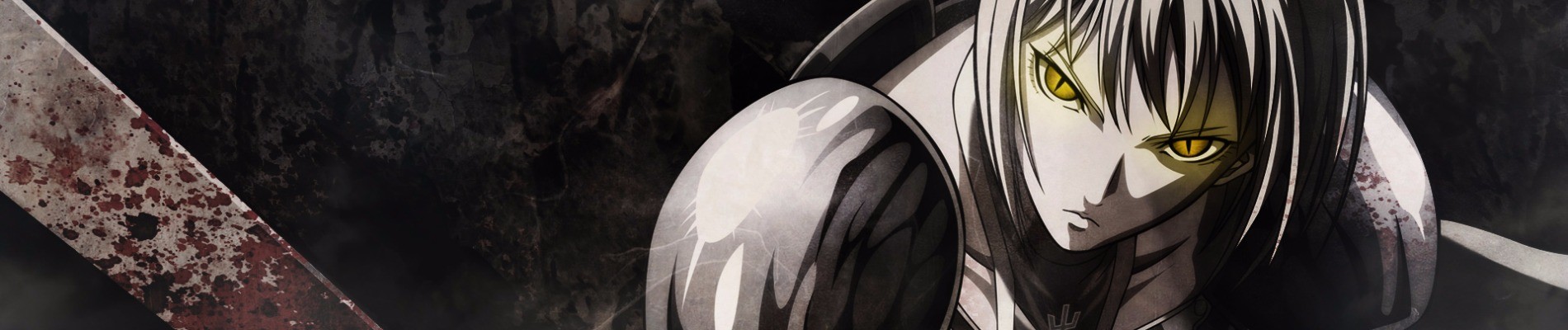
What makes Claymore’s atmosphere singular isn’t its horror or swordplay—it’s the weight of endurance. This is a world where survival isn’t heroic; it’s arithmetic. Every victory costs a piece of your humanity—literally, biologically—and every ally is a potential vector of dissolution. There’s no catharsis in revenge, only recursion: Clare’s past isn’t backstory, it’s ballast, dragging her forward while hollowing her out. The tragedy isn’t that she suffers—it’s that she remembers too clearly, and memory here isn’t comfort. It’s the slow, cold seep of frost into marrow. You don’t feel empowered watching her fight. You feel witnessed—as if the show knows, with quiet certainty, that grief doesn’t end. It calcifies. It waits.
That same melancholic exploration—a phrase pulled directly from the real match data—anchors three games that breathe the same air. Hollow Knight doesn’t just share Claymore’s ruined grandeur; it mirrors its emotional architecture. The description says you explore “twisting caverns” and “befriend bizarre bugs”—but the player review nails it: “Lovely story.” Not epic. Not triumphant. Lovely, like finding a wilted flower growing through cracked stone in a tomb. Both Claymore and Hollow Knight treat discovery as an act of mourning—every new chamber, every faded mural, every silent companion is another fragment of a world that chose self-erasure over surrender. You don’t conquer the past. You curate its remains.
Then there’s DARK SOULS™ III, whose description promises you’ll “Embrace The Darkness!”—but the player review cuts deeper: “Why Do We Still Reach for the Fire When It Is Dying?” That line is Clare’s entire arc. Not hope—but habit. Not faith—but muscle memory forged in ash. Both works treat perseverance as physiological, not philosophical. You raise your blade because your shoulder remembers the angle. You walk toward the bonfire because your feet know the path—even when the flame sputters, even when you know it won’t last. There’s no triumph in surviving the boss; there’s only the exhausted, aching relief of having delayed the inevitable—again.
And Sacred Gold, though clunky (“Full of jank, bugs… not very stable”), shares Claymore’s grim, unromantic scale. Its description names “blood-thirsty orcs & lumbering ogres”—no chosen ones, no prophecies—just a kingdom already fallen, where evil isn’t rising. It’s settled in, like mold on stone. You don’t save Ancaria. You carve temporary clearings in its decay—exactly as Claymores do in their borderlands, swinging steel not to build, but to hold back. The instability the player mentions? It echoes Claymore’s own narrative instability—the constant threat of transformation, of the body turning traitor, of loyalty curdling mid-sentence. Neither work trusts stability. Both treat consistency as the first lie.
This pairing isn’t for fans of power fantasies or redemption arcs. It’s for people who’ve ever stood in an empty room and felt the echo of a voice they haven’t heard in years—not with longing, but with recognition. For those who understand that some wounds don’t scar—they become compass points. Who find beauty not in resolution, but in the precise, trembling control of a hand holding a blade it knows will one day turn on its owner. These are stories for the quietly furious, the patiently shattered—the ones who don’t need light at the end of the tunnel. They just need to know the tunnel has walls they can still feel, even when their fingers go numb.
🎮59 Games That Match the Vibe














Match Dimensions Explained
❓Frequently Asked Questions
Why does Claymore feel so similar to Hollow Knight despite being set in a completely different world?
Both lean hard into melancholic exploration and emotional narrative—think Clare’s quiet, haunted journey through the Northern Waste mirroring the Knight’s silent trek through Hallownest’s decaying ruins. You’ll spot the same weighty atmosphere in Hollow Knight’s City of Tears (rain-soaked, grief-drenched) as in Claymore’s mist-shrouded mountain passes, and both use environmental storytelling to convey trauma without exposition—like how Hollow Knight’s abandoned dreamers echo Claymore’s lost Awakened beings.
Is there an anime or live-action adaptation of Assassin's Creed that captures the same vibe as Claymore?
No official anime or live-action adaptation nails that exact Claymore blend—but Assassin’s Creed: Director’s Cut Edition *itself* delivers the closest tonal match: dark fantasy meets political thriller, with Altaïr’s isolated, morally gray missions echoing Clare’s lone-wolf vigilance in the Organization’s shadowy hierarchy. The game’s melancholic exploration—soaring over war-torn Damascus at dusk, then dropping silently onto a rooftop like a ghost—feels spiritually kin to Claymore’s wind-swept, emotionally restrained action sequences.
Sacred Gold vs. Dark Messiah of Might & Magic—which one has more Claymore-style swordplay and tragic warrior energy?
Dark Messiah wins hands-down for Claymore-style swordplay: its Source Engine melee system lets you parry, disarm, and chain brutal finishers—exactly like Clare’s precise, exhausting blade-work against Yoma. Plus, the emotional narrative hits hard with characters like Sareth wrestling guilt and legacy, much like the Claymore warriors burdened by their own humanity. Sacred Gold leans more into chaotic action spectacle (think orc hordes, not intimate duels), and its jankier combat lacks that visceral, grounded tension.
What’s the best ‘Claymore-like’ game if I want that slow-burn, rain-soaked, emotionally heavy vibe—not just action?
Hollow Knight is your absolute best bet: it’s steeped in melancholic exploration and emotional narrative, with a hauntingly beautiful OST and environments dripping with sorrow—like the Forgotten Crossroads’ perpetual twilight or Deepnest’s suffocating silence. It mirrors Claymore’s tone beat-for-beat: no exposition dumps, just quiet moments where you piece together tragedy from crumbling murals, abandoned armor, and the way NPCs avoid eye contact—just like Clare watching a village sleep, knowing she can never belong.