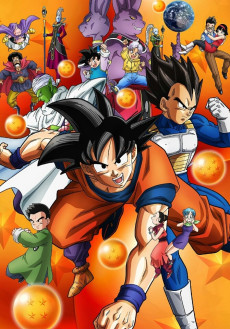
Dragon Ball Super
After 18 years, we have the newest Dragon Ball story from creator Akira Toriyama. With Majin Buu defeated, Goku has taken a completely new role as...a radish farmer?! With Earth at peace, our heroes have settled into normal lives. But they can’t get too comfortable. Far away, the powerful God of Destruction, Beerus, awakens to a prophecy revealing his demise at the hands of an even more formidable being. When his search for the Saiyan God brings him to Earth, can Goku and his friends take on their strongest foe yet?
(Source: Crunchyroll)
📺Anime Details
📝Editorial Analysis
The smell of burnt radishes hangs in the air—charred, earthy, absurd—while Goku, barefoot and grinning, kicks up dirt in a sun-drenched field, his gi flapping like a banner nobody asked for. Then, without warning, the sky shatters. Not with thunder, but with silence—absolute, vacuum-deep—and the slow, impossible descent of a purple-skinned god who breathes starlight and carries extinction in his smirk. That whiplash—from radish rows to cosmic dread—is Dragon Ball Super’s heartbeat.
It doesn’t just move between scales; it collapses them. One second, you’re watching Beerus nap on a floating couch shaped like a crescent moon, tail twitching as he dreams of pudding. The next, you’re staring into the hollow eyes of a being who unmade universes for breakfast—and yet, Goku’s laugh cuts through it all, raw and unbroken. This isn’t tonal whiplash as flaw—it’s intentional vertigo. It makes you feel small, then invincible, then tired, then giddy, often in the same five-minute stretch. It asks you to hold contradiction like a sacred object: that peace is fragile, power is absurd, gods are petty, and love—not ki, not technique, not even divinity—is what bends fate. You don’t watch it to believe in strength. You watch it to remember how alive disbelief feels.
That emotional DNA—the reverence for mythic scale and domestic absurdity, the thrill of spectacle that never forgets its heart—echoes in three real games from the list. Quake III Arena drops you into an arena where “the greatest warriors of all time and space have been summoned to battle for the amusement of an ancient alien race.” Just like Beerus and Whis turning Earth into a proving ground, or the Tournament of Power reducing multiversal survival to a bloodsport judged by bored deities—there’s the same gleeful, almost cruel theatricality. A player notes it’s still alive online “as of typing this,” and that’s key: like Dragon Ball Super, it thrives on shared, immediate spectacle—no lore dumps, no cutscene weight, just bodies in motion, physics defying gravity, ego colliding with consequence. The joy is in the collision itself.
Then there’s STAR WARS™ Jedi Knight - Jedi Academy™, where you “build out a Padawan—who is then thrust into a Galaxy-spanning adventure.” Notice the phrasing: not “you become a Jedi,” but you build out one—like Goku building Ultra Instinct not as a final form, but as a practice, a flawed, evolving self. The review calls it a “Galaxy-spanning adventure to help…”—unfinished, open-ended, echoing how Dragon Ball Super treats legacy: not as inheritance, but as invitation. Both refuse to let destiny be pre-written. They trust the player/viewer to lean in, to sweat, to fail mid-air, to get back up—not because they’re destined to win, but because the act of trying matters more than the outcome.
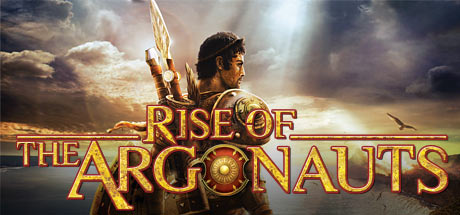
And Rise of the Argonauts, where Jason—“King of Iolcus… prosperous kingdom, respect, beautiful fiancé”—loses it all on his wedding day and vows anything to restore her. That grief isn’t abstract. It’s visceral, human-scale, buried under mythic stakes. Like when Goku begs Whis to revive Krillin—not with godly power, but with a voice cracking on the word please. The anime doesn’t shy from making gods weep over radishes or broken promises. Neither does this game: “If you love games based on ancient history this one does it right…”—not because it’s accurate, but because it treats myth as emotional architecture, not costume. It understands that every god, every alien, every universe-ending threat only lands if the soil beneath it is real.
This pairing isn’t for fans of “strong heroes” or “cool fights.” It’s for the person who cried when Beerus spared Earth—not because he was merciful, but because he tasted a good meal and decided, on a whim, that life was worth keeping. It’s for the player who spends hours tweaking their Padawan’s stance in Jedi Academy, not to win, but to feel the weight of the saber hilt. It’s for the one who still logs onto a Quake III Arena server at 2 a.m., not for rank, but for the sound of a railgun crack echoing across galaxies—then laughs, because yeah, it’s ridiculous, and that’s exactly why it matters. They know greatness isn’t polished. It’s messy, hungry, humble, and always, always one radish away from changing everything.
🎮32 Games That Match the Vibe




Match Dimensions Explained
❓Frequently Asked Questions
Why does Quake III Arena feel like a Dragon Ball Super fight even though it's sci-fi?
Because the moment-to-moment combat—blazing-fast movement, instant weapon swaps (like the rocket launcher’s splash damage or the railgun’s one-shot precision), and arena-based 1v1/4v4 showdowns—mirrors DBS’s high-stakes, momentum-driven sparring. Players report duking it out on maps like 'Q3DM17' with the same adrenaline rush as Goku vs. Jiren, especially when chaining strafe-jumps and air-control like they’re dodging Kamehamehas.
Is there a Dragon Ball Super game adaptation that actually covers the Tournament of Power arc?
No—there’s no official Dragon Ball Super game covering the Tournament of Power. Instead, fans looking for that scale and spectacle turn to games like STAR WARS™ Jedi Knight - Jedi Academy™, where you build your own Padawan, unlock Force powers (think telekinetic throws and lightning dashes), and face off in massive, physics-bending duels across varied arenas—capturing DBS’s over-the-top escalation without licensing the anime directly.
How does Rise of the Argonauts compare to Loki for mythological action that feels like Dragon Ball Super?
Rise of the Argonauts nails the heroic, larger-than-life tone—Jason’s rage-fueled combat, divine power-ups like Zeus’s lightning strike or Poseidon’s tidal slam, and cinematic set-pieces (e.g., storming the Temple of Ares) deliver DBS-style spectacle with emotional weight. Loki tries similar ground with its Norse hero, but player reviews call out constant crashes and an anticlimactic ending—so if you want mythic intensity *without* breaking your save file, Argonauts is the safer, more polished pick.
What’s the best Dragon Ball Super-like game if I just want nonstop, cathartic action without story fatigue?
DOOM + DOOM II—it’s pure, unrelenting spectacle: ripping through hordes of demons with the BFG, chaining glory kills, and moving at breakneck speed across hellish arenas mirrors DBS’s ‘fight first, talk later’ energy. As one fan put it, it was the reason they built their first PC in ’93—and that raw, tactile joy of blasting enemies while barely touching the ground? That’s Goku going Ultra Instinct in spirit, no ki meter required.