
Tengoku Daimakyo
In the year 2024, the world has collapsed. Grotesque monsters lurk amongst the ruins of Japan, while remaining people scrape together what they can to survive. Kiruko, an odd-job girl in Nakano, accepts a mysterious woman's dying wish to take a boy named Maru to a place called Heaven.
(Source: Disney+, edited)
📺Anime Details
📝Editorial Analysis
The silence after the rain in Nakano isn’t peaceful—it’s heavy, thick with the smell of wet concrete, rust, and something faintly organic, like spoiled fruit left too long in a sealed room. Kiruko walks beside Maru, her boots scuffing over cracked pavement where weeds punch through asphalt like desperate fingers. She doesn’t hold his hand. She doesn’t look at him much. But when she does—just once, as a distorted shadow flickers across a broken department store window—her breath catches, not in fear, but in recognition. Not of the monster. Of the weight in his small shoulders. That moment isn’t about action or exposition. It’s about carrying grief so quietly it becomes architecture.
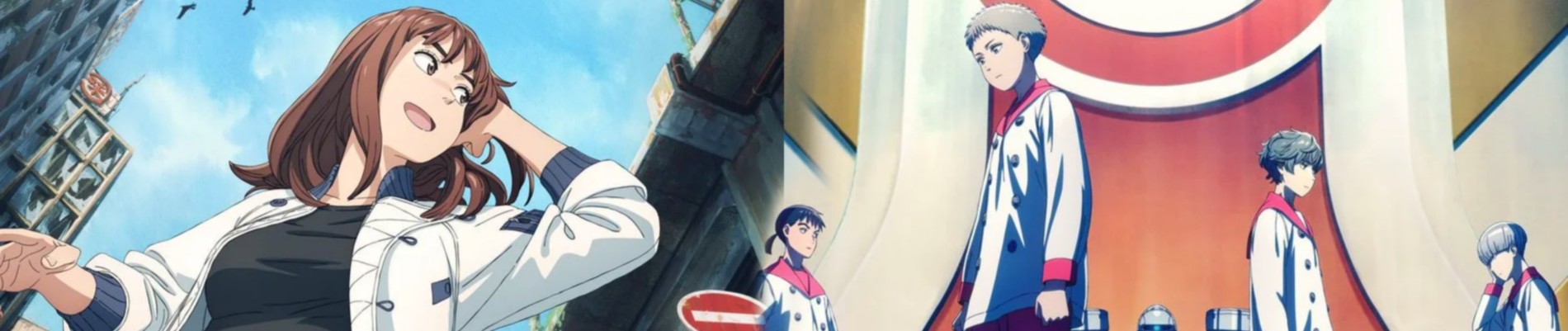
That’s the atmosphere of Tengoku Daimakyo: a slow-burn melancholy that lives in the gaps between words, in the way light falls across ruined train platforms, in how survival isn’t heroic—it’s logistical, weary, intimate. It’s not dystopia as spectacle, but as texture: the frayed edge of Kiruko’s jacket, the hum of a dying generator, the way Maru blinks too slowly after hearing a name he shouldn’t know. This isn’t adrenaline-driven dread. It’s resonant dread—the kind that lingers in your ribs hours after the episode ends, whispering questions about memory, consent, and what “heaven” means when the ground itself has forgotten how to hold you.
S.T.A.L.K.E.R.: Shadow of Chernobyl shares that same resonant dread—not through cutscenes or exposition, but through geography. Its Zone isn’t just dangerous; it’s alive with absence. The player review notes how you fear “not only the radiation, anomalies and deadly creatures, but other S.T.A.L.K.E.R.s”—a layered tension where threat comes from environment, physics, and human desperation alike. Like Kiruko navigating Nakano’s ruins, you learn the Zone by listening, by noticing how wind shifts before an anomaly flares, by reading the silence between radio static bursts. Both demand embodied attention: every step matters because the world refuses to explain itself.
Then there’s BioShock, whose description flags it as “Adult & Dark Seinen”—a rare, precise label for a game that treats its player not as a power fantasy, but as a witness. Its political thriller dimension isn’t about speeches—it’s about peeling back ideology like rotten wallpaper in Rapture’s flooded halls. The player review calls it “revolutionary,” and it is—but not for its guns. For how its world accuses you. Kiruko’s journey mirrors that: every clue about Heaven, every fragmented memory triggered by body-swapping, every whispered conspiracy isn’t plot candy—it’s moral sediment. You don’t solve the mystery; you absorb its weight, just as BioShock forces you to confront the cost of objectivist utopias in real time, breath by breath.
Even Assassin’s Creed™: Director's Cut Edition, buried beneath dated textures and early-gen tech, pulses with the same melancholic exploration. Its description cites “Political Thriller” and “Dark Fantasy”—but what sticks is how Altair moves through Jerusalem’s sun-bleached alleys: not as a conqueror, but as a man haunted by duty, his parkour less flashy than ritualistic, each rooftop landing echoing with isolation. The player review admits flaws—but says “no issues with me.” Why? Because the feeling transcends polish: the hush before an assassination, the way history feels less like backdrop and more like gravity. Kiruko’s journey has that same hush. Her odd-job existence isn’t filler—it’s the quiet labor of keeping meaning alive in a world that’s stopped assigning it.
Who loves this pairing? Not just fans of “post-apocalyptic stuff.” It’s the person who replays the opening 90 seconds of S.T.A.L.K.E.R. just to hear the wind rattle through abandoned buildings. It’s the one who paused BioShock mid-dialogue—not to skip, but to stare at a crumbling fresco of Andrew Ryan’s face, tracing the cracks with their eyes. It’s the viewer who watches Kiruko adjust Maru’s backpack strap—not because it’s cute, but because that tiny gesture holds more narrative weight than ten exposition dumps. They’re drawn to stories where silence is calibrated, where trauma isn’t dramatized but worn, and where “heaven” isn’t a place—it’s the unbearable, beautiful act of continuing to walk forward, even when every step echoes.
🎮66 Games That Match the Vibe














Match Dimensions Explained
❓Frequently Asked Questions
Why does Assassin's Creed: Director's Cut Edition show up in 'Games Like Tengoku Daimakyo' matches?
Tengoku Daimakyo leans hard into melancholic exploration and political thriller vibes—think quiet, weighty moments wandering ancient, layered spaces with moral ambiguity hanging in the air. Assassin's Creed fits *because* of its hauntingly atmospheric Jerusalem and Damascus districts, Altaïr’s silent, introspective journey through power structures, and that slow-burn tension where every rooftop perch feels like both sanctuary and surveillance—exactly the kind of somber, politically textured worldbuilding fans love in Tengoku Daimakyo.
Is there an anime or manga adaptation of S.T.A.L.K.E.R.: Shadow of Chernobyl?
Nope—S.T.A.L.K.E.R. has never gotten an official anime or manga adaptation, despite its rich, eerie lore and cult following. Unlike Tengoku Daimakyo (which *does* have anime roots), the Zone stays firmly in-game: think the rusted Ferris wheel at Pripyat, the whispering anomalies near Jupiter Factory, or your first tense standoff with a Bloodsucker in the dark—all built through environmental storytelling, not licensed adaptations.
How is BioShock different from RAGE when both are listed as 'Games Like Tengoku Daimakyo'?
BioShock nails the *adult & dark seinen* + *political thriller* layers—Andrew Ryan’s speeches, the Little Sisters’ tragic mechanics, and Rapture’s decaying Art Deco grandeur all mirror Tengoku Daimakyo’s philosophical weight and emotional gravity. RAGE, meanwhile, shares the *cyberpunk & dystopia* tag but leans into explosive vehicle combat and id Tech 5’s raw spectacle—more Mad Max than melancholy philosophy, with less narrative depth and zero moral ambiguity about who’s shooting whom.
What’s the best 'Games Like Tengoku Daimakyo' pick if I want something deeply emotional but low-stakes and relaxing?
Go straight to Chains—it’s the outlier that *works* for this mood. While it’s a match-3 arcade game (not a narrative RPG), its gentle physics-driven bubble-linking, soft color palette, and unhurried pacing create a meditative flow—like watching cherry blossoms fall in slow motion. Players say it ‘reminds me of Connect 4 in a nutshell’, and that calm, tactile satisfaction? That’s your Tengoku Daimakyo-esque emotional respite without the existential dread.