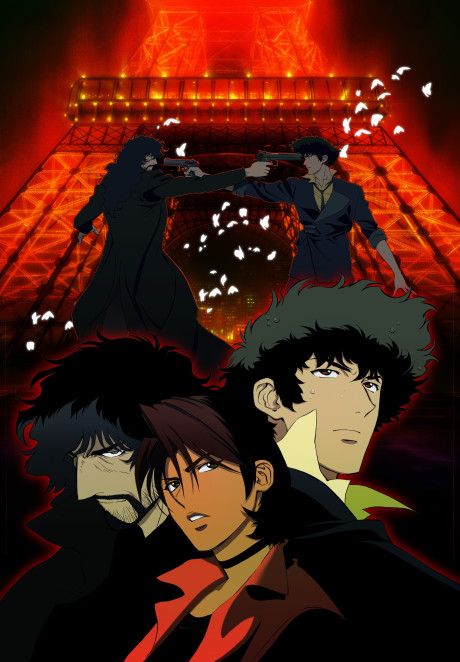
Cowboy Bebop: The Movie - Knockin' on Heaven's Door
As the Cowboy Bebop crew travels the stars, they learn of the largest bounty yet, a huge 300 million Woolongs. Apparently, someone is wielding a hugely powerful chemical weapon, and of course the authorities are at a loss to stop it. The war to take down the most dangerous criminal yet forces the crew to face a true madman, with bare hope to succeed.
(Source: Anime News Network)
📺Anime Details
📝Editorial Analysis
Rain slicks the neon-drenched streets of Mars City—not gently, but in cold, insistent sheets that blur the flicker of holographic ads and turn alleyways into liquid mirrors. Spike Spiegel stands beneath a broken awning, coat collar up, breath fogging in the chill. He doesn’t draw his gun yet. He just watches—listens—as distant sirens warp through the downpour like wounded birds. That silence before the storm isn’t calm. It’s weighted. Heavy with memory, regret, and the quiet certainty that no one walks away clean.
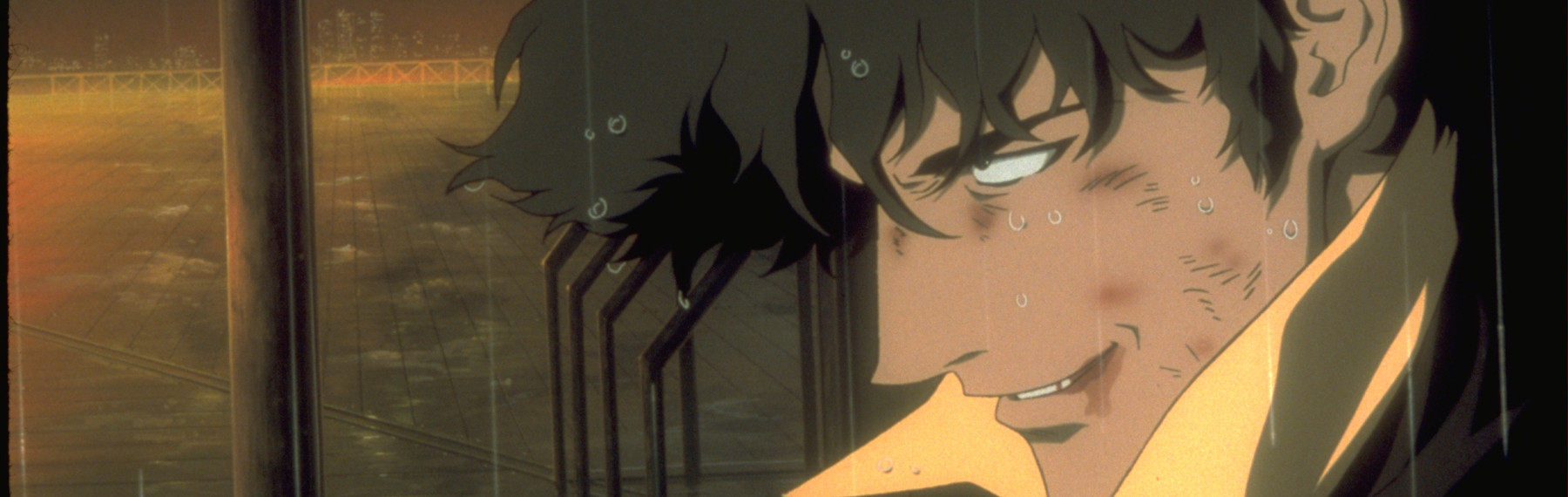
That’s the heartbeat of Cowboy Bebop: The Movie - Knockin' on Heaven's Door: not spectacle, but resonance. It’s the way dread pools in your chest when the camera lingers on a child’s abandoned toy in an evacuated sector—or how the score drops out entirely as a chemical weapon’s timer ticks down in near-total darkness. This isn’t sci-fi as escapism. It’s sci-fi as echo chamber: urban decay folded into orbital drift, martial arts choreography that feels less like combat and more like exhausted conversation, philosophy whispered between gunshots. You don’t feel excited watching it—you feel hollowed, then strangely anchored, like you’ve just caught your breath after holding it for years. It makes you think about consequence—not as plot device, but as gravity.
Max Payne shares that same hollowed-out rhythm. Its description calls it “a man with nothing to lose in the violent, cold urban night”—and that’s Spike in the rain, Jet nursing whiskey at 3 a.m., Faye staring at her reflection in a cracked viewscreen. The player review mentions passing the controller after death—not as frustration, but as ritual: shared exhaustion, shared futility. That’s the DNA match. Both Max Payne and Knockin’ on Heaven’s Door treat violence not as catharsis, but as symptom—of systems failing, of pasts refusing to stay buried, of men who’ve long since stopped believing in exits. The noir isn’t visual shorthand; it’s psychological weather.
Then there’s Max Payne 2: The Fall of Max Payne, described as “a violent, film-noir love story. Dark, tragic and intense.” Not “romance”—love story, with all its unbearable tenderness and terminal stakes. Spike and Julia weren’t given time. Neither are Max and Mona. The player review praises “shocking twists and revelations”—but what lands hardest isn’t the surprise, it’s the inevitability. Like the moment in the film when the crew realizes the terrorist isn’t some cartoon villain, but a shattered idealist weaponizing despair—that same gut-punch lives in Max Payne 2’s final corridor, where every bullet feels like a confession.
And Hitman: Codename 47? Its description frames the assassin as “enigmatic,” operating with “stealth and tactical problem solving” for a price—but crucially, with access. Not to weapons or intel, but to contexts: embassies, penthouses, war-torn hospitals. That’s the Bebop’s entire operating mode—entering spaces already saturated with history, reading the room before the first shot, knowing the real target is rarely the one named in the bounty. The player review admits it’s “jank” and “old,” but insists it’s playable if you know how to read it. Exactly like Knockin’ on Heaven’s Door: its mystery isn’t solved by deduction alone—it’s unraveled by listening to silences, by noticing how a scientist flinches at the word “vaccine,” by understanding that terrorism here isn’t ideology—it’s amnesia made manifest, and the cure is worse than the disease.
This isn’t for the viewer who wants closure. It’s for the one who keeps the last frame of a dying starship burning in their peripheral vision long after the credits roll. It’s for the player who reloads not to win, but to witness—to see how light catches dust in a derelict lab, or how a single misplaced footstep changes everything. It’s for people who understand that noir isn’t a genre—it’s the color of truth when the lights go out.
🎮52 Games That Match the Vibe





Match Dimensions Explained
❓Frequently Asked Questions
Why does Max Payne 2 match Cowboy Bebop: The Movie so well?
Because both are tragic, rain-slicked noir love stories with morally gray antiheroes haunted by loss—Max’s grief over Mona and Spike’s final confrontation with Vicious mirror that same aching, fatalistic tone. The slow-motion gunfights in Max Payne 2 (like the iconic opera house shootout) echo the balletic, melancholic action of 'Knockin’ on Heaven’s Door', especially when paired with its jazz-tinged score and voiceover narration.
Is there a Hitman game that captures the lone-wolf, existential vibe of Cowboy Bebop: The Movie?
Yes—Hitman: Codename 47 nails it: Agent 47 is a stoic, emotionally detached outsider moving through shadowy, stylized locales (like the neon-drenched Hong Kong hotel or the eerie Siberian monastery), just like Spike drifting between Tokyo and Mars. Its emphasis on silent observation, improvisational kills, and cold, poetic detachment—plus that iconic barcode tattoo echoing Spike’s lone-wolf symbolism—hits the same existential, atmospheric notes.
How does Desperados 2 compare to Max Payne 2 for Cowboy Bebop fans?
Desperados 2 leans into ensemble tactics and wild-west pacing—think crew banter and coordinated ambushes—while Max Payne 2 is all about solitary, brooding intensity and cinematic, slow-mo set pieces (like the warehouse finale). If you loved Spike’s solo descent into the asteroid base, Max Payne 2’s tight, personal tragedy fits better; if you preferred the Bebop crew’s chemistry and planning, Desperados 2’s squad-based stealth might surprise you.
What’s the best game like Cowboy Bebop: The Movie if I want that rainy, jazz-noir mood and zero hand-holding?
Max Payne is your strongest pick—it drops you straight into a gritty, rain-soaked NYC night as a framed cop with no allies, no backup, and a voiceover dripping with world-weary irony. The ‘bullet time’ mechanic feels like Spike’s hyper-focused moments before a fight, and scenes like the snow-covered alleyway shootout or the subway tunnel chase hit that exact blend of melancholy, style, and raw tension you remember from the film’s opening.