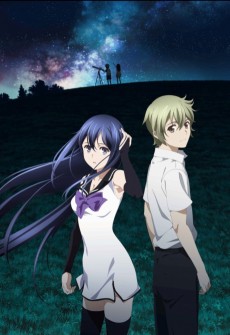
Brynhildr in the Darkness
📺Anime Details
📝Editorial Analysis
Rain slicks the pavement like oil on black glass. A girl in a hospital gown stumbles barefoot across an overpass at midnight, her breath ragged, one hand pressed to a wound that shouldn’t exist—blood welling between her fingers, not red but violet, shimmering faintly before it cools and darkens. She doesn’t scream. She just looks back—not at pursuers, but at the city’s indifferent glow—and blinks, as if trying to remember what blinking means. That moment isn’t action. It’s erosion. The slow, quiet unspooling of self.
That’s the atmosphere: dread without spectacle. Not horror as jump-scare or gore-as-spectacle (though the Brynhildr in the Darkness tag confirms the presence of gore), but dread as accumulation—of memory loss, of violated autonomy, of bodies weaponized without consent. It’s amnesia not as plot device but as lived disorientation; urban fantasy stripped of wonder, reduced to alleyways where magic smells like antiseptic and burnt wiring. This isn’t about power fantasy—it’s about the suffocation of being known before you know yourself, watched by institutions that catalog your trauma like lab specimens. You don’t feel heroic. You feel unmoored, watching characters orbit each other in gravitational collapse—tragedy not as fate, but as bureaucratic inevitability.
The resonance with Return of the Obra Dinn hits like cold static. Its score flags Mystery & Detective, Emotional Narrative, Adult & Dark Seinen—same dimensions that anchor Brynhildr in the Darkness. But look deeper: both force you to reconstruct meaning from fragmented, often traumatic evidence. In Obra Dinn, you stare at frozen, grotesque tableaus—bodies mid-scream, limbs twisted, eyes wide—not for shock, but because truth is buried in the silence between frames. Just like Brynhildr in the Darkness, where every recovered memory feels less like revelation and more like forensic excavation: a girl’s name, a lab ID number, the exact angle of a scalpel in a flashback. No exposition. Just consequence, rendered in stillness.
Then there’s The Witcher 3: Wild Hunt, tagged Dark Fantasy, Emotional Narrative, Adult & Dark Seinen. Its description centers Geralt tracking “Ciri — the Child of Prophecy,” a girl hunted, altered, erased and rewritten by forces far older and colder than any human agency. Player reviews praise its emotional weight—“DLC announced 11 years after release, my favourite game keeps getting better…”—not for spectacle, but for how deeply it lives in moral residue. Like Brynhildr in the Darkness, it refuses catharsis. Choices aren’t binary—they’re stains. Ciri’s arc mirrors the anime’s core tension: what does it mean to reclaim personhood when your body has been engineered, your memories overwritten, your very biology treated as prototype? Both treat power not as liberation, but as another kind of cage—super power made tragic by design.
Even The Witcher 2: Assassins of Kings Enhanced Edition, with its description of “a time of untold chaos” and “armies on the march [that] are not enough to stop a b…”—that trailing “b” feels intentional, like a breath cut short—mirrors Brynhildr in the Darkness’s structural unease. Its player review calls it “more thoughtfully designed than the next entry,” hinting at restraint, at narrative density over scale. Same here: no grand battles, just tense, claustrophobic confrontations in stairwells and abandoned clinics, where violence is clinical, sudden, and quietly devastating. The female harem tag isn’t fan service—it’s pathology refracted: multiple girls, each a variation on violation, each orbiting the male protagonist not as romantic options, but as shared wounds.
This pairing isn’t for fans of “cool powers” or “epic stakes.” It’s for people who linger on the nudity not as titillation, but as vulnerability—skin exposed not for desire, but because clothes were torn off during extraction. For those who read seinen not as demographic, but as tone: adult not in age, but in exhaustion. Who understand that gore here isn’t blood for blood’s sake—it’s the physical grammar of erasure. Who feel magic not as wonder, but as violation made manifest. If you’ve ever stared at a rain-slicked overpass in your own city and wondered what ghosts walk unseen beneath the streetlights—if you ache for stories that treat trauma not as backstory, but as architecture—then these aren’t matches. They’re echoes. Quiet, violet, and utterly unforgettable.
🎮85 Games That Match the Vibe
































Match Dimensions Explained
❓Frequently Asked Questions
Why does Return of the Obra Dinn match Brynhildr in the Darkness so well despite having no combat or dialogue?
Because both hinge on unraveling a tightly wound, emotionally devastating mystery through fragmented, time-looped revelations—Obra Dinn’s monochrome vignettes echo Brynhildr’s nonlinear flashbacks to traumatic lab experiments and memory suppression scenes. The game’s ‘deduction grid’ mechanic forces you to sit with ambiguity like Brynhildr’s protagonists do when confronting suppressed identities or hidden powers—no hand-holding, just quiet dread and sudden, gut-punch realizations.
Is there a Brynhildr in the Darkness video game adaptation?
No—there’s never been an official game adaptation. But fans who crave that same blend of dark seinen tension, psychic trauma, and morally gray scientific ethics often land on The Witcher 3: Wild Hunt, where Geralt’s investigations into cursed bloodlines, forbidden experiments (like the Lodge’s mutant trials), and Ciri’s forced containment mirror Brynhildr’s core themes beat-for-beat.
How does The Witcher 2 compare to Return of the Obra Dinn for someone who loves Brynhildr’s slow-burn psychological weight?
They’re polar opposites in pacing but united in emotional gravity: Obra Dinn drops you into silence and stillness to piece together fate; The Witcher 2 throws you into tense political interrogations (like questioning Saskia in Vergen) where every choice reshapes trust and consequence—just like Brynhildr’s characters navigating betrayal under surveillance. Both demand attention to subtext, not spectacle.
What’s the best Brynhildr-in-the-Darkness-like game if I want that oppressive, lab-coat-and-steel-corridor vibe with zero action?
Return of the Obra Dinn is your answer—it nails the clinical dread of Brynhildr’s underground facility scenes through its stark black-and-white visuals, timed memory snapshots (like watching Kuroda’s suppressed memories flicker in and out), and zero combat. You’re not fighting monsters—you’re reconstructing tragedy, one chilling, silent frame at a time, exactly like deciphering the truth behind Mako’s cryo-chamber logs.