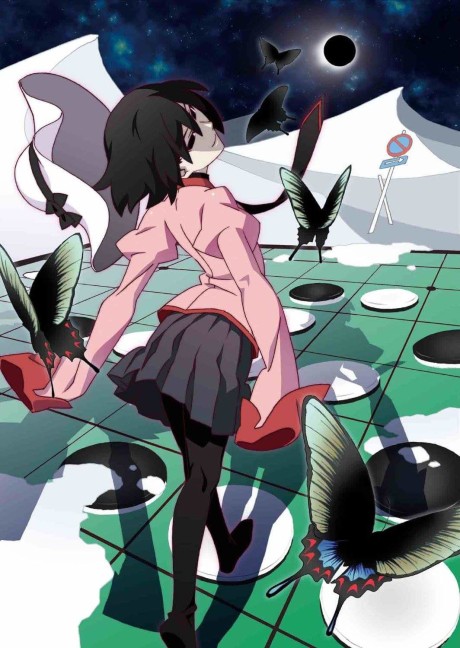
Owarimonogatari
Third and “Final Season” of the Monogatari Series, part 3/5. Contains the arcs Ougi Formula, Sodachi Riddle, Sodachi Lost and Shinobu Mail from the Owarimonogatari light novels.
During the month of October of his third year in high school, Koyomi Araragi is introduced to a transfer student named Ougi Oshino by his underclassman Suruga Kanbaru. Ougi tells Koyomi that she has something she wishes to consult with him. When she draws the map of Naoetsu High School, she finds something peculiar on there. This discovery reveals a tale that wasn’t meant to be told, and this makes Koyomi’s high school life totally different. This is the story that brings to light “what” makes Koyomi Araragi. This is the story that reveals the “beginning” of everything.
(Source: Aniplex)
Note: The first episode aired with a runtime of ~48 minutes as opposed to the standard 24 minute long episode.
📺Anime Details
📝Editorial Analysis
The fluorescent hum of a high school classroom in October—Koyomi Araragi staring at Ougi Oshino’s hand-drawn map of Naoetsu High, her pencil hovering just above the floor plan as if tracing not architecture but absence. That pause—before she says, “There’s something here that shouldn’t be”—is where Owarimonogatari lives: not in spectacle, but in the quiet, suffocating weight of what’s missing, what’s unspoken, what’s been erased from memory and yet refuses to vanish. It’s the sound of a breath held too long—not for suspense, but for grief.
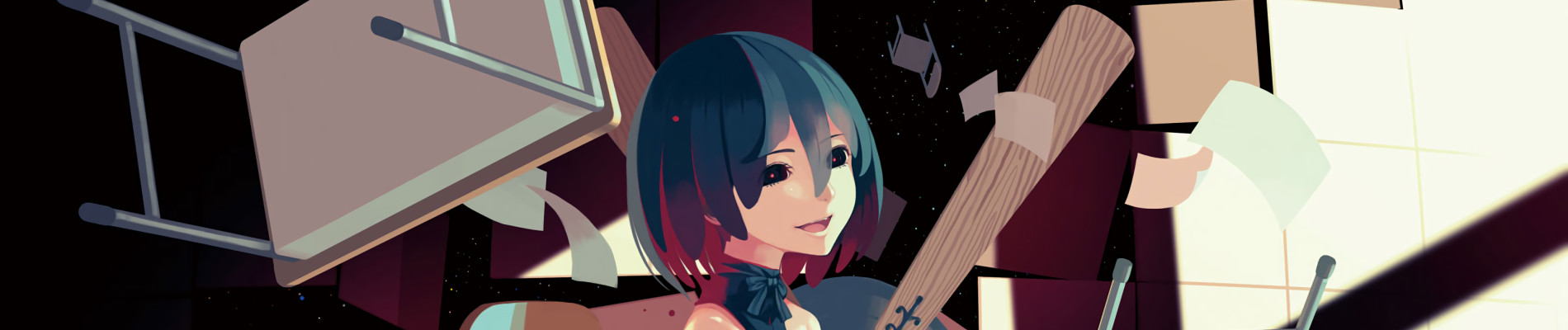
This isn’t urban fantasy as escapism. It’s urban fantasy as autopsy. Every hallway, every stairwell, every empty desk is saturated with the residue of choices already made, wounds already scarred over but still tender. The achronological order doesn’t disorient—it retraces: like flipping through a notebook where pages are out of sequence because the writer couldn’t bear to face them in order. You don’t watch Owarimonogatari to solve a mystery—you watch to feel the slow, grinding realization that the mystery is the self. That suicide isn’t a plot point but a gravitational center; that tragedy isn’t dramatic climax but ambient weather; that philosophy isn’t debated in lectures but breathed in silences between sentences. It makes you think about how language fails us—not as a quirk, but as a wound. How confession becomes performance. How love wears the mask of interrogation. How loneliness can echo louder than any vampire’s roar.
That emotional DNA pulses strongest in Disco Elysium - The Final Cut, where you play a detective whose mind is literally fractured across skill branches—Logic, Empathy, Esprit de Corps—each voice arguing against the others while you stand in rain-slicked ruins trying to reconstruct not a crime scene, but yourself. The description calls it “a groundbreaking role playing game” with “a whole city to carve your path across”—but the real terrain is interior: guilt, addiction, ideological collapse. A player review quotes capital subsuming critique—a line that lands like a hammer in Owarimonogatari’s world, where every conversation with Ougi or Sodachi feels like ideology performing autopsy on itself. Both refuse catharsis. Both make you sit with the unbearable thickness of consequence.
Then there’s The Witcher 3: Wild Hunt, described as tracking “Ciri—the Child of Prophecy” across a “war-torn, monster-infested continent.” But the monsters aren’t just outside—they’re inherited, internalized, passed down like trauma. Geralt’s quest isn’t linear; it folds back on itself, haunted by choices in Velen, Novigrad, Skellige—choices that linger, that mutate meaning over time, just like Koyomi’s October unraveling across arcs titled Riddle, Lost, Mail. A player review notes the DLC announced 11 years later—proof that the story refuses to close, that its emotional architecture keeps expanding outward, demanding reinterpretation. That’s Owarimonogatari’s rhythm: not resolution, but reverberation.
Even The Witcher 2: Assassins of Kings Enhanced Edition, described as a time of “untold chaos” where “armies on the march are not enough to stop a b…” (the sentence cuts off—just like so many truths do in Owarimonogatari)—mirrors the anime’s obsession with systems collapsing under their own weight: political, psychological, linguistic. A player calls it “more thoughtfully designed than the next entry,” praising its structural rigor—echoing how Owarimonogatari’s rigid formalism (dialogue-heavy, static shots, obsessive repetition) isn’t austerity—it’s control, a desperate scaffolding against entropy.
Who would love these pairings? Someone who reads Nietzsche not for answers but for the tremor in his syntax. Someone who replays a dialogue tree not to optimize outcomes but to hear how the same words land differently when spoken from a different mental state. Someone who watches Koyomi stare at a blank wall for 47 seconds—not bored, but attending. Someone who knows that the most devastating tragedies aren’t loud—they’re the ones that settle into your ribs and stay there, quiet, inescapable, inescapably human.
🎮81 Games That Match the Vibe





Match Dimensions Explained
❓Frequently Asked Questions
Why is The Witcher 3 always the top match for Owarimonogatari fans?
Because both lean hard into layered, emotionally fraught character arcs with morally ambiguous choices — like Geralt’s agonizing decision at the end of the Bloody Baron questline, or Koyomi’s quiet, devastating confrontation with Oshino in the final arc. The Witcher 3’s adult & dark seinen tone, dense dialogue, and emphasis on consequence-heavy storytelling (plus that haunting, introspective score) mirror Owarimonogatari’s psychological weight and narrative precision.
Is there an anime or visual novel adaptation of Disco Elysium?
No — Disco Elysium has no anime or visual novel adaptation (and likely never will). It’s a deeply text-driven, system-heavy RPG where your internal monologue *is* the story — think Harry DuBois arguing with his own Skill Checks about capitalism while staring at a rain-slicked alley in Revachol. That’s why fans love it as a match for Owarimonogatari: both use dense, self-referential dialogue and unreliable narration instead of cutscenes or voice acting to build tension.
How does Crash Time 2 compare to The Witcher 2 for someone who loves Owarimonogatari’s tone?
It doesn’t — Crash Time 2 is basically the *opposite*: janky arcade racing with awful controls and zero narrative depth (one reviewer bluntly called it 'factually BAD controls'). Meanwhile, The Witcher 2 delivers the exact emotional gravity and political intrigue Owarimonogatari fans seek — like Roche’s tragic loyalty arc or the morally gut-punching ending where your choices fracture friendships and kingdoms. Skip Crash Time 2; go straight to Witcher 2’s 'A Matter of Life and Death' chapter.
What’s the best game like Owarimonogatari if I want that late-night, melancholic, overthinking vibe?
Disco Elysium — hands down. Picture sitting alone in a damp hotel room in Martinaise, your Skills whispering contradictory theories while you stare at a half-drunk bottle of whiskey… that’s the same exhausted, hyper-verbal, philosophically spiraling headspace as Koyomi dissecting his own guilt in the lighthouse scene. Its adult & dark seinen dimension, emotional narrative pacing, and relentless interiority make it the perfect companion for that 3 a.m. existential reread energy.