Akiba Maid War
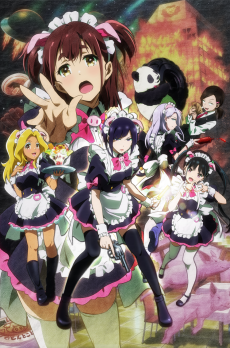
Akihabara is the center of the universe for the coolest hobbies and quirkiest amusements. In the spring of 1999, bright-eyed Nagomi Wahira moves there with dreams of joining a maid café. She quickly dons an apron at café Ton Tokoton, AKA the Pig Hut. But adjusting to life in bustling Akihabara isn’t as easy as serving tea and delighting customers. Paired with the dour Ranko who never seems to smile, Nagomi must do her best to elevate the Pig Hut over all other maid cafés vying for top ranking. Along the way she’ll slice out a place for herself amid the frills and thrills of life at the Pig Hut. Just when Nagomi’s dreams are within her grasp, she discovers not everything is as it seems amid the maid cafés of Akihabara.
(Source: HIDIVE)
📺Anime Details
📝Editorial Analysis
The clatter of porcelain on lacquered wood. The sharp hiss of steam escaping a kettle just as Nagomi Wahira’s hand trembles—not from fear, but from the weight of Ranko’s silent gaze across the counter of café Ton Tokoton. It’s spring 1999 in Akihabara, and the air smells of burnt sugar, dust motes dancing in neon-bleached light, and something sharper beneath: tension coiling like wire inside a maid’s starched apron. Nagomi pours tea with practiced grace—but her wrist wobbles just once. That tiny tremor is the whole show: a girl trying to serve joy while standing knee-deep in a world where loyalty is measured in bullet counts and café rankings are settled with silenced pistols.

This isn’t parody as wink-and-nudge farce. Akiba Maid War’s atmosphere is dual-frequency: one channel humming with the warmth of ritual—bowing, honorifics, the soft chime of a doorbell—and the other vibrating with cold, procedural dread. You feel it in the way Ranko never smiles, not even when the café hits its daily quota; in how “Pig Hut” isn’t a joke—it’s a territory, a name spat like gravel. It’s the dissonance of pastel uniforms against the gunmetal glint of a concealed sidearm under a frilly sleeve. What lingers isn’t the action or the comedy—it’s the exhaustion of performance, the quiet grief of women who’ve traded dreams for duty, and the terrifying clarity that in this world, kindness is both weapon and wound.
That emotional DNA—neon noir realism draped over ritualized violence, where every smile is calibrated and every silence loaded—echoes unmistakably in certain games. Take Assassin's Creed™: Director's Cut Edition, whose description positions it as redefining action through “tactical warfare” and “next-gen” immediacy—even if player reviews admit its models are dated. That friction between polished intent and tactile roughness mirrors Akiba Maid War’s own texture: the anime doesn’t hide its genre scaffolding (yakuza tropes, maid café kitsch), yet treats them with such granular seriousness that the artifice deepens the pathos. Like Altaïr moving through Damascus with lethal precision wrapped in spiritual doubt, Nagomi moves through Akihabara with a tray held high and a heart learning how to lock itself.
Then there’s Vampire: The Masquerade - Bloodlines, tagged with neon noir and dark fantasy, described as blending “core RPG elements with… brutal combat.” Its player review insists you must “BUY IT ON GOG”—not for convenience, but because the game requires intervention to function properly, to reveal its true self beneath broken code. That’s Akiba Maid War in a nutshell: a story that only breathes fully when you accept its contradictions—the absurdity of maids in tactical formation, the tragedy buried under service-industry banter. Both demand you lean in, patch the gaps yourself, and find meaning in the seams.
And Hitman 2: Silent Assassin, where the description frames the protagonist as a retired assassin forced back into action by treason, bound by “a sense of loyalty and justice” in a world “corrupted by…”—the sentence cuts off, but the implication hangs thick. Player reviews note graphics are merely decent, yet the reality blurs when you’re deep in a mission. That same moral fog blankets Akiba Maid War: no one here is purely villain or victim. Loyalty fractures along café lines, justice wears a frilly collar, and every “assignment” (a rival maid’s sabotage, a supplier’s betrayal) forces Nagomi to recalibrate what “right” means when survival is non-negotiable.
This pairing isn’t for fans of slick power fantasies. It’s for the ones who pause mid-episode to stare at Ranko’s hands—calloused, steady, wiping the same spot on the counter for seventeen minutes straight—and wonder what muscle memory lives there. It’s for players who reload after a failed stealth takedown not to win, but to understand the rhythm of consequence. They’re drawn to stories where the most violent moment isn’t a gunshot—it’s a sigh held too long, a bow held a half-second past protocol, the weight of a name like “Ton Tokoton” echoing in an empty dining room at 3 a.m. These are people who don’t want escape. They want resonance—in the clink of porcelain, the hiss of steam, the quiet, relentless hum of a world that runs on both devotion and danger.
🎮66 Games That Match the Vibe





























Match Dimensions Explained
❓Frequently Asked Questions
Why does Akiba Maid War feel so different from Hitman: Codename 47 even though both are stealth assassinations?
Great question — it’s all about tone and execution. Akiba Maid War leans hard into chaotic, over-the-top maid-battle absurdity with neon-drenched Tokyo flair, while Hitman: Codename 47 is stone-cold serious tactical stealth (dim: Neon Noir + Tactical Warfare), where you’re a silent, bald contract killer solving puzzles with fiber wire and disguises. The Hitman games reward patience and observation — like casing a Kyoto temple in Codename 47 or infiltrating a Dubai penthouse in Silent Assassin — whereas Akiba Maid War swaps tension for slapstick timing and character-driven banter.
Is there an anime or manga adaptation of Vampire: The Masquerade – Bloodlines?
No official anime or manga adaptation exists — Bloodlines remains purely a cult-classic PC RPG (score: 78, dims: Neon Noir + Dark Fantasy). Fans love its gritty, morally gray L.A. vampire politics — think Ventrue scheming in the Hollywood Hills or Malkavians whispering prophecies in a smoky Silver Lake dive bar. There *is* an upcoming Bloodlines 2, but the original still stands on its own: GOG version includes the essential unofficial patch, and yes, that infamous 'Sewers' bug is real — but also weirdly charming once you learn to love the jank.
How does Dark Messiah of Might & Magic compare to Assassin’s Creed: Director’s Cut Edition?
They’re both action-RPGs with melee focus and dark fantasy vibes (both share Neon Noir + Dark Fantasy), but Dark Messiah (score: 75) is all about visceral, physics-driven chaos — think kicking enemies down stairs in the Skulk Caverns or using environmental traps against goblin warbands. Assassin’s Creed (score: 80) is more about parkour flow and crowd-blending in Jerusalem’s sun-bleached alleys, though its textures and models *are* dated (as one player put it: 'some models and textures are quite dated but no issues with me'). Neither has maid battles — sorry, Akiba fans.
What’s the best game like Akiba Maid War if I’m craving emotional storytelling with dark fantasy vibes?
Go straight for Dark Messiah of Might & Magic (score: 75, dims: Neon Noir + Dark Fantasy + Emotional Narrative). It’s got surprising weight beneath the gore — your choices ripple through the story, especially around the tragic arc of the sorceress Iselda and the betrayal at the Tower of Keld. Unlike Akiba Maid War’s comedic energy, Dark Messiah delivers raw, personal stakes — like confronting your own corrupted reflection in a cursed mirror or choosing whether to spare a fallen ally who’s become a monster. Just grab the patched version; it *needs* that fix to run right.