
Angels of Death
13-year old Rachel awakens to find herself trapped in the basement of an abandoned building. Without any memories, or even a clue as to where she could be, she wanders the building, lost and dizzy. In her search, she comes across a man covered in bandages. He introduces himself as Zack and he wields a grim-reaper like sickle.
A strange bond is struck between them, strengthened by strange, crazy promises…
These two, trapped in this strange building, don't know why fate has placed them there. But they will work together desperately to find a way out…
📺Anime Details
📝Editorial Analysis
The fluorescent light flickers—once, twice—then dies with a wet hiss, plunging Rachel into near-total blackness. She’s crouched on cold concrete, breath shallow, fingers scraping the damp wall as she stumbles forward. Her bare feet slip on something slick. She doesn’t look down. She can’t. Not yet. That silence—not empty, but charged, like air before lightning—that’s where Angels of Death lives. Not in jump scares, but in the weight of a pause between heartbeats, in the way Zack’s bandages don’t hide his eyes—they hold hers, unblinking, as if he already knows what she’ll forget tomorrow.
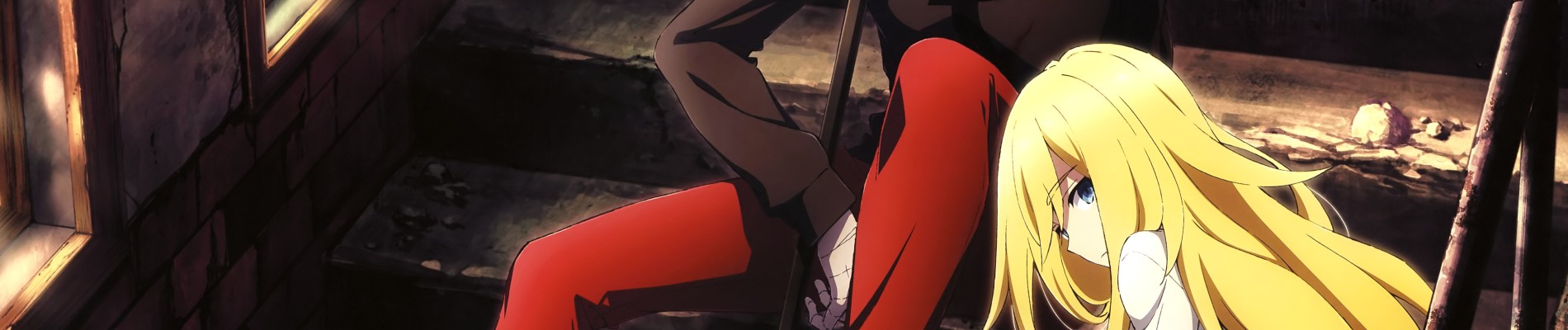
This isn’t horror that screams. It’s horror that settles: thick, slow, and sacramental. The building isn’t just abandoned—it’s consecrated by absence. Every stairwell echoes with the ghost of ritual. Every door handle is cold not from neglect, but from intention. You don’t feel hunted—you feel observed by architecture itself, like the walls are breathing in time with Rachel’s amnesia. It makes you question memory not as data, but as sacred contract—and what happens when someone breaks it on your behalf. There’s no safety in logic here, only the dread of coherence: every clue pulls you deeper into a theology of guilt, where salvation looks like blood on a sickle and forgiveness smells like antiseptic and rust.
That emotional DNA—the suffocating intimacy of trauma dressed as devotion, the way despair curdles into something almost tender—resonates sharply with Disco Elysium - The Final Cut. Its description calls it a “groundbreaking role playing game” where you’re a detective “with a unique skill system at your disposal and a whole city to carve your path across.” But read the player review: “Capital has the ability to subsume all critiques into itself. Even those who would critique capital end up reinforcing it instead. It's a cruel iro…” That same irony—where resistance becomes complicity, where healing rituals replicate the wound—is baked into Angels of Death’s core. Rachel and Zack don’t escape the building; they re-enact its theology until it reshapes them. Like Disco Elysium’s crumbling detective parsing ideology through hungover monologues, both works trap you inside a mind (or structure) that thinks itself free, while every choice tightens the chain.
Then there’s The Witcher 3: Wild Hunt, described as a world where “you stand before a war-torn, monster-infested continent you can explore at will,” hunting “Ciri—the Child of Prophecy.” The player review notes DLC announced “11 years after release… my favourite game keeps getting better…”—a quiet testament to enduring consequence. That’s the ache Angels of Death shares: not spectacle, but inescapable gravity. Geralt doesn’t win wars—he bears witness to their fallout, just as Rachel doesn’t solve the building; she inherits its sorrow. Both force you to hold contradictions: love that kills, mercy that maims, faith that starves. The orphaned girl and the witcher both walk worlds where morality isn’t chosen—it’s imposed, then worn like a second skin.
And yes—even Chains, the match-3 arcade game described as “relaxing” with “increasingly difficult physics-driven levels,” carries a sliver of that DNA. Its player review says: “Reminds me of connect 4 in nutshell. Basically link 3 or more of the same color and clear enough till you can proceed and hit the next stage.” That loop—link, clear, repeat—mirrors Rachel’s own rhythm: find a clue, erase a memory, move one floor up. The horror isn’t in chaos, but in pattern. In how trauma repeats until it becomes ritual. Chains doesn’t ask for emotion—it extracts it through repetition, just as Angels of Death makes dread habitual, almost soothing in its predictability.
This pairing isn’t for fans of “dark stories.” It’s for people who recognize the tremor beneath stillness—who’ve sat with grief so long it starts humming a lullaby. For those who flinch at sincerity but lean in when someone whispers a confession in the wrong key. For players who replay dialogue trees not to optimize outcomes, but to hear the same line again—just softer, just sadder—because the truth isn’t in the answer, but in the fracture between question and reply. They’re drawn to works where the most terrifying thing isn’t death—it’s the quiet, devoted work of staying alive inside the ruin.
🎮87 Games That Match the Vibe









Match Dimensions Explained
❓Frequently Asked Questions
Why is Disco Elysium listed as similar to Angels of Death when it’s not horror or escape-based?
Great question—it’s not about jump scares or locked rooms, but the shared DNA of psychological weight, morally gray choices, and a protagonist unraveling trauma in a decaying world. Like Zack in Angels of Death, Detective Harrier in Disco Elysium battles addiction, fractured memory, and oppressive systems—especially in the crumbling district of Martinaise, where every dialogue choice echoes with consequence. Both games force you to sit with discomfort, not just in story, but in mechanics: Disco’s skill checks (like Logic or Empathy) mirror Zack’s methodical, almost clinical approach to solving rooms—and people.
Is there an anime or manga adaptation of Angels of Death like there is for The Witcher?
No—unlike The Witcher (which has official anime, live-action, and manga adaptations), Angels of Death has *no* licensed anime, manga, or film. The Witcher: Enhanced Edition Director's Cut and The Witcher 3 both benefited from years of expanded lore across media, but Angels of Death remains strictly a visual novel series with no official cross-media expansions—just fan translations and deep-dive YouTube analyses of its hospital symbolism and Rachel’s ambiguous final monologue.
How does Chains compare to Angels of Death in terms of tone and storytelling?
It doesn’t—at all. Chains is a cheerful, physics-driven match-3 arcade game where you ‘link adjacent bubbles’ to clear stages; it’s literally described as ‘relaxing’ and compared to Connect 4. Angels of Death is claustrophobic, dialogue-heavy, and steeped in body horror and existential dread—think Rachel’s hollow stare in Room 107 versus Chains’ bubbly UI and ‘clear enough till you can proceed’ loop. If you’re craving Angels of Death’s oppressive atmosphere, skip Chains and go straight to Disco Elysium’s rain-soaked, guilt-slicked streets instead.
What’s the best game like Angels of Death if I want that slow-burn, emotionally devastating detective vibe?
Disco Elysium — hands down. It nails the same slow-burn dread, layered mystery, and emotional devastation—but swaps hospital corridors for the rain-lashed ruins of Revachol. Like Zack interrogating floor tiles and bloodstains, you’ll spend hours questioning NPCs who hide trauma behind irony (e.g., Cuno’s grief over his brother), while your own skills argue *in your head*—just as Zack’s voiceover dissects every decision. Even the score (78) and shared dimensions—Mystery & Detective, Emotional Narrative, Adult & Dark Seinen—confirm it’s the closest spiritual sibling.