
Dead Leaves
Pandy and Retro awaken naked on Earth with no recollection of their past. They embark on a devastating crime spree in search of food, clothing and transportation, but are captured by authorities and sent to the infamous lunar penitentiary named Dead Leaves. While incarcerated, they quickly discover that Dead Leaves is also a top-secret cloning facility, occupied by villainous guards and deformed genetic experiments. Ultra-manic chaos and hyper-violent bedlam ensue as they organize a prison break with the aid of their fellow mutant inmates.
📺Anime Details
📝Editorial Analysis
Naked. Not metaphorically—naked. Pandy and Retro hit the pavement like dropped mannequins, skin raw against asphalt, zero memory, zero clothes, zero mercy. One second: void. Next: a stolen motorcycle’s engine screaming as they fishtail through neon-slicked alleys, Retro’s bare feet slapping the handlebars, Pandy laughing mid-air while firing a pistol backwards at police cars flipping like discarded soda cans. That’s not an opening—it’s a detonation. The kind that doesn’t ask permission to rearrange your nervous system.
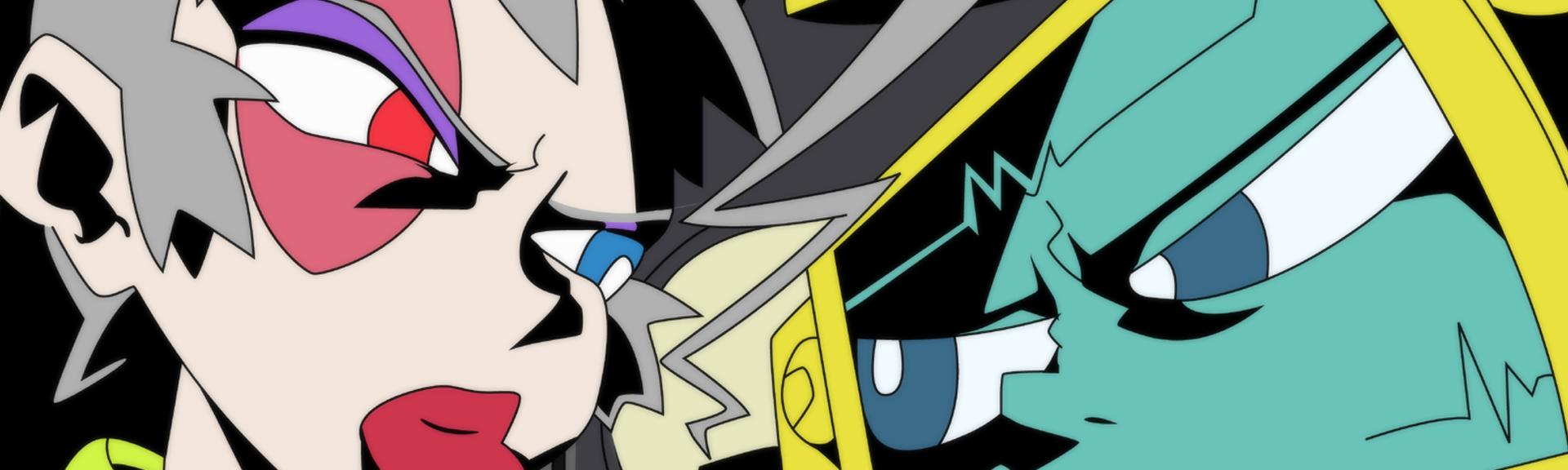
What Dead Leaves does isn’t just surreal—it’s sensory sabotage. It doesn’t build tension; it shatters rhythm. Slapstick collides with gore so abruptly your brain stutters—Pandy’s grin still wide as her arm detaches in a spray of glitter and viscera. There’s no breathing room between absurdity and horror because the world itself refuses coherence: lunar prison guards wear clown masks fused to rotting flesh; cloned prisoners melt into wallpaper; gravity wobbles when someone screams too loud. You don’t watch it—you get tossed. It makes you feel unmoored, giddy, then sick, then laughing again before the nausea finishes rising. It’s not satire pretending to be chaos—it is chaos pretending to have a thesis. And the thesis? That identity, law, even biology, are just flimsy costumes ripped off mid-chase.
That same jagged, self-aware vertigo lives in Disco Elysium - The Final Cut. Its description calls it “a groundbreaking role playing game” where you’re “a detective with a unique skill system”—but the player review cuts deeper: “Capital has the ability to subsume all critiques into itself. Even those who would critique capital end up reinforcing it instead.” That’s Dead Leaves’ DNA in text form: systems (prison, cloning, capitalism) so grotesquely overgrown they parody their own logic. Both weaponize disorientation—not as a bug, but as the interface. Retro’s amnesia isn’t plot convenience; it’s epistemological collapse. Harry Du Bois’ fractured psyche isn’t backstory—it’s the default state. You don’t solve the mystery—you survive the syntax.
Then there’s Indiana Jones® and the Fate of Atlantis™, described as “The Man With The Hat Is Back In His Greatest Adventure Yet!”—but the player review nails its soul: “An archaeological wonder trapped in amber.” That phrase aches with the same energy as Dead Leaves’ lunar penitentiary: a place where history, myth, and bureaucracy have fossilized into something both sacred and ridiculous. Indy dodges booby-trapped temples while Nazi agents babble about Atlantean super-weapons; Pandy dodges laser grids while mutant clones recite corporate mission statements. Both treat ancient power structures (mythology, eugenics, empire) as punchlines and landmines—equally absurd, equally lethal. The tone isn’t reverence or mockery alone. It’s ritual farce: sacred texts read aloud by lunatics in lab coats.
And Sam & Max 103: The Mole, the Mob and the Meatball, whose description drops us into “an underground operation at the Ted E. Bear Mafia-Free Playland and Casino”—yes, that’s the title—and whose player review calls it “A great reboot of a legendary game.” That “Mafia-Free Playland” is pure Dead Leaves: a setting so aggressively nonsensical it loops back into terrifying plausibility. The bear-themed casino isn’t whimsy—it’s institutional absurdity given plush fur and a slot machine that dispenses teeth. Like Dead Leaves’ cloning facility masquerading as a prison, it’s bureaucracy dressed as carnival, authority disguised as cartoon logic. Both use escalating nonsense not to distract, but to expose: the moment you stop questioning why a bear runs a casino, you’ve already surrendered to the script.
This isn’t for fans of tidy arcs or moral clarity. It’s for the person who rewinds that scene where Retro kicks a guard into a vat of bubbling clone serum—not to analyze the animation, but to savor how the splash pauses mid-air for three frames while a kazoo trill plays. It’s for the player who spends twenty minutes arguing with a hallucination of Marxist theory in Disco Elysium’s headspace, then laughs when the thought-skill fails and spits out a limerick about wage slavery. It’s for the one who still owns the original LucasArts floppy disk, not for nostalgia—but because that version of logic, where a fedora can deflect metaphysics, feels more honest than most modern narratives. They don’t want coherence. They want velocity. They want the world to spin so fast its seams burst—and then lean in, grinning, to lick the glitter off the shrapnel.
🎮76 Games That Match the Vibe





























Match Dimensions Explained
❓Frequently Asked Questions
Why does Dead Leaves feel so different from Assassin's Creed: Director's Cut Edition even though both have neon noir and political thriller vibes?
Great question — it’s all in the pacing and tone. Dead Leaves is hyper-stylized, breakneck action with surreal anime violence (think blood-splatter wipes and bullet-time acrobatics), while Assassin’s Creed leans into grounded parkour, historical conspiracy, and slower-burn political intrigue — like Altaïr navigating Jerusalem’s bazaars under Mamluk surveillance. The neon noir shows up in AC’s moody lighting and shadowy assassinations, but it lacks Dead Leaves’ chaotic, satirical energy.
Is there a Dead Leaves anime or movie adaptation?
No official anime or film adaptation exists — Dead Leaves remains a cult-classic PS2 game only. That said, fans often compare its vibe to *Disco Elysium*’s hallucinatory monologues or *Indiana Jones and the Fate of Atlantis*’s pulpy, fourth-wall-breaking absurdity — especially when Max in *Sam & Max 103* delivers a rant about ‘the meatball as capitalist metaphor’ while dodging mob goons in a casino.
How does Runaway: A Road Adventure compare to Dead Leaves in terms of dark seinen themes and pacing?
Runaway leans hard into adult dark seinen through its gritty mob chase, moral ambiguity, and Brian’s desperate flight with the enigmatic Gina — but it’s a slow-burn point-and-click with dialogue-heavy scenes and inventory puzzles, totally unlike Dead Leaves’ relentless, wordless action. You’ll feel the same existential dread in Runaway’s rain-soaked New York alleys as in Dead Leaves’ dystopian wastelands, but where Dead Leaves hits you with a flying kick, Runaway makes you *think* your way out of a basement full of henchmen.
What’s the best ‘Dead Leaves-like’ game if I want something fast, surreal, and politically biting — but with actual detective work instead of pure chaos?
Go straight to *Disco Elysium: The Final Cut*. It nails the political thriller dimension with razor-sharp writing (like your brain’s ‘Logic’ skill dissecting a fascist pamphlet in Revachol’s slums), and its surrealism matches Dead Leaves’ off-kilter energy — just swap gunfights for internal monologues that argue with themselves. Plus, the ‘Dark Fantasy’ overlap shines when you’re negotiating with a sentient, communist streetlamp named ‘The Lighthouse’ in the Whirling-in-Rags district.