
Hell Girl
Somewhere in the vast sea of the Internet, there's a website that can only be accessed at the stroke of midnight. Known as the Jigoku Tsushin, rumor has it that if you post a grudge there, the Jigoku Shoujo will appear and drag whoever torments you into the inferno. Very little is known about the girl - all we know for sure is that she lives with her equally enigmatic grandmother, that three magical straw dolls accompany and serve her, and that whenever a posting on the Jigoku Tsushin moves her, she becomes the Jigoku Shoujo.
📺Anime Details
📝Editorial Analysis
The screen flickers—midnight blue, static hissing like distant rain—and then the cursor blinks, alone, in the center of a black browser window. Jigoku Tsushin. No logo, no disclaimer, just that name hovering like breath on cold glass. You type the name of the person who broke you. You hit enter. The page reloads—not with confirmation, but with silence so thick it hums. Then, faintly, the sound of wooden sandals on wet stone. Not approaching. Already here.
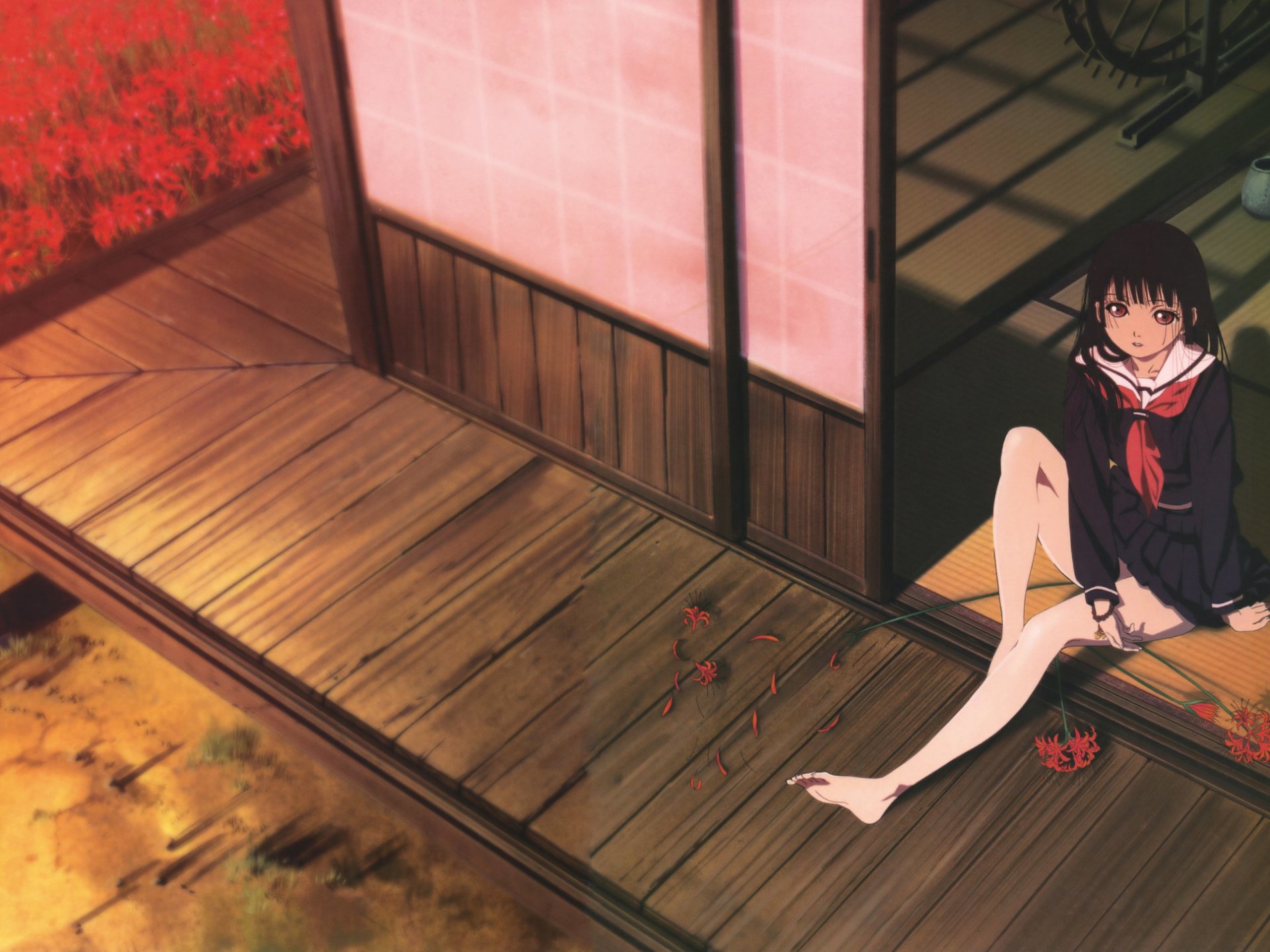
That’s not horror as jump-scare or gore. It’s horror as inevitability—the quiet dread of knowing your own bitterness has just signed a contract written in ash and drowned lilies. Hell Girl doesn’t ask if revenge is justified. It asks what happens when you stop believing justice exists at all—and hand your soul over to a girl who rows a boat made of sorrow. Her grandmother watches from the shadows, the three straw dolls sway without wind, and every episode ends not with catharsis, but with the slow, hollow echo of a gong sinking into water. This isn’t supernatural spectacle. It’s melancholy made structural: grief folded into ritual, trauma dressed as folklore, vengeance stripped of triumph until all that remains is the chill of the riverbank—and the terrible clarity of having chosen hell yourself.
What makes Hell Girl’s atmosphere singular isn’t its ghosts or curses—it’s how relentlessly urban and intimate its despair feels. The bullying isn’t cartoonish; it’s whispered rumors in school hallways, stolen test scores, a chair pulled away mid-laugh. The afterlife isn’t grand or fiery—it’s a mist-choked river, endless and indifferent, lit only by the pale glow of a single lantern. There are no heroes, no villains with motives—just people wearing masks until their faces forget how to move. You don’t fear the Jigoku Shoujo. You fear recognizing yourself in her stillness. That’s the feeling: resignation, isolation, the weight of unspoken shame—all wrapped in the soft rustle of silk and the scent of burnt incense.
That same emotional DNA pulses in Vampire: The Masquerade - Bloodlines, where the neon-lit streets of Los Angeles don’t glitter—they bleed. Its Body Horror & Occult dimension isn’t about grotesque transformation alone; it’s about watching your humanity erode in real time, one compromised choice at a time—exactly like the slow unraveling of a grudge into damnation. A player review nails it: “BUY IT ON GOG; if you want to use the steam version you need to download the unofficial patch…”—a line dripping with weary pragmatism, the same exhausted persistence that keeps someone refreshing Jigoku Tsushin at midnight, again and again. Both demand you live inside moral decay—not as spectacle, but as daily weather.
Then there’s Disco Elysium - The Final Cut, where every dialogue branch feels like another straw doll being turned, each decision weighted with the gravity of self-betrayal. Its Mystery & Detective and Melancholic Exploration dimensions mirror Hell Girl’s episodic structure: not solving crimes, but excavating wounds buried under layers of denial, bureaucracy, and bad coffee. A player quotes philosophy mid-review—“Capital has the ability to subsume all critiques into itself”—not as pretension, but as lived fatigue. That’s the same exhaustion that lives in Ai Enma’s eyes when she hands over the doll: the understanding that systems—social, spiritual, economic—don’t break; they bend you until you fit.
And Max Payne, with its Mystery & Detective and Neon Noir pulse, shares that claustrophobic urban fatalism. Max isn’t chasing truth—he’s running from memory, gun in hand, voiceover raw with insomnia and regret. His world is rain-slicked alleys and flickering fluorescents, where every bullet feels less like action and more like punctuation in a sentence he never chose to write. A player remembers passing the controller after dying—not for fun, but because survival felt too heavy to bear alone. That’s the shared rhythm: the sense that the city isn’t a setting. It’s a witness, silent and judgmental, holding up a cracked mirror to your rage.
This pairing isn’t for fans of power fantasies or triumphant arcs. It’s for the ones who pause mid-episode of Hell Girl, stare at their own reflection in a dark phone screen, and whisper, “I know that silence.” It’s for players who replay Disco Elysium not to win, but to hear that one broken-down cop say something true—just once—before the rain washes it away. It’s for anyone who’s ever typed a name into a blank field at 11:59 p.m., not hoping for justice… but just wanting the world to notice how much it hurts. That’s the bond: not genre, not plot—but the shared, aching recognition of what it costs to stay human when everything around you has already gone quietly, irrevocably, to hell.
🎮112 Games That Match the Vibe


















































Match Dimensions Explained
❓Frequently Asked Questions
Why does Vampire: The Masquerade - Bloodlines feel like Hell Girl’s cursed contract system?
Because both hinge on irreversible moral bargains with supernatural consequences—like when Hell Girl forces victims to sign their name in the notebook, Bloodlines makes you choose a clan and embrace, locking in body horror transformations (think thin-blood degeneration or Nosferatu deformities) that permanently alter how NPCs react to you. That sense of inescapable consequence, layered over neon-noir L.A. streets and occult dread, hits the same nerve as watching someone’s soul unravel after accepting vengeance.
Is there a Hell Girl video game adaptation?
No—there’s never been an official Hell Girl game. But fans who crave that exact vibe (melancholic revenge, occult contracts, oppressive atmosphere) often land on Disco Elysium for its existential weight and detective work steeped in despair, or Max Payne for its noir fatalism and ‘no turning back’ narrative structure—both channel Hell Girl’s tone without copying its plot.
How is Assassin’s Creed Director’s Cut Edition different from Disco Elysium in capturing Hell Girl’s mood?
Assassin’s Creed leans into melancholic exploration through silent, rain-slicked rooftops and lonely rooftop prayers in Jerusalem—evoking Hell Girl’s isolation—but it’s more about duty than damnation. Disco Elysium dives deeper into psychological unraveling: your detective literally argues with his own skill voices (like Logic vs. Empathy), mirroring Hell Girl’s internal torment, all wrapped in that same smoggy, neon-noir lighting and world-weariness.
What’s the best game like Hell Girl if I want that slow-burn dread and eerie urban loneliness?
Disco Elysium — hands down. Its rain-soaked city of Revachol, decaying architecture, and protagonist who’s literally falling apart mentally (‘The Shivers’ hallucinations, failed skill checks that spiral into self-loathing monologues) nails Hell Girl’s suffocating stillness before the storm. Even the way you overhear fragmented, haunting dialogue from alleyways—like a half-heard whisper from the underworld—mirrors how Hell Girl lingers just outside the frame, waiting.