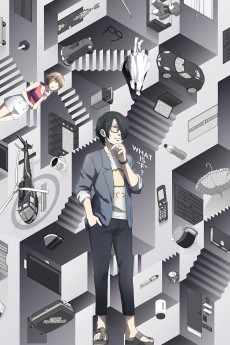
The Perfect Insider
The story of the original Subete ga F ni Naru novel revolves around Souhei Saikawa, a member of the Saikawa Research Lab. He goes on a vacation held by the lab, and Moe Nishinosono, the daughter of his mentor, joins the group on their vacation despite not being a part of the lab. There, the two end up finding a corpse. The two work together to solve the mysteries of what becomes a serial murder case.
(Source: Anime News Network)
📺Anime Details
📝Editorial Analysis
The silence after the first body is found isn’t empty—it’s charged, thick with the damp chill of a mountain lodge at dusk, the low hum of a malfunctioning air conditioner, and the unspoken weight of Moe Nishinosono’s gaze as she stands beside Souhei Saikawa, not flinching, not weeping, just measuring the corpse like a theorem waiting to be solved. Her fingers don’t tremble; her voice, when it comes, is calm, precise—almost clinical—as if grief had been edited out of her syntax long before this vacation began.

That’s the atmosphere: not dread, but intellectual vertigo. The Perfect Insider doesn’t thrill with chase sequences or jump scares—it unsettles by making philosophy physical. Every conversation in the Saikawa Research Lab’s offsite retreat feels like standing on a floor that’s slowly tilting—not toward chaos, but toward revelation so absolute it threatens identity itself. You don’t feel scared; you feel unmoored, as if your own assumptions about motive, memory, and selfhood are evidence in a case you didn’t know you were testifying in. The incest tag isn’t sensationalized—it’s structural, a buried axiom in the family’s logic, echoing how trauma folds into cognition like recursive code. The orphan, the teacher, the fugitive—all aren’t roles but epistemological positions: ways of knowing (or refusing to know) what’s true when language, memory, and even biology have been weaponized as variables.
That same vertigo lives in Disco Elysium - The Final Cut, where every internal monologue is a tribunal, and the player’s own skill checks—Logic, Empathy, Electrochemistry—don’t just inform dialogue options but fracture the narrator’s authority. Like Moe parsing a crime scene through layers of suppressed memory and inherited ideology, Harry DuBois interrogates his own mind as if it were a suspect dossier. The player review nails it: “Capital has the ability to subsume all critiques into itself.” That’s the horror—not external evil, but the system’s quiet assimilation of resistance, just as The Perfect Insider reveals how even grief, love, or justice can be reconfigured as functions within a larger, inescapable architecture. Both refuse catharsis. They offer insight—and then make you question whether insight is liberation or just another cage.
Then there’s BioShock, where Rapture’s decaying Art Deco halls aren’t just set dressing—they’re the physical manifestation of an ideology gone terminal. The player review calls it “revolutionary,” and it is—but not for its combat. It’s revolutionary because the game’s central twist lands not as plot shock, but as philosophical recoil: you realize your choices, your moral compass, even your sense of agency, were scripted by the very doctrine you thought you were dismantling. Just like Souhei realizing his mentor’s research lab wasn’t a sanctuary for truth, but a controlled environment for testing how far reason can bend before snapping—and who gets erased when it does. The “Adult & Dark Seinen” dimension isn’t about gore; it’s about confronting how adulthood means inheriting systems you never consented to, then discovering you’ve already internalized their grammar.
And Deus Ex: Game of the Year Edition—2052, economies collapsing, conspiracies older than nations—mirrors the anime’s claustrophobic intellectualism. Its description names “an ages old conspiracy bent on world domination,” but what lingers is how ordinary the machinery feels: surveillance feeds, corporate memos, whispered academic rivalries—all dressed in plausible bureaucracy. Like the Saikawa Lab’s vacation, Rotten Island isn’t a stage for villains; it’s a laboratory, and everyone inside—including you—is both subject and unwitting collaborator. The player review praises how the game gives you “all options with one hit of the esc key”—not freedom, but exposure: here are the levers, the wires, the lies. You see the architecture. And seeing it changes nothing—except how deeply you feel the weight of complicity.
This isn’t for someone who wants puzzles to solve and villains to defeat. It’s for the person who reads a murder report and wonders what kind of mind constructs a perfect alibi, who replays a character’s line three times because the pause before “I remember” feels heavier than the confession itself, who stares at a loading screen and thinks What am I agreeing to, just by pressing continue? They’re the ones who’ll sit still in the silence after the first body—and listen, really listen, to what the quiet is saying back.
🎮86 Games That Match the Vibe































































Match Dimensions Explained
❓Frequently Asked Questions
Why does Disco Elysium keep coming up when people talk about games like The Perfect Insider?
Because both dive deep into philosophical detective work—Disco Elysium’s Detective Harry DuBois literally argues with his own skill voices (like Logic or Empathy) while investigating a murder in the rain-soaked, ideologically fractured city of Revachol. Its ‘Mystery & Detective’ + ‘Political Thriller’ dimensions mirror The Perfect Insider’s cerebral campus mystery and academic power struggles, and that 84 Metacritic score reflects how tightly its writing and themes lock together.
Is there an anime or visual novel adaptation of The Perfect Insider that’s actually good?
No—The Perfect Insider has never been adapted into a game, anime, or visual novel. It’s strictly a Japanese mystery novel series (by Hiroshi Mori), so all the 'games like it' recommendations—like BioShock or Deus Ex: GOTY—are *spiritual* matches, not adaptations. That said, BioShock’s Rapture feels like the kind of decaying, ideology-obsessed setting Mori might’ve written into a lecture hall scene gone horribly wrong.
How is Deus Ex: Game of the Year Edition different from Assassin’s Creed Director’s Cut for fans of The Perfect Insider?
Deus Ex (83 score, ‘Cyberpunk & Dystopia’ + ‘Neon Noir’) gives you systemic, choice-driven conspiracy unraveling—hacking security systems in dystopian Hong Kong or debating world control with shadowy factions—while Assassin’s Creed Director’s Cut (also 84, but ‘Neon Noir’ + ‘Adult & Dark Seinen’) leans harder into stylized, almost theatrical political assassination in Jerusalem’s layered urban sprawl. If you loved The Perfect Insider’s slow-burn academic deception, Deus Ex’s dialogue trees and faction consequences feel more like a philosophy seminar with guns.
What’s the best game like The Perfect Insider if I want that moody, rain-slicked, late-night-thinkpiece vibe?
Disco Elysium — The Final Cut is your absolute go-to: think Revachol’s perpetual drizzle, the crumbling Art Deco police station, and Harry muttering Marxist theory to himself while staring at a dead man on the beach. Its ‘Neon Noir’ lighting, ‘Mystery & Detective’ pacing, and that haunting 84-scored writing make it feel like stepping into one of Mori’s dense, atmospheric campus monologues—but with dice rolls and hangovers.