
Memories
Memories is a compilation of three standalone short films encompassing different genres.
Magnetic Rose — a science fiction tale that tells a chilling story of love, loss, and the unwillingness to forget.
Stink Bomb — a tongue-in-cheek story of a chemical researcher who is just looking for a way to get rid of his cold... so why is everybody around him dying?
Cannon Fodder — an introspective tale about modern wars and simply following orders.
📺Anime Details
📝Editorial Analysis
The airlock hisses open—not with relief, but with the slow, metallic groan of a tomb unsealing. Inside Magnetic Rose, the corridor stretches into impossible darkness, lit only by flickering emergency strips that cast long, trembling shadows of the crew’s own faces—faces already slack with dread, already half-lost to the ghost in the machine. You don’t hear the horror first. You feel it: the weight of silence pressing in like deep-sea pressure, the way time bends and frays as memory becomes architecture, as grief hardens into steel and vacuum. That moment isn’t sci-fi spectacle—it’s the quiet before the mind breaks.
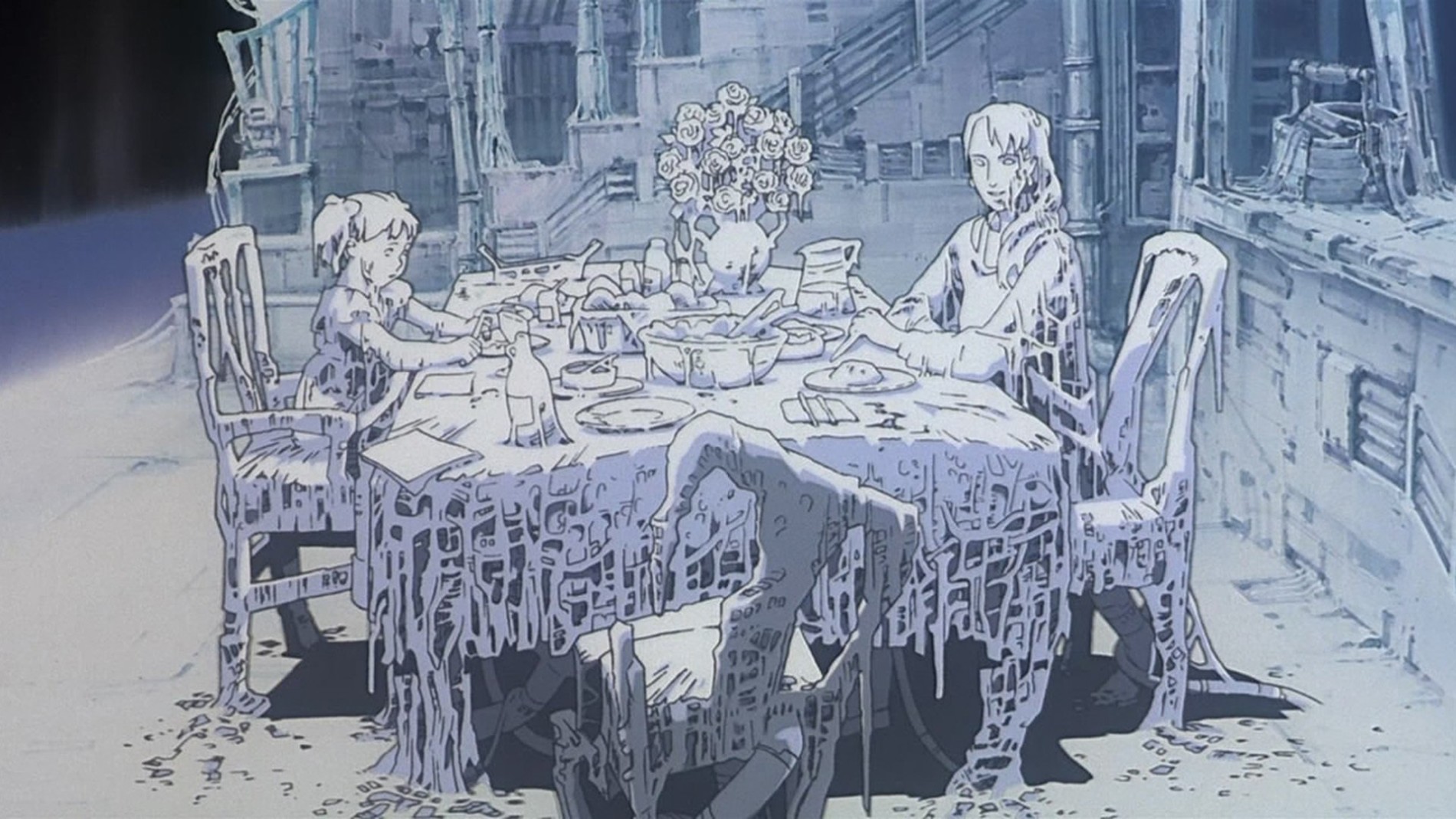
What makes Memories singular isn’t its genre-hopping—it’s how each segment weaponizes absence. Not just missing people or lost futures, but the erasure of context: no exposition dumps, no moral hand-holding, no safety net of narrative certainty. Magnetic Rose doesn’t explain why the station’s AI resurrects a dead opera singer—it lets you drown in her aria while your oxygen ticks down. Stink Bomb doesn’t satirize bureaucracy with punchlines—it shows a man coughing politely as his own body becomes a biological event horizon, his earnestness making the carnage more horrifying. And Cannon Fodder? It renders war not as strategy or heroism, but as geometric inevitability—children marching in perfect formation toward cannons that fire only at other children, their uniforms identical, their names never spoken. The feeling isn’t dread or irony—it’s dislocation, the chilling clarity of seeing systems—emotional, political, technological—run perfectly, beautifully, and utterly wrong.
That dislocation is why BioShock™ hits with such visceral resonance. Its description calls it “a shooter unlike any you’ve ever played”—and that’s true, but not because of the plasmids or the Big Daddies. It’s because Rapture breathes the same air as Magnetic Rose: a dead utopia where ideology curdled into architecture, where every decaying mural and looping audio diary whispers, “I was certain this was right.” The player review nails it: “genuinely changed the gaming world”—not for its mechanics, but because it made you complicit in its collapse, just as Magnetic Rose makes you complicit in its haunting. You don’t fight the system—you inhabit its logic until it consumes you.
Then there’s Deus Ex: Game of the Year Edition, whose description drops you straight into “2052… economies close to collapse… an ages-old conspiracy bent on world dom[ination].” No flourish, no setup—just the cold arithmetic of decay. Like Cannon Fodder, it refuses to let you feel like a rebel; you’re a node in the network, given choices that all feed the same machine. The player review says it starts up immediately, hands you “all options with one hit of the esc key”—that’s the Cannon Fodder rhythm: no grand speeches, just interfaces, menus, protocols. You don’t overthrow power—you navigate it, and every path feels like another uniform, another parade ground.
And BioShock 2, with its “halls of Rapture once again echo[ing] with sins of the past,” mirrors Stink Bomb’s grotesque escalation—not in tone, but in structure. Both escalate with terrifying consistency: Delta’s pursuit of Eleanor, like Koji’s search for cold medicine, follows an internal, almost bureaucratic logic. The player review complains about crashes—but that instability echoes the anime’s own fragility: systems failing not with drama, but with a soft, persistent glitch, a cough that won’t stop, a loading screen that never resolves.
These pairings aren’t for fans of “cool settings” or “deep stories.” They’re for the person who watches Cannon Fodder and feels their throat tighten not at the violence, but at the precision of the marching—someone who plays Deus Ex not to win, but to trace the seams in the world’s logic, who walks through Rapture’s flooded halls and doesn’t flinch at the splicers, but at the familiarity of their slogans. They’re drawn to work that treats certainty as the real horror—the kind of viewer who pauses Magnetic Rose not to look away, but to stare longer at the reflection in the darkened viewport, wondering which side of the glass they’re really on.
🎮88 Games That Match the Vibe





















































Match Dimensions Explained
❓Frequently Asked Questions
Why is BioShock always the top match for Memories when it's a shooter and not a visual novel?
Great question — it’s because Memories leans hard into dystopian political thrills and layered, morally ambiguous storytelling, just like BioShock’s Rapture: think Andrew Ryan’s ‘Ayn Rand gone mad’ monologues echoing through flooded halls, or the Little Sisters’ haunting lullabies juxtaposed with brutal choices. Both use environmental storytelling to make you *feel* the weight of ideology collapsing — not just tell you about it.
Is there a TV or movie adaptation of Memories that explains the lore better?
No — and honestly, that’s part of why fans keep circling back to games like Deus Ex: Game of the Year Edition. Its immersive sim design (like hacking every security panel in UNATCO HQ or overhearing conspiratorial whispers in smoky Hong Kong alleys) delivers the same dense, systems-driven worldbuilding you’d want from an adaptation — just without needing a scriptwriter to spell it out.
BioShock Infinite vs. Deus Ex: Game of the Year Edition — which one nails the 'haunted by your own choices' vibe more?
Deus Ex wins that specific feeling — especially early on, when you’re deciding whether to kill or spare Majestic 12 agents in the NYC subway tunnels, and those choices ripple into faction reputation, dialogue options, and even ending branches. BioShock Infinite has big twists (hello, Songbird and Columbia’s floating bigotry), but Deus Ex makes *every corridor* feel consequential — like Rapturesque dread, but with your fingerprints all over it.
What’s the best game like Memories if I want that slow-burn, oppressive cyberpunk dread — not action-heavy, just heavy atmosphere?
Go straight to Deus Ex: Invisible War — yes, it’s less polished than the original, but its decaying, rain-slicked cityscapes (like the ruined Chicago arcology), the muffled radio chatter about Illuminati splinter factions, and that constant low hum of failing infrastructure nail the suffocating, paranoid mood. It’s not about shooting first — it’s about listening to a dying world whisper its secrets while your augmentations glitch faintly in the background.