
Redline
Redline is about the biggest and most deadly racing tournament in the universe. Only held once every five years, everyone wants to stake their claim to fame, including JP, a reckless dare-devil driver oblivious to speed limits with his ultra-customized car - all the while, organized crime and militaristic governments want to leverage the race to their own ends. Amongst the other elite rival drivers in the tournament, JP falls for the alluring Sonoshee - but will she prove his undoing, or can a high speed romance survive a mass destruction race?
(Source: Anchor Bay Films)
📺Anime Details
📝Editorial Analysis
The smell of burnt rubber and ozone hangs thick—not from tires on asphalt, but from plasma-ignited thrusters tearing through the thin atmosphere of Roboworld’s desert moon. JP’s Takuma screams sideways across a canyon rim, chassis screaming as it grazes a floating monolith carved with alien glyphs—then launches, airborne for three impossible seconds before slamming down, suspension shuddering, cockpit glass spiderwebbed, his knuckles white on the wheel. No music swells. Just the raw, distorted whine of overtaxed engines, the crackle of static on comms, and Sonoshee’s voice cutting through: “You’re not winning this race—you’re surviving it.” That’s Redline: not speed as elegance, but speed as sacrifice, as defiance flung into the teeth of militarized borders, corporate surveillance drones, and gravity itself.
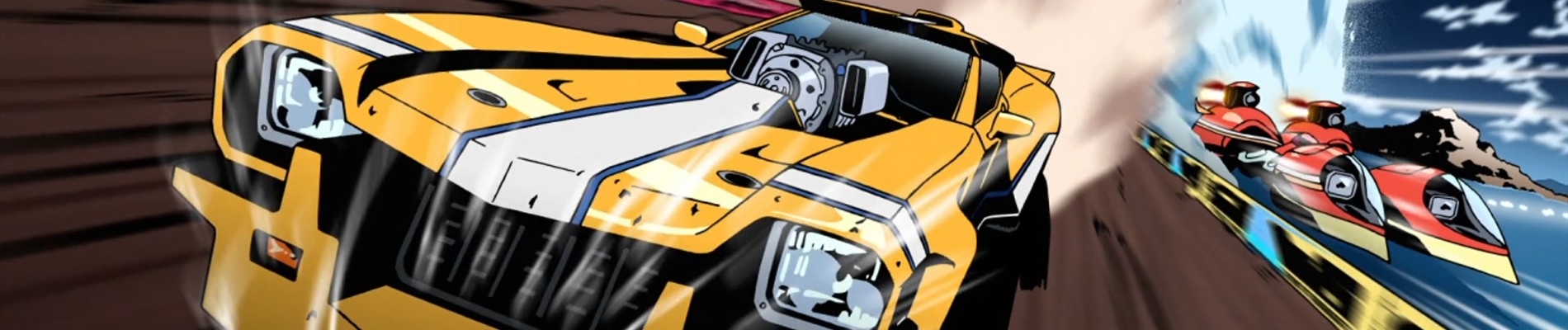
What makes Redline’s atmosphere singular isn’t its space-racing premise—it’s the weight of its joy. Every frame vibrates with handmade urgency: hand-drawn animation so dense it bleeds, colors so saturated they hum, backgrounds so detailed they feel lived-in by aliens who’ve forgotten Earth. It doesn’t ask you to suspend disbelief—it demands you feel the G-force in your molars, the grit in your throat, the dizzying, exhilarating terror of trusting your life to a machine you welded yourself—and to a woman whose loyalties shift like sand under anti-grav treads. It’s romance as high-stakes negotiation, crime as bureaucratic inevitability, cyberpunk not as neon noir gloom, but as sun-blasted, sweat-slicked vitality. You don’t watch it—you lean in, breath held, pulse syncing to the engine’s stutter-and-roar.
That same electric, almost reckless aliveness pulses through Unreal Tournament: Game of the Year Edition. Its player review calls it “an excellent classic… to remind you of the good’ole days”—and that’s precisely it: the tactile thrill of movement, the split-second reads, the arena as sacred, lawless ground where skill is the only passport. Like Redline, it’s built on competitive spirit distilled to its purest form—no story scaffolding, no moral ambiguity slowing the sprint. Just you, your weapon, and the visceral feedback of impact. Both reject polish for presence: the crunch of a frag, the shriek of a tire locking up mid-drift—they land in your nervous system first.
Then there’s Tribes: Ascend, where the player sighs, “Man, I used to love this game. Just mindless fun.” But it’s never mindless—it’s embodied. The jetpack’s burn, the slide-turn physics, the way momentum carries you across ice fields or ruined orbital stations—that’s the same kinetic logic as JP’s drift-jump across a collapsing bridge. Both exist in a Sci-Fi & Space dimension where technology isn’t sleek—it’s gritty, patched-together, humming with barely-contained power. The “potential” the reviewer laments? It mirrors Redline’s own mythos: a project so passionately overstuffed, so defiantly analog in a digital age, that its very ambition becomes its emotional core.
Even Ricochet, with its bizarre player review calling it “a life changing experience… combining the drama of a soap opera and the tense atmosphere of a horror movie,” taps the same nerve. Its one-on-one arenas—tight, geometric, unforgiving—echo the claustrophobic intensity of Redline’s final lap: no room for error, no time for doubt, just reflex and raw nerve. The drama isn’t scripted—it’s generated in real-time, by the collision of wills, just like JP and Sonoshee’s silent glances across a pit lane, charged with everything unsaid.
This pairing isn’t for the casual viewer or the completionist player. It’s for the person who keeps a dented racing helmet on their shelf—not as decor, but as a reminder of velocity felt in the bones. For the one who replays the exact same 10-second clip of a perfect Tribes slide-turn, not to master it, but to re-live the weightlessness. For those who don’t just watch Redline—they hold their breath when JP downshifts into the Death Canyon hairpin, heart hammering not from fear, but from recognition: this is what it feels like to be alive at full throttle, in a universe that refuses to slow down—and wouldn’t let you if it could.
🎮85 Games That Match the Vibe

















Match Dimensions Explained
❓Frequently Asked Questions
Why does Redline feel so much like Unreal Tournament?
Because both are pure, high-speed arena shooters built around movement-first combat—think rocket-jumping off walls in UT’s Facing Worlds while dodging plasma fire, just like Redline’s drift-and-dodge car physics. The Cyberpunk & Dystopia + Competitive Spirit overlap isn’t accidental: UT’s 1999 Game of the Year Edition nails that same adrenaline-fueled, no-holds-barred energy, and players still call it 'the good’ole days' for a reason.
Is there a Redline anime or movie adaptation?
No—Redline has never been adapted into anime or film, unlike some other racing titles. But if you love its hyper-stylized, neon-drenched chaos, Tribes: Ascend delivers that same frenetic, sci-fi spectacle with jetpacks, team-based flag captures, and arenas dripping in Cyberpunk & Dystopia vibes—plus fans say it’s 'mindless fun' with serious competitive teeth.
How does Redline compare to S.T.A.L.K.E.R.: Shadow of Chernobyl?
They’re total opposites in pacing but share deep DNA in mood: Redline is breakneck, cartoonish speed; STALKER is slow-burn, oppressive survival in the Zone’s radioactive ruins. Yet both live in that same Cyberpunk & Dystopia + Sci-Fi & Space space—and STALKER fans love how 'big and beautiful' the map feels, just like Redline’s sprawling, hazard-packed tracks demand mastery of terrain and timing.
What’s the best Redline-like game for late-night, high-energy solo play?
Ricochet is your go-to—it’s got tight one-on-one duels in glowing futuristic arenas where agility and aim collide, just like Redline’s split-second reflex demands. With its 81 Metacritic score and fan praise calling it a 'life changing experience', it’s the perfect pick when you want fast, focused, no-nonsense action that still oozes Sci-Fi & Space and Competitive Spirit.