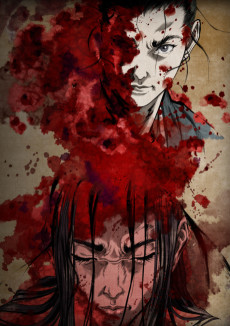
Shigurui: Death Frenzy
Two damaged warriors wear the scars of a twisted and violent past. Bitter rivals for the secrets of their master's sword and the right to his daughter, these samurai inflict wounds on each other that would destroy lesser men. The final chapter of their saga unfolds within a brutal samurai tournament, a gruesome contest arranged to satisfy the bloodlust of a cruel tyrant overlord.
The disfigured legends of the blade must summon the strength for one last battle - a final lesson in the artistry of violence where nothing is more beautiful than the kill.
(Source: Funimation)
📺Anime Details
📝Editorial Analysis
The rain doesn’t fall in Shigurui: Death Frenzy—it drips, thick and warm, from the severed tendon of a wrist still twitching mid-air. That’s the first thing you feel: not the clash of steel, but the weight of tissue parting, the wet shuck of cartilage yielding, the way light catches on the glistening, uneven edge of a blade that’s just carved through ligament and bone—not clean, not heroic, but hungry. This isn’t combat as choreography. It’s anatomy as narrative.
What makes Shigurui: Death Frenzy singular isn’t its samurai setting or even its gore—it’s how every frame presses inward. The camera lingers not on faces, but on knuckles splitting open, on spines arching under unbearable torque, on eyes that have long since stopped registering pain and now only register continuance. There’s no catharsis here, no moral pivot—just the slow, grinding erosion of selfhood under inherited violence. You don’t watch it to root for someone; you watch because you can’t look away from how deeply trauma settles into muscle, tendon, posture. It makes you think about legacy not as honor or duty, but as scar tissue passed down like heirlooms. It makes you feel exhausted, hypervigilant, and strangely awake—like your nervous system has been rewired by proximity to irreversible consequence.
That emotional DNA—the suffocating weight of embodied history, the intimacy of decay, the way violence reshapes identity from the inside out—echoes powerfully in Red Dead Redemption 2. Its description names Arthur Morgan and the Van der Linde Gang as “outlaws on the run,” hunted across a “rugged heartland”—but the player review cuts deeper: “a roller coaster of emotions… it’s a feeling inside me right now.” That’s Shigurui’s pulse: not spectacle, but visceral interiority. Arthur’s coughing fits, his trembling hands, the way his body betrays him long before his mind surrenders—that’s the same bodily betrayal seen in Shigurui’s warriors, where every movement is haunted by past wounds made flesh. Both refuse to let the body lie.
Then there’s The Witcher 3: Wild Hunt, described as a world “war-torn, monster-infested” where Geralt hunts Ciri—but the player review reveals the real resonance: “DLC announced 11 years after release, my favourite game keeps getting better…” That devotion isn’t about content volume—it’s about emotional persistence. Like Shigurui, The Witcher 3 treats trauma as non-linear, recurring, physical. Geralt’s scars aren’t cosmetic; they’re memory anchors. His muteness in grief, his flinches at sudden noise, the way he touches old wounds when lying awake—these are Shigurui’s rhythms translated into Western fantasy. Both understand that tragedy isn’t an event—it’s a condition, worn like a second skin.
And GUN™, with its description of Colton White robbed of “all that matters,” trusting only his GUN—that raw, stripped-down premise mirrors Shigurui’s core austerity. The player review calls it a “cult classic… better than most AAA titles”—not for polish, but for uncompromising tone. Like Shigurui, GUN™ trades grand mythos for granular consequence: every gunshot echoes with finality; every wound leaves a permanent tremor in the hand; every act of vengeance arrives already hollow. There’s no triumph—only the grim arithmetic of survival, written in blood and dust.
This pairing isn’t for fans of “cool sword fights” or “gritty Westerns.” It’s for people who’ve ever stared at their own hands after an argument and wondered how long the tension would stay lodged in the tendons. For those who find catharsis in honest exhaustion, not victory. For viewers and players who don’t want to escape reality—but to witness it, unflinchingly, in all its broken, aching, unrelenting truth. They’ll recognize themselves in the way a warrior’s spine bends—not from defeat, but from carrying too much history in his bones.
🎮116 Games That Match the Vibe


















Match Dimensions Explained
❓Frequently Asked Questions
Why does the duel scene in Shigurui feel so different from Red Dead Redemption 2’s gunfights?
Shigurui’s duels are hyper-stylized, slow-motion, psychologically brutal clashes—like the infamous 'Kisaragi Pass' fight where every twitch and hesitation matters—while RDR2’s shootouts prioritize grounded tension, environmental awareness, and consequence (e.g., Arthur’s final stand at Beaver Hollow). Both tap into Adult & Dark Seinen and Body Horror & Occult dimensions, but RDR2 leans into Western & Frontier realism; Shigurui is pure, unflinching seppuku-level intensity.
Is there a Shigurui: Death Frenzy anime adaptation or game remake?
No official game remake or licensed anime adaptation exists—but Sacred Gold nails that same oppressive, janky-yet-compelling Dark Fantasy + Adult & Dark Seinen vibe as Shigurui’s world, especially during its grim orc-slaying crusades and morally gray quests. Fans often cite its unstable, gritty presentation (‘full of jank, bugs and is not very stable on modern systems…’) as weirdly authentic to Shigurui’s raw, unpolished brutality.
How does Dark Messiah of Might & Magic compare to The Witcher 3 for emotional weight and melee combat?
Dark Messiah delivers visceral, physics-driven melee—think kicking enemies down stairs or impaling them on spikes—with a dark fantasy tone and emotional narrative beats (like the betrayal of Leanna), but it’s leaner and more arcadey than The Witcher 3’s layered storytelling and Geralt’s morally complex contracts (e.g., ‘The Bloody Baron’). Both score 82/81 and share Dark Fantasy + Emotional Narrative + Adult & Dark Seinen dimensions—but Dark Messiah trades dialogue depth for kinetic, chaotic swordplay.
What’s the best game like Shigurui if I want that same oppressive, fatalistic mood with body horror undertones?
Red Dead Redemption 2 is your strongest match—it’s got that same suffocating inevitability, especially in Arthur’s coughing fits, gang betrayals, and the grotesque occult undertones of the Saint Denis cult missions. Paired with GUN™’s cult-classic Western grit (Colton White’s revenge arc mirroring Shigurui’s honor-obsessed tragedy), it hits both Body Horror & Occult and Adult & Dark Seinen harder than most. Just skip the horse glitches and dive straight into Beaver Hollow.