
Cells at Work! CODE BLACK
A rookie Red Blood Cell has been bustling about, frantically making oxygen deliveries all around the body! But his workplace is on the brink of going Code Black!! Drinking, smoking, stress, sleep deprivation... Struggling to survive a life not unlike the brutal corporate world, what must these overworked cells be thinking at the end of the day? This is a tale about the inside of your body...
(Source: Funimation)
Notes:
- Episodes 3 and 4 were broadcast in Japan as a one hour special episode on Jan 19, 2021 at 1:40 JST.
📺Anime Details
📝Editorial Analysis
The fluorescent hum of a hospital corridor at 3 a.m. — except it’s not a corridor. It’s the lumen of a coronary artery, narrow and slick, walls pulsing with exhausted rhythm. A single Red Blood Cell stumbles forward, oxygen molecules slipping from his grasp like sand, his uniform frayed, his breath ragged. No fanfare. No music swell. Just the low, grinding static of a body running on fumes — nicotine residue clouding alveoli, cortisol flooding capillaries, sleep debt collapsing microtubules like overburdened scaffolding. This isn’t biology class. This is shift work inside a failing organ.
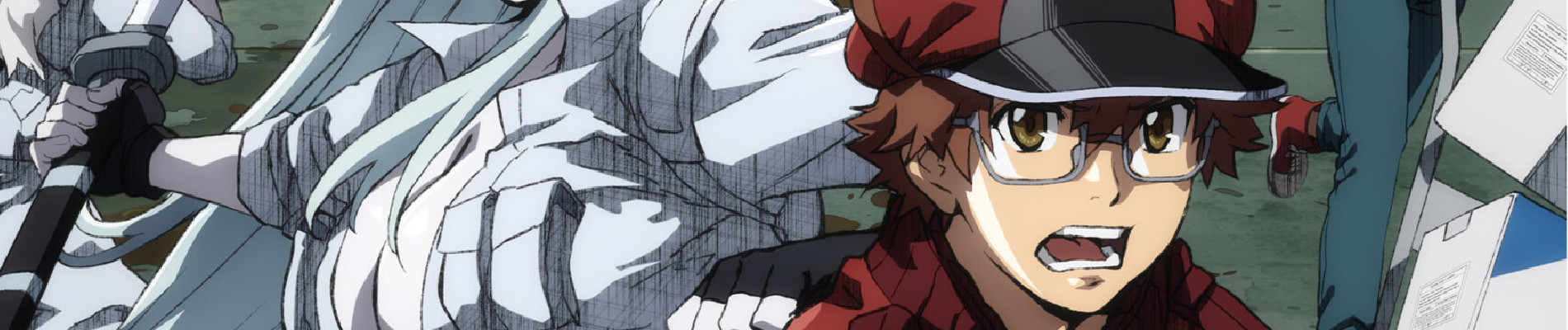
What makes Cells at Work! CODE BLACK ache so deeply isn’t its anthropomorphism — it’s the weariness. Not heroic exhaustion, but the quiet, cumulative weight of systemic neglect: the smoker’s tar-clogged bronchioles aren’t villains — they’re management decisions made years ago, now calcified into tissue. The stress-induced vasoconstriction isn’t drama — it’s overhead costs cutting into R&D. Every cell speaks in hushed tones, not because they’re afraid, but because they’re too tired to raise their voice. This is dystopia rendered not in chrome and neon, but in chronic inflammation, in hypoxia that smells faintly of stale coffee and ash, in the way a white blood cell pauses mid-patrol to rub his temples — not from injury, but from emotional labor no one trained him for. It’s adult, yes — but specifically adult as erosion: the slow, unglamorous unraveling of resilience when care is treated as overhead instead of infrastructure.
That same emotional DNA thrums in Hollow Knight — not because of bugs or kingdoms, but because of its melancholic exploration. Its description calls it “an epic action adventure through a vast ruined kingdom,” and the player review praises its “lovely story” and “beautiful art style” — but what lingers is the silence between notes: the hollow chime of an abandoned tram station, the way light catches dust motes drifting through collapsed cathedrals. Like CODE BLACK, it treats decay as lived-in, not cinematic. You don’t conquer the ruins — you navigate their grief, just as the Red Blood Cell navigates necrotic tissue not as terrain, but as testament. Both make you feel the weight of systems that once worked — and the quiet dignity of those still showing up.
Then there’s The Witcher 3: Wild Hunt, whose description frames Geralt tracking Ciri across a “war-torn, monster-infested continent,” and whose player review celebrates how “my favourite game keeps getting better” — even eleven years later. That longevity isn’t just polish; it’s emotional stamina. Geralt doesn’t save the world with a sword slash — he patches wounds, mediates feuds, sits with widows, and watches children grow up in villages he’ll never see again. His world is adult & dark seinen not because it’s violent, but because it refuses easy answers — much like CODE BLACK’s refusal to moralize smoking or stress. Both understand that tragedy isn’t a plot point; it’s the ambient temperature of existence when institutions fail, and compassion becomes the only protocol left.
Even Tank Universal, described as an “action FPS tank wargame inspired by Tron and Battlezone,” resonates — not for its lasers or polygons, but for the raw, personal note in its player review: “Play cool tank game with dad when you were 6… Love the cool sound effects… time goes on; loose access to game. Grew up dad passes away…” That’s the emotional narrative dimension — not grand war, but memory encoded in mechanics, loss folded into interface. Like CODE BLACK, it finds profundity in the mundane: the hum of a tank engine echoing the throb of a stressed aorta; the flicker of a HUD mirroring the erratic pulse of a fatigued heart. Both turn routine — patrol, delivery, maintenance — into vessels for unspoken longing.
This pairing is for the person who cries during a loading screen — not because of spectacle, but because the pause feels like breath held too long. For the viewer who watches a Red Blood Cell wipe sweat from his brow and thinks, I know that exact muscle fatigue. For the player who walks past a ruined NPC village in Hollow Knight, hears the wind whistle through broken arches, and feels the same hollow echo as when CODE BLACK cuts to black after a silent shift change. They’re not seeking escape. They’re seeking recognition: the profound, tender, exhausted truth that care — whether for a body, a kingdom, or a memory — is never glamorous. It’s just showing up, again and again, in the dim light, with your oxygen half-depleted and your resolve quietly, fiercely, holding.
🎮131 Games That Match the Vibe

































































































Match Dimensions Explained
❓Frequently Asked Questions
Why does Hollow Knight feel like Cells at Work! CODE BLACK even though it's not about biology?
Because both lean hard into visceral, body-horror-adjacent worldbuilding—Hollow Knight’s infected bugs and decaying fungal veins mirror CODE BLACK’s corrupted cells and failing organ systems, all wrapped in melancholic exploration. You’ll recognize that same emotional weight when you watch the Pale King’s tragic backstory unfold or witness the Hollowed Knights shudder in ruined cathedrals—just like watching macrophages collapse under systemic failure in CODE BLACK.
Is there a mobile or anime adaptation of The Witcher 3 that captures the same gritty medical urgency as CODE BLACK?
No official mobile or anime adaptation of The Witcher 3 mirrors CODE BLACK’s clinical tension—but Geralt’s monster-hunting contracts *do* echo its diagnostic urgency: think of the ‘Bloody Baron’ questline where you piece together trauma like a hematologist analyzing coagulation cascades, or the ‘Lilies of the Valley’ scene where Geralt treats a poisoned child with surgical precision. It’s not cellular, but it’s the same adult, dark-seinen weight applied to human physiology under duress.
How is Sacred Gold different from Assassin's Creed Director's Cut Edition if they both have 82 scores and share ‘Dark Fantasy’ and ‘Adult & Dark Seinen’ tags?
Sacred Gold leans into janky, chaotic melee brawling against orcs and ogres in a crumbling high-fantasy wasteland—think visceral, messy combat like CODE BLACK’s neutrophil swarm clashes—but it’s unstable on modern systems. Meanwhile, Assassin’s Creed (Director’s Cut) trades fantasy for grounded, parkour-driven stealth in a historically textured Mideast; its melancholic exploration feels more like navigating CODE BLACK’s sterile, echoing hospital corridors than fighting monsters—plus, its dated textures ironically mirror the show’s clinical, low-saturation visual tone.
What’s the best game like Cells at Work! CODE BLACK if I want that heavy, quiet sadness but also moments of warm human connection?
Tank Universal—it’s unexpectedly perfect. Its sci-fi tank combat unfolds in a lonely, neon-drenched virtual world, but the core story revolves around playing alongside your AI allies (like loyal T-cells) and revisiting memories of bonding with your dad during childhood play sessions. That bittersweet blend of melancholic exploration + tender emotional narrative hits the same notes as CODE BLACK’s quiet ICU scenes and the macrophage’s soft-spoken dedication—plus, the player review literally calls it ‘love the cool sound effects, and the colors’ just like how CODE BLACK makes medical chaos feel strangely beautiful.