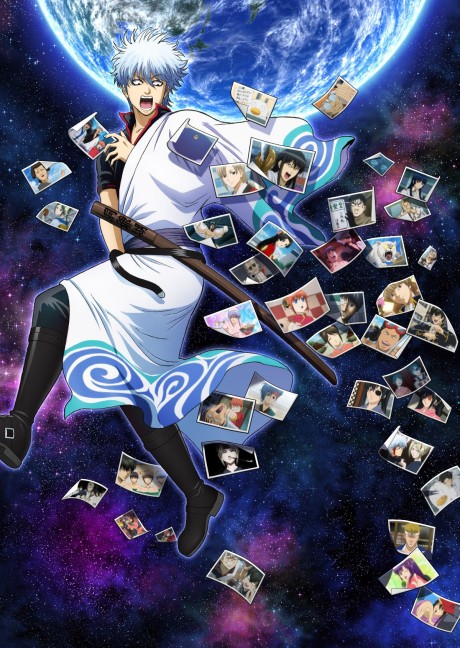
Gintama.: Slip Arc
Consists of episodes animated from unused manga chapters, before returning to the Silver Soul Arc on January 8, 2018. Porori is an Onomatopoeia for something (mainly water) falling.
📺Anime Details
📝Editorial Analysis
Rain hits the cobblestones of Edo—not in sheets, but in porori, porori, porori: tiny, irregular drops that cling to the edge of a broken gutter before falling. You hear it first—before you see the ghost. Before you smell the burnt rice from the ruined okonomiyaki stand. Before Gintoki slumps against the alley wall, sword sheathed, eyes half-lidded, watching water bead on his sleeve like time itself hesitating. This isn’t a battle cry or a punchline. It’s the sound of something slipping—memory, chronology, gravity—and no one’s rushing to catch it.
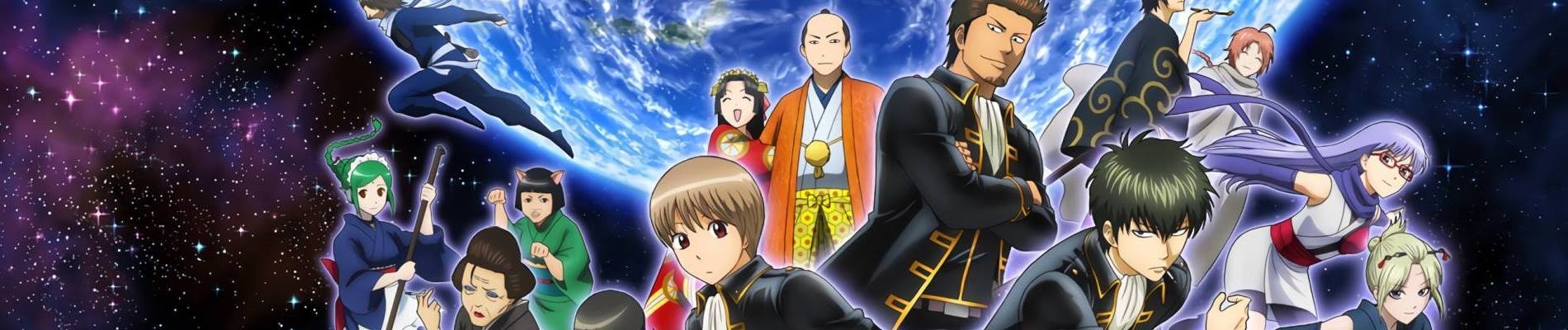
That’s the feeling of Gintama.: Slip Arc: not chaos, but slippage. Not parody as mockery, but parody as tenderness—rewriting canon with ink still wet, stitching unused manga pages into a quilt of near-misses and almost-remembered faces. The achronological order isn’t gimmickry; it’s grief wearing flip-flops. You watch a scene where Kagura laughs mid-air, then cut to her staring silently at an empty futon—no explanation, no cue music—just the weight of what’s missing settling like dust in sunbeams. It’s wistful, off-kilter, warmly disoriented. You don’t laugh at the absurdity—you laugh with it, because the absurdity is the only thing holding the sorrow upright. It’s shōnen that remembers its own expiration date, samurai who polish their blades while humming commercial jingles, aliens who file union grievances. The sci-fi isn’t about tech—it’s about how far you’ll bend reality just to keep your found family breathing in the same room.
Which is why Oddworld: Stranger's Wrath HD lands with such uncanny resonance. Its description calls it “a Fantasy-SciFi-Western game about being a bounty hunter”—and yes, the Stranger wears spurs and shoots live ammo critters, but his mission isn’t glory. It’s desperation: “you need that money like no one else because there is something very wrong with your health.” That quiet, bodily urgency—the way exhaustion leaks into every reload, every leap across canyon rims—mirrors Gintoki’s coughs hidden behind bad jokes, the way he leans on his cane like it’s a confession. A player review nails it: “its the best Fantasy-SciFi-Western game about being a bounty hunter ever made.” Not action—bounty hunter. A role worn thin, patched with gallows humor, sustained by debt and devotion. Same DNA: the frontier isn’t lawless—it’s fragile, and everyone’s pretending the fence posts are still buried deep.
Then there’s the raw, adrenalined slip of Quake III Arena, where “the greatest warriors of all time and space have been summoned to battle for the amusement of an ancient alien race.” No lore dump. No motive beyond spectacle and survival. Just bodies warping through zero-G arenas, guns roaring like kettledrums, power-ups blinking like faulty neon signs above a pachinko parlor. A player says it’s still alive: “There are still internet mp game servers out there as of typing this…” That persistence—that stubborn, sweaty, analog aliveness—echoes Gintama.: Slip Arc’s very existence: episodes animated from unused manga chapters, resurrected not for canon’s sake, but because the characters refused to stay shelved. Both exist in the liminal zone between legacy and lark—gladiatorial, yes, but also deeply, weirdly communal. You don’t win Quake III to conquer. You frag to stay in the room where your friends still type “lol” in chat after getting gibbed. Same as Gintoki sharing stolen melon soda with a ghost who just wanted to taste something sweet one last time.
And DOOM + DOOM II, that foundational quake—“definitive, newly enhanced versions” of games built on body horror & occult textures, where demons aren’t metaphors but meat, and every shotgun blast is a punctuation mark in a sentence written in blood and static. A player recalls building their first computer for this, a 486 with a Sound Blaster card—WOO! That tactile, generational love, that reverence for the physical act of play (loading disks, adjusting contrast, flinching at pixelated gore), mirrors how Gintama.: Slip Arc treats its own history: not as sacred text, but as playground. The ghosts, the aliens, the swords—they’re not world-building devices. They’re toys pulled from a drawer labeled “what if we made fun of this and loved it at the same time?”
This pairing isn’t for the completionist. It’s for the person who rewinds anime scenes just to hear the porori again. Who boots up Quake III not for rank, but to feel the floor drop out beneath them in a 1999 map called q3dm17. Who saves their DOOM save file named “okonomiyaki.bak”. Who knows that the deepest loyalty isn’t to continuity—but to the slip, the stumble, the shared, slightly ridiculous breath before the next thing falls.
🎮106 Games That Match the Vibe














Match Dimensions Explained
❓Frequently Asked Questions
Why does Gintama.: Slip Arc feel so much like Oddworld: Stranger's Wrath HD?
Because both lean hard into that absurd Western-meets-sci-fi bounty hunter vibe—imagine Gintama’s Sakata Gintoki swapping his wooden sword for the Stranger’s live ammo crossbow, chasing weird alien bounties across dusty frontier towns while cracking jokes about medical debt. Stranger’s Wrath HD (81 score) nails the same tonal whiplash: gritty action, surreal worldbuilding, and deadpan parody of genre tropes—all wrapped in tight third-person platforming and FPS hybrid mechanics.
Is there a Gintama anime or game adaptation of Slip Arc?
No—'Slip Arc' isn’t an official Gintama anime arc or licensed game; it’s a fan-made title referencing the chaotic, off-the-rails energy of Gintama’s 'Slip' gag episodes (like when Gintoki hallucinates himself as a cowboy in Episode 132). That’s why games like Quake III Arena (80 score) and DOOM + DOOM II (80 score) match so well—they’re pure, unfiltered spectacle with body horror, alien arenas, and zero hand-holding, just like those gloriously nonsensical Slip moments.
How is Unreal Tournament 2004: Editor's Choice Edition different from UT3 for Gintama.: Slip Arc fans?
UT2004 (80 score) delivers the crisp, fast-paced gladiatorial chaos Gintama’s Slip Arc thrives on—think Kagura going full berserker in a 10-mode arena, complete with mutators and over-the-top weapon combos—while UT3 (also 80) feels clunkier and visually dated per its editor review ('a mess... visuals feel overloaded'). If you want that snappy, self-aware, 'anything goes' energy, UT2004’s tight netcode and mod-friendly design hit closer to Slip Arc’s irreverent rhythm.
What’s the best game like Gintama.: Slip Arc if I just want chaotic, laugh-out-loud sci-fi action?
Oddworld: Stranger's Wrath HD (81 score) is your top pick—it’s got the same blend of sharp satire, bizarre alien designs (like the grubby, talking Mudokons), and sudden tonal swerves that make Slip Arc so fun. One minute you’re blasting a giant worm with live ammo, the next you’re delivering dry one-liners about healthcare while riding a lopsided hover-bike. It’s not just 'like' Slip Arc—it *gets* the joke, and plays it flawlessly.